downloadGroupGroupnoun_press release_995423_000000 copyGroupnoun_Feed_96767_000000Group 19noun_pictures_1817522_000000Member company iconResource item iconStore item iconGroup 19Group 19noun_Photo_2085192_000000 Copynoun_presentation_2096081_000000Group 19Group Copy 7noun_webinar_692730_000000Path
Skip to main content
Default Banner Image

Simgui

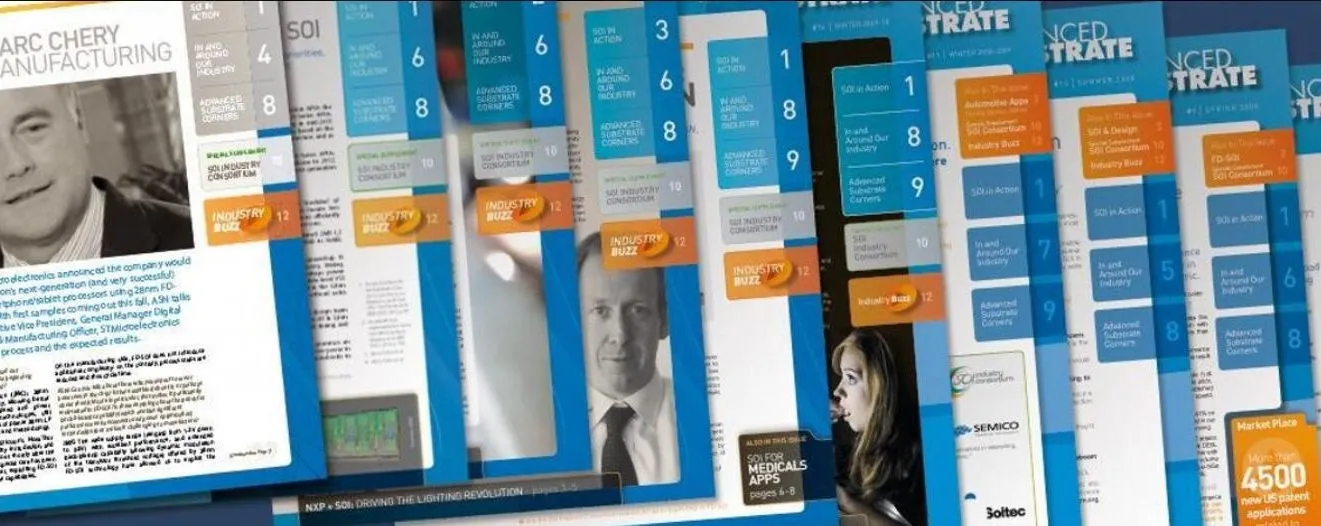
Let’s celebrate! As of April/May 2020, Advanced Substrate News – or ASN for short, and now aka the SOI Consortium newsletter – has been bringing you news for 15 years. I hope you’ll forgive me if this post has a personal angle, as I have been the Editor-in-Chief since Day 1 back in 2005. One of the things I’ve learned over my career covering technology in general and SOI in particular is that “new” technologies are never really new. They don’t pop out fully formed like Venus Boticelli-style. They take years – decades, even. SOI is no exception. What is exceptional about SOI imho is that the ecosystem – from the substrate providers to the end-product designers – keeps finding new things to do with it. There have always been naysayers – and for a while it took on an quasi-fanatic ferocity. There were those who quipped that SOI was the technology of the future...and always would be. But as it turns out, SOI’s is, has been and will be the right technology at many right moments, and I don’t see any sign of that changing in the years to come. We Need a Newsletter! [caption id="attachment_32012" align="alignright" width="189"] My Design News piece on SOI from June 2000 - it changed my life![/caption] As so much in the SOI story, ASN began with Soitec. I first encountered Soitec when I was working as Contributing Editor in Europe for Semiconductor International in the mid 1990’s. It was a start-up of just a few people that made silicon-on-insulator aka SOI wafers. Most of us at the time had barely a notion of what that was all about, but they had an intriguing story to tell about higher performance and lower power. It so happened a few years later (circa 2000) I was also writing for another publication called Design News – not about chip design, but product design, for folks designing cars and consumer electronics and washing machines and such. I kept hearing a new requirement added to the product-design mantra of faster-smaller-cheaper: lower power. It seemed to me that these SOI wafers could go a long way in solving some of product designers’ challenges. I pitched a story to my editor and it wound up on the cover (those were the days some might remember when trade magazines were on paper…). The big players were IBM for digital (in a current-events aside, DKY that those big iron machines at the US national labs cranking on the solutions for the current pandemic use IBM FinFET-on-SOI chips? Just saying…), Philips (now NXP) for power/analog, and Soitec for wafers – and of course Honeywell for aerospace and the big electronics players in Japan for all sorts of things automotive and ultra-low power. Top management at Soitec read the piece and saw that I “got it”. They brought me on board as a consultant, writing early websites, PR, brochures and such. But also most importantly, they invited me “in” – I sat in on sales reviews and attended the big shin-digs they sponsored on the Riviera and in the Alps. The people I met there – and stayed in touch with – were many of the ones that drive the industry today. (Of course, that was then, this is now: I don’t have that insider status any more, but I’ve kept in touch with and often still rely on the expert advice of people I met during that heady time.) Anyway, one day at the end of 2004, the Soitec folks said to me, “We need a newsletter.” They asked me to come up with a concept they could pitch to the Board. Since Soitec was also doing GaN SiC at the time, I thought it should be called Advanced Substrate News – ASN for short. And we agreed it should involve the entire ecosystem: end users, equipment manufacturers, academics, suppliers of all sorts, and especially: chip designers. But it was not an easy pitch. Who’d want to read about SOI wafers, they asked? Wouldn't we run out of things to say after two or at most three editions? But the idea was a solid one: ASN could be a bully pulpit for the nascent SOI ecosystem. Happily it won the day. I was named Editor-in-Chief, and have held that title ever since. Our very first edition (we were a print quarterly then) had about a dozen articles on SOI, including automotive with Philips, ultra-low power FD-SOI with Oki for Casio’s G-Shock watches (oh yes – it goes back a long ways!), low-power (by a company that Arm then bought), high-performance, high-resistivity SOI wafers for RF…it was all there. And if you look at what we cover now, it’s still all there – albeit better than ever and growing fast. (I just listened to the most recent Soitec Q4'20 quarterly financial report audiocast – announcing that they’d just had their best quarter ever – largely driven by RF-SOI.) We Need a Consortium! In 2007, the SOI Consortium was created with 19 members (a dozen of whom are still members today). As ASN Editor-in-Chief, I was honored to be part of that effort, participating in the meetings where we hashed out what it was all about and what a consortium would do. It was a great opportunity to meet the movers and shakers across the industry, many of whom I’m still in touch with. We published steadily, as the years, technologies and applications came and some went, but ASN readership continued to grow worldwide. Then in 2015, I got an email from the head of the Shanghai Academy of Sciences, which had recently spun off an SOI wafer maker called Simgui. He was (and is!) an ASN reader (though now he’s China’s Vice-Minister of Science Technology). Would I come to Shanghai and present some of the SOI-based applications ASN had been covering to his team there? They’d been working on SOI in parallel for many years, and were interested in where it was going in Europe and America. That was exciting! My first trip (of many, now) to China, it coincided with Semicon China 2015 and the announcement of the “Big Fund”. It was hall upon massive hall of stands immense and tiny, and the level of excitement was nothing short of amazing. (I was one of the only Western journalists there, and essentially broke the story in a piece I wrote for Consortium member Applied Materials’ customer magazine). That trip opened a lot of doors for me and ASN. As the SOI Consortium teamed up to with partners in China to host symposia there, we devoted more and more extensive coverage in ASN to those exciting events. [caption id="attachment_32041" align="alignright" width="328"] Here's some of our core players at the SOI Consortium: Executive Co-Directors Carlos Mazure (also of Soitec) and Jon Cheek (also of NXP) on the far left and right, respectively, Event Manager Iris Rith in the middle, me (Adele Hars) next on the right. We're joined here by Lucy Dai (2nd from left) of Simgui.[/caption] Eventually in 2016, ASN moved under the aegis of the SOI Consortium. We’re quite a jolly band that I have the privilege of working with. Granted at the time of this writing, the world is a difficult place, with so much uncertainty. But there are exciting times ahead with new products and technologies enabled by SOI, and you can be sure we’ll be covering them. RF-SOI will continue its juggernaut path in 5G mmWave. FD-SOI is steadily defining the new mainstream at the edge. The huge amounts of data the world is generating is driving photonics (which is all about SOI) to new heights. SOI for power (meaning high-voltage – think smart power) and imagers continues to grow. [caption id="attachment_32045" align="alignleft" width="99"] That's me - Adele Hars, ASN Editor-in-Chief - at the SOI Consortium's 2019 FD-SOI Symposium. (Photo courtesy VeriSilicon)[/caption] I’m honored to have brought you ASN for the last 15 years. Our archives are truly a treasure trove, and our mailing list of over 2500 really is an industry who's who. We’ve published well over a thousand (!) pieces in that time, most of which I’ve written with guidance from many an expert. However, we of course encourage our readers to pitch stories and/or submit SOI articles for publication consideration - so please, don't hesitate! I want to thank you all for your interest and your continued support. And thank you especially to all the SOI experts out there who so generously – and so patiently – share their time and enthusiasm with me and our readers. Stay safe! With warm regards, - Adele P.S. If you're not already on our emailing list and would like to join, just fill in the form at the bottom of this page. Thanks!
Read More
Digitimes Research is predicting a doubling of the global SOI market between 2019 and 2024, "...thanks to significant expansion in applications to mobile devices, communication infrastructure, IoT devices and automotive electronics in the 5G era...". (Read the full article in Digitimes here.) Beyond the continued enormous success of SOI in front-end modules (FEMs) for RF (aka RF-SOI, which as we know is found in every smartphone on the planet), the report cites high growth specialty areas such as imaging chips for smartphones and photonics in data centers. They also predict that FD-SOI will be "massively applied" in 5G, with applications in base stations and data centers. And of course, low voltage and low power consumption will be the big drivers in IoT and wearables. All this is driving Soitec, the major SOI wafer manufacturer, to expand capacity at its facilities in France and Singapore in 2020, says the report. This is happening in strategic cooperation with Shanghai-based Simgui. As noted in ASN about a year ago, Soitec and China’s SOI wafer leader Simgui announced an enhanced partnership and increased production capacity of 200mm SOI wafers in China, securing future growth. At that time the two companies redefined their manufacturing and licensing relationship to better serve the growing global market for RF-SOI in mobile and Power-SOI in automotive and consumer electronics. Separately, Okmetic of Finland, which specializes in SOI wafers for MEMS, sensors and RF, is also doubling its capacity (we covered their 2019 Shanghai presentation here.) (Image courtesy: Soitec)
Read More
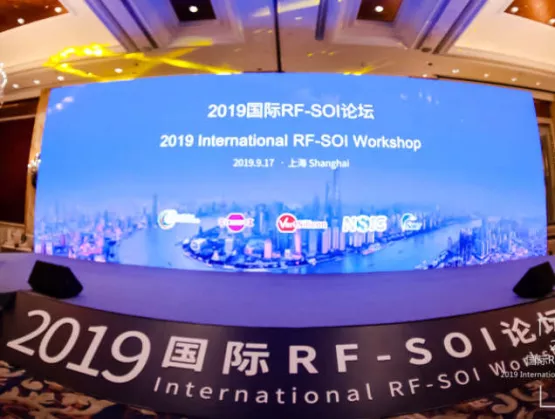
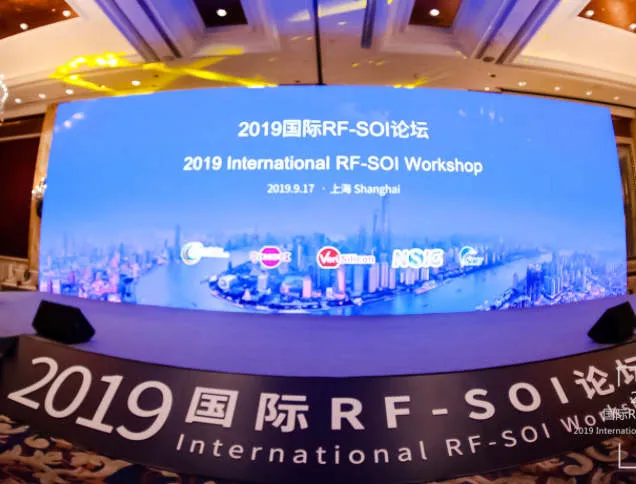
The 2019 International RF-SOI Workshop in Shanghai was packed to overflowing, with over 500 attendees, noted SOI Consortium Chairman Executive Director, Carlos Mazure. There were 16 presentations over the course of the day – every one of them excellent – so it will take two posts to cover them all. We covered Danni Song's compelling keynote in a previous post – see it here. In this post, we’ll cover the remaining keynotes and the morning session, which was dedicated to 5G deployment. In the next post, we’ll cover the afternoon sessions, which were dedicated to the China RF-SOI ecosystem, and the RF value chain. PDFs of the presentations are not yet posted, and then they will only be available to those whose companies belong to the SOI Consortium. But we’ve summarized them all for you, so read on! KeynotespSemi: 30 Years of RF-SOI – Past, Present and Future (Jim Cable, Chairman and CTO, pSemi (a Murata company))The keynote by RF-SOI legend Jim Cable chronicled his always-innovating journey from digital to RF via sapphire then SOI. (Cable's work was recognized in an award that evening.) His original vision back in the early days was for a RF front-end module (FEM) + CMOS transceiver. At the time, doing it on sapphire (an insulator) rather than bulk made it much easier, as sapphire eliminated the non-linear capacitances. That was the beginning of their UltraCMOS technology, and though it did very well, sapphire was only available in 6” wafers. So pSemi (or Peregrine, as it was known at the time), engaged with Soitec on bonded-SOS. “It was a killer technology, and the marketshare we won was staggering,” he recalled, and helped convince Soitec RF-SOI was worth looking at. The goal is to handle high RF power levels: you can use SOI to handle higher voltages than you'd think were possible. They added an invention they called HaRP, that dealt with accumulated charges and enabled them to hit the linearity specs on silicon. With that, he explained, they came to completely dominate the switch industry. UltraCMOS evolved, getting 60% smaller with 20x better linearity – but now of course you have 50 switches, not six. He heralded the great partnership they have with GlobalFoundries, noting, “We were pioneers in this field.” In fact, in 2017 they were in the top 10 for IP generation in semiconductor manufacturing. Now comes mmWave, where he says, “We see everything we believed and more.” They're currently sampling an 8-channel mmWave RFFE (RF Front End). Soitec: 5G-on-Insulator: the 5th Gear In Mobile Radio (Michael Reiha, GM, Soitec)Michael Reiha's talk centered on how SOI wafer-leader Soitec is positioning itself on 5G, which, he explained, demands a wider portfolio. Soitec looked at what they could do to make 5G ready for sub-6GHz. Massive MIMO (mMIMO) is an efficient technique to improve throughput. With SOI, you can reduce the power it takes, making it a good choice for urban environments. RF-SOI is a candidate for power amplifiers, and FD-SOI is enabling more users to be added. The concept of network sharing is an opportunity for compact, low-cost filters that can meet the requirements with simpler, lower-cost, higher-efficiency filters. That's why they've just announced a new substrate called piezo-on-insulator (POI). However, total cost-of-ownership is not just how much a product costs, but how much it costs to run it.. Currently, RF and mechanics dominate the bill-of-materials, so you need to decrease the number of RF FEM components and get savings scaled with the array size. The main challenge of SOI is in efficiency, but the advantage is that it can be used in integrating digital with analog sensing and RF. Then you can use AI sensing for tracking temperature, for example, and control for 5G optimization. In short, with RF-SOI, you apply AI to the radio head, especially for things like mMIMO. And btw, he added, Soitec currently has capacity of two million wafers per year. SESSION 1 – 5G DeploymentYole: 5G is ON. Which Impact for RFSOI Technologies? (Cederic Malaquin, Technology Market Analyst)There are over a thousand 5G networks available today worldwide, said Cederic Malaquin. Adoption is accelerating, driven by 5G cloud gaming, AR/VR/XR, 5G multi-video calling and stadiums. However, carriers need better ROI. 5G should address this so that customers are better served. MIMO and carrier aggregation (CA) are the main techniques supporting network capacity and coverage improvements. 5G NR will bring more spectrum. With each generation putting more content in phones, new spectrum is happening in sub6 and mmWave. The impact of 5G on mobile phones is huge in terms of both content and complexity. Some phonemakers (like Apple and Samsung) are moving towards increased integration. Others (like Huawei) are going more for discretes. Yole sees tuners, switches / LNA as addressable by RF-SOI, but they are less convinced about power amplifiers. They also see SiP (system in package) as prevailing over integration. The 5G mobile and base station markets will really build up in 2022-25. RF-SOI will remain the mainstream technology for switches and antenna tuners through at least 2025: they don't see anything else replacing it. There is still increasing demand for 8” wafers. 12” wafers growth comes from integrated switch/LNAs, which comes from the Tier 1's. In the front-end space, Murata leads in dollars by far, followed by Skyworks and others. Though mmWave is not yet clear, there are opportunities for RF-SOI. ST: 5G Deployment Driving RF and SOI Technology Opportunity (Laura Formenti, Sr. Director)STMicroelectronics has a long history in RF-SOI, noted Laura Formenti, dating back to 2000 when they started collaborating with Soitec and Leti. An IDM, ST also offers foundry services. For 5G, their foundry offering includes H9SOIFEM, C65SOIFEM and SOI mmW for high-performance analog, dedicated RF processes for RF switches, LNA, PA plus RFFEM. Then they have FD-SOI for RF, mixed signal and digital integration. From antennas to transceivers there's an opportunity for full integration. For infrastructure, it depends on the customer preferences. 12” C65SOIFEM was introduced in 2019, and 12” SOIMMW will be introduced in 2020. Both their fabs at Crolles and Rousset, France, are in production. H9SOIFEM is for 4G and 5G sub-6GHz RF FEMs, enabling monolithic integration of the PA, LNA and switches, which is especially good for wifi. The C65SOIFEM is high-performance. Panel: 5G Deployment in China, Jeffrey Wang, CEO, Simgui Technology, moderatorWith Danni Song (China Mobile), Jim Cable (pSemi), Peter Rabbeni (GF), YangYang Pen (SmarterMicro), Paul Hurwitz (TJ), Michael Reiha (Soitec)Q: Why sub-6GHz and not mmWave?Danni Song said its a question of available spectrum. In sub-6, you get the same level of coverage with fewer base stations; also, sub-6 is much more mature. When will mmWave be ready? It depends. In the US, yes, but in China the spectrum allocation for mmWave has not yet been done. So it's a wait and see for the industry to be ready. Peter Rabbeni agreed, adding that in the US sub-6 is crowded and conflicts with military bands. Paul Hurwitz added that mmWave is for fixed wireless access. Michael Reiha added that mmWave has advanced a lot even in the last few months (Verizon in Washington, DC, for example), so there is momentum.Q: Does China lead in the sub-6GHz opportunity?Jim Cable said that at pSemi they have two business models: mobile and infrastructure. He sees massive MIMO in base stations as huge (though in mobile their role is more supporting Murata). Peter Rabbeni added that they're working with innovative partners in China, and that GF also offers skills in services and packaging. Yangyang Peng sees big opportunites with 5G for SmarterMicro and China. Paul Hurwitz has seen an increase in the capabilities of RF companies in China, and that the market in China moves faster than elsewhere. Michael Reiha sees China as strategic, and because there is central deployment, they can plan with the right partners.Q: Data usage will be huge – what will it cost to individual users?Danni Song said 5G phones will be expensive, but consumers want them, so we need to bring down costs and increase performance – but what about power consumption? Power needs to come down, maybe levering things like sleep mode more. For 3G 4G, she noted, they had lots of time. People are pushing hard for 5G, but there's a need for patience. Yangyang Peng said he didn't want to pay more than for 4G. In summary, Jim Cable noted that mmWave will demand huge amounts of silicon, to which Paul Hurwitz agreed, and Michael Reiha said Soitec will be ready. Everybody agreed that 3D packaging would be very important, especially for mmWave. And that's it for our coverage of the morning. Next up we'll cover the presentations given during the afternoon.
Read More
The SOI Consortium and member companies had a significant presence at two important events in China recently: the World Semiconductor Congress (WCS) in Nanjing and the SOI Academy, including an FD-SOI Training Day in Shanghai. Nanjing is especially known as a leading RF chip design hub in China, but WCS went well beyond RF. The three-day 2019 event was held at the Nanjing International Expo Center. It attracted over 30,000 visitors, 5000 of whom attended the various summit forums. Presenting at WCS '19 in Nanjing (clockwise from top left): Wayne Dai, CEO/Founder, VeriSilicon; Carlos Mazure, Executive Director, SOI Consortium; Giorgio Cesana, Director, STMicroelectronics; Christophe Tretz, Design Expert, SOI Consortium. (Photos courtesy: WCS)The SOI Consortium organized the SOI Forum, which was part of an afternoon Innovation Summit. Presentations were given by members of the SOI Consortium team, and by leaders from our membership, including Simgui, NXP, Incize, ST, IBM, Cadence and Xpeedic. Some of those presentations are now available from our website -- click here to get them.Earlier in the day, SOI Consortium member VeriSilicon participated in a morning session on AI and IoT Wireless Communications. They presented their low-power Bluetooth design platform for GlobalFoundries 22FDX, and CEO Wayne Dai moderated a lively round-table discussion.Following hard on the heels of the Nanjing event, the SOI Consortium team and members headed to Shanghai for the SOI Academy 2019, hosted for the second year in a row by member SIMIT (Shanghai Institute of Microsystem and IT under the Chinese Academy of Sciences). The two-day event attracted more than 250 professionals from more than 100 domestic and foreign IC companies and research institutes. Keynotes by SOI Consortium Executive Director Carlos Mazure, SITRI CEO Mark Ding and Jean-Eric Michallet, Head of the Microelectronics Components Department at Leti and bizdev director for the SOI Consortium focused on the SOI ecosystem. The SITRI and Leti talks also gave updates on their research and industrialization alliance. Further talks were given by leaders from Soitec, GlobalFoundries, VeriSilicon, IBM and Xpeedic. These addressed the growing FD-SOI ecosystem, applications in automotive electronics, 22 nm and 10 nm FD-SOI devices, advanced SOI substrate technology, China’s FD-SOI development, the FD-SOI manufacturing process, product design, EDA tools and all aspects of industry’s software and modeling value chain.Several speakers noted that more and more local Chinese customers are actively adopting FD-SOI for low-power, high-performance chips. SOI Academy, Shanghai, 2019, FD-SOI Training Day attendees.(Photo credit: SIMIT)The second day was devoted to hands-on professional training, given by experts from Leti using an actual PDK and punctuated by in-depth discussions. This helped the IC designers to fully understand the advantages and flexibility of FD-SOI in low-power logic, analog/mixed-signal and RF. All in all, “It was a great success,” concluded Jean-Eric MICHALLET, Head of the Microelectronics Components Department at Leti and bizdev director for the SOI Consortium. Plans for the next SOI Academy are already underway, with plans to extend the topics to include more on photonics, RF, power and MEMS.
Read More
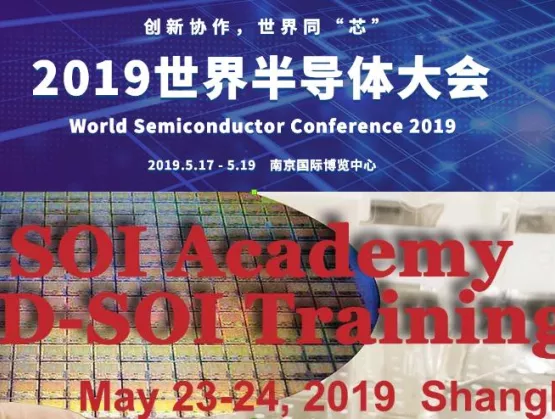
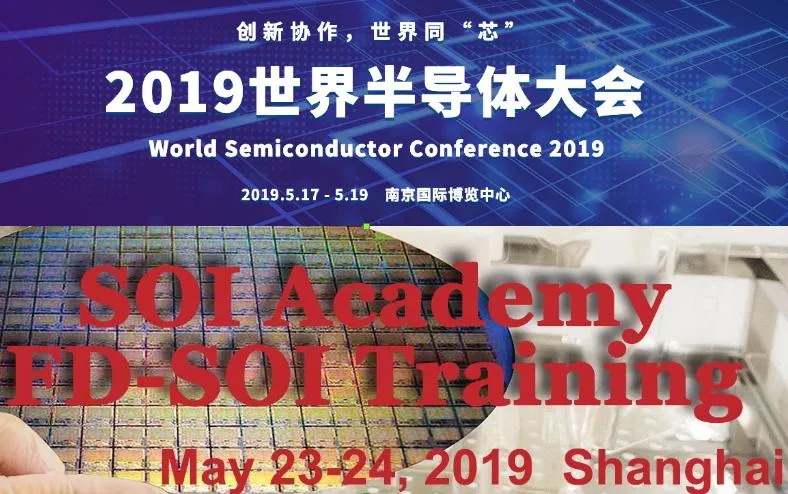
Join us! In partnership with our members, the SOI Consortium is co-organizing and participating in two key SOI events coming up in China over the next few weeks. On May 18th, we’ve put together an SOI Forum at the World Semiconductor Congress (WCS) in Nanjing. And on May 23rd 24th, we’ve teamed up with our members SIMIT, Sitri and Leti for another in our series of SOI Academies, including an FD-SOI Training Day. (The last one this past winter was a terrific success – read about that here if you missed our coverage at the time.) QR code for WCS, Nanjing '19At WCS, the SOI Forum (sub-forum #8) is part of the afternoon Innovation Summit. We’ll cover the broader SOI ecosystem, including both RF-SOI and FD-SOI – from wafers to design through manufacturing. Presentations will be given by members of the SOI Consortium team, and by leaders from our membership, including Simgui, NXP, Incize, ST, IBM, Cadence and Xpeedic. Click here or scan the QR code for the full program and registration information. Also at WCS, SOI Consortium member VeriSilicon will be participating in a morning session on AI and IoT Wireless Communications (sub-forum #4). They’ll be giving a presentation on their low-power Bluetooth design platform for GlobalFoundries 22FDX, and their CEO Wayne Dai will be moderating a round-table discussion. You can get more information on that (in Chinese only, tho) here, or follow VeriSilicon on WeChat. QR code for SOI Academy and FD-SOI Training, Shanghaid 2019The SOI Academy in Shanghai is an opportunity for experienced designers to gain solid expertise in FD-SOI. The event begins in the afternoon of May 23rd with a series of informative plenary talks by members of the SOI Consortium team, and by experts from our members Leti, Soitec, VeriSilicon, GlobalFoundries and NXP. The FD-SOI Training starts the next morning, on May 24th.. This is a hands-on event lead by top experts from Leti. The morning is devoted to digital design in FD-SOI, and the afternoon to RF design (including for 5G) in FD-SOI. Attendees will get a comprehensive understanding of design techniques for low-power chips leveraging the multiple benefits and flexibility of FD-SOI technology. Get more information here, or from the WeChat QR code.We've got a busy schedule! To keep up to date with where we and our members will be promoting the SOI ecosystem, be sure to check our Events page regularly.
Read More
The world's SOI wafer leader, Soitec is posting strong sales and issuing a steady stream of compelling announcements. This is clearly good news for everyone in the SOI ecosystem, as the outlook for the various families of SOI wafers is excellent. Soitec CEO Paul Boudre told ASN, “I'm excited because of the fundamentals behind the growth. Reaching down the supply chain gives us the ability to help our customers with the next generation. We're not in a technology push, but in a technology pull. It's long-term growth we're seeing.” [caption id="attachment_15532" align="alignleft" width="239"] Paul Boudre, CEO, Soitec[/caption] Soitec has brought people from the device side into the company to better understand the solutions customers need, he said. They're talking to the carmakers, telcos and more, working one-on-one with them to understand the constraints and the problems they are trying to fix, in order to deliver a solution based on the Soitec product roadmap. Boudre is particularly excited about 5G. It's not just new handsets and systems: the entire infrastructure will require a massive upgrade, across which Soitec has a role to play supplying SOI wafers. They also have other SOI and engineered substrates for specific markets like filters, displays, imaging and power. He adds that they're seeing nice growth in SOI wafers for photonics, driven by cloud computing, and for smart power in markets like automotive and white goods. Here's a roundup of some recent developments. Chips made on RF-SOI wafers are in every mobile phone made on the planet these days, so lets look at what they're doing there first. We'll follow that with an update on the surge of activity on FD-SOI wafers. Simgui, RF Power It's no secret that the runaway success of RF-SOI for front-end modules (FEMs) in mobile phones has stretched wafer capacity mightily. To help address this, in February 2019 Soitec and China's SOI wafer leader Simgui announced an enhanced partnership and increased production capacity of 200mm SOI wafers in China, securing future growth. The two companies redefined their manufacturing and licensing relationship to better serve to better serve the growing global market for RF-SOI in mobile and Power-SOI in automotive and consumer electronics. [caption id="attachment_15535" align="alignright" width="936"] (Image courtesy: Simgui)[/caption] Since the two companies signed their original licensing and technology transfer agreement in May 2014, Simgui has mastered Soitec’s Smart Cut™ proprietary process to deliver world-class RF-SOI and Power-SOI products. Simgui’s strategic partnership with Soitec allows them to use the same tools and processes to deliver the same products meeting the same specifications. Simgui has invested in their Shanghai fabrication line in order to double annual 200mm SOI wafer production capacity from 180,000 to 360,000. The fab is production ready, having been qualified by multiple key customers inside and outside China. Simgui CEO Dr. Jeffrey Wang notes, “China has design, wafer manufacturing and good momentum in the IC industry. We are committed to our strategic partnership with Soitec to keep advancing SOI as China’s key differentiator.” With China Mobile China Mobile's interest in the SOI ecoystem is clear: they've presented at the SOI symposia in Shanghai for two years running now. In a February 2019 press release, Soitec announced that they've joined the China Mobile 5G Innovation Center – and they're the first materials supplier to do so. The China Mobile 5G Innovation Center is an international alliance chartered to develop 5G communication solutions for China, the world’s largest wireless communications market with 925M mobile subscribers. The Center aims to accelerate the development of 5G by establishing a cross-industry ecosystem, setting up open labs to create new products and applications, and fostering new business and market opportunities. Soitec's RF-SOI wafers have been critical in the deployment of 4G communications, and the opportunity in 5G is even bigger. Plus the company's FD-SOI wafers enable the technology that brings unique RF performance, making it an ideal solution for many applications including mmWave communications such as 5G transceivers. They are also enabling full RF and ultra-low-power computing integration for IoT and edge computing. For Samsung Foundry In January 2019, Soitec announced that they have expanded their collaboration with Samsung Foundry on the FD-SOI wafer supply, securing the high-volume Samsung needs to meet industry's current and future demands in consumer, IoT and automotive applications. The agreement is built on the existing close relationship between the companies and guarantees wafer supply for Samsung’s FD-SOI platform starting with the 28FDS process. “Samsung has been committed to delivering transformative industry leading technologies,” said Ryan Lee, Vice President of Foundry Marketing at Samsung Electronics. “FD-SOI is currently setting a new standard in many high-growth applications including IoT with ultra-low-power devices, automotive systems such as vision processors for ADAS and infotainment, and mobile connectivity from 5G smartphones to wearable electronics. Through this agreement with Soitec, our long-term strategic partner, we hope to lay the foundation for steady supply to meet high-volume demands of current and future customers.” “This strategic agreement validates today’s high-volume manufacturing adoption of FD-SOI,” said Christophe Maleville, Soitec’s Executive Vice President, Digital Electronics Business Unit. “Soitec is ready to support Samsung’s current and long-term growth for ultra-low power, performance-on-demand FD-SOI solutions.” Silicon Catalyst Partner In February 2019 Soitec announced they'd become a strategic partner in Silicon Catalyst's start-up incubator. Silicon Catalyst is a Silicon Valley-based incubator providing silicon-focused start-ups access to a world-class network of advisors, design tools, silicon devices, networking, access to funding and marketing acumen needed to successfully launch their businesses. [caption id="attachment_15534" align="alignright" width="300"] (Image courtesy: Soitec, Silicon Catalyst)[/caption] Soitec will engage in this start-up ecosystem to gain insight into the newest technologies and applications across high-growth markets, and to guide nascent technologies to successful market penetration. “As a Strategic Partner of Silicon Catalyst, Soitec has a unique opportunity to grow our visibility among early-stage semiconductor companies,” said Thomas Piliszczuk, Executive VP of Global Strategy for Soitec. “Engineered substrates give semiconductor related start-ups a competitive edge in developing new high-performance, energy-efficient solutions." Pete Rodriguez, CEO of Silicon Catalyst said, “Soitec is creating technical advances that are enabling the next generation of products across many market segments. Their SOI technology is a key ingredient to meet the diverse challenges for breakthrough differentiated semiconductor products, combining ultra-low power with excellent analog/mixed-signal performance.” Energy Harvesting with Renesas And finally, jumping back a few months, at the end of 2018 Soitec announced that their SOI wafers are at the heart of a new Renesas SOTBTM energy harvesting chipset, opening a self-powered future for IoT devices. SOTB is how Renesas refers to its FD-SOI technology. [caption id="attachment_15533" align="alignleft" width="300"] (Image courtesy: Renesas)[/caption] (BTW, here at ASN we've been covering the work that Renesas has quietly done on this technology since 2005 (!). And we did a piece about an EETimes Japan article back in 2015 that revealed the launching of the 65nm work. ) Soitec supports the Renesas SOTB chipset with a special version of its FD-SOI wafer product line. The new Renesas SOTB-based chipset overcomes the energy constraints of IoT devices and reduces the power consumption to approximately one-tenth that of the existing products in the market today. That makes the chipset perfectly suited for extreme low-power, maintenance-free and energy harvesting applications including wearable devices, smart home applications, smart watches, portable appliances, infrastructure monitoring systems, industrial, business, agricultural, healthcare, as well as health and fitness apparel, shoes, drones and more. Renesas has developed its energy harvesting chip using its unique SOTB 65nm process technology that achieves both low active current of 20 μA/MHz and deep standby current of 150 nA. As a result, Renesas’ SOTB chipsets offer enhanced control of the transistor electrostatics and reductions in both the standby and active currents to levels never before achieved. Additionally, Renesas has successfully delivered the dopant-less channel to suppress Vth variability for the ultra-low voltage operation, and the ultra-low power back bias control to reduce the standby current at the same time. “To spur innovations in IoT and consumer applications, we have integrated our exclusive energy-harvesting SOTB technologies into our Energy Harvest Controller,” said Mr. Toru Moriya, Vice President of Renesas’ Home Business Division, Industrial Solutions Business Unit. “We are confident that our SOTB technology built on Soitec’s ultrathin substrates can deliver unmatched capabilities for developing maintenance-free IoT devices that never require power supply or replacement, giving rise to a new IoT global market based on endpoint intelligence.” [caption id="attachment_15714" align="alignleft" width="300"] (click to enlarge) Block diagram of the Renesas R7F0E Embedded Controller, their first device based on their SOTB (aka FD-SOI) technology. Target applications are battery-free connected IoT sensing devices with endpoint intelligence. (Image courtesy Renesas)[/caption] The new R7F0E Embedded Controller is the first device based on Renesas’ SOTB technology. Developers can now design applications that need no battery or recharging. The R7F0E features: an Arm® Cortex® -M0+; operating frequency up to 32 MHz, and up to 64 MHz in boost mode (that's body bias in action!); memory of up to 1.5 MB flash, 256 KB SRAM; and active current consumption while operating at 3.0V of just 20 µA/MHz, and in deep standby of 150 nA with real-time clock source and reset manager. As of this writing, Renesas indicates it's engaging select customers through July 2019, with mass production in 4Q19. Read more about the RE Family SOTB™ Process-Based Energy Harvesting Embedded Controllers on the Renesas website.
Read More
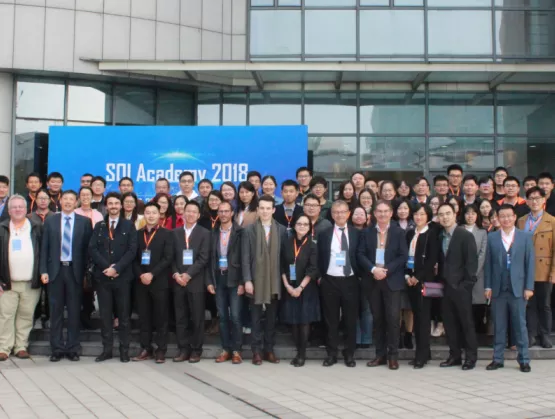
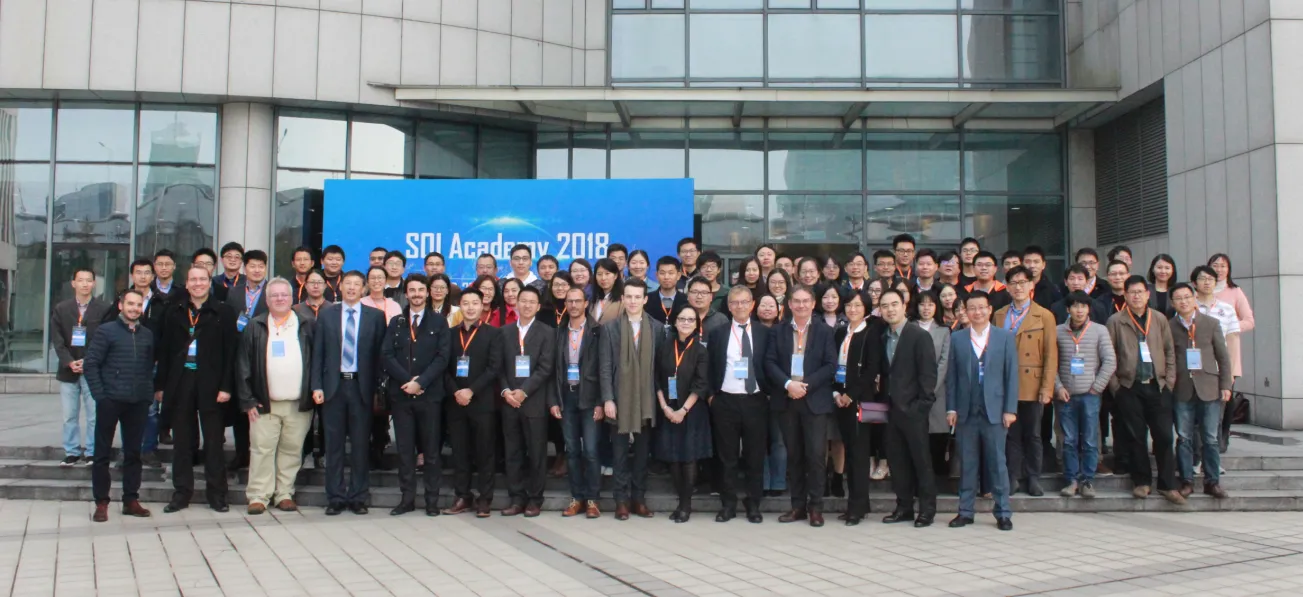
There were over 220 participants at the recent SOI Academy FD-SOI Training event organized in Shanghai. The event extended over two days, with the first day covering a basic introduction to the technology as well as the ecosystem worldwide and in China. The second day was hands-on professional training. Attendees got a comprehensive understanding of how to leverage the benefits and flexibility of FD-SOI design techniques for low-power chips including logic, mixed-signal/RF and analog blocks. They had a great line-up of experts from whom to learn – check out the agenda here. There was also a follow-up press release (in Chinese) from SITRI here. There will be more of these SOI Academy events in cities across China in the year to come – we'll keep you posted (and of course, keep checking back for news on the Consortium's Events page). [caption id="attachment_12981" align="aligncenter" width="1000"] SOI Academy '18 keynotes by: Dr. Mark Ding, CEO, SITRI; Dr. Carlos Mazure, EVP Soitec and Chairman/Executive Director SOI Consortium. Dr. Julien Arcamone, EVP Leti. (Images courtesy: SITRI). Lower right: the hands-on FD-SOI training.[/caption] The two-day seminar and hands-on FD-SOI design training was (superbly!) co-organized by SITRI and Leti, with the support of the SOI Industry Consortium at the Jiading SIMIT campus outside of Shanghai. Just to put this in perspective, SIMIT and SITRI are absolutely key players in China's chip ecosystem. SIMIT is the Shanghai Institute of Microsystem and Information Technology, one of the most venerable institutes in the Chinese Academy of Science (CAS) and one of the world's earliest pioneers in SOI. SITRI is the Shanghai Industrial μTechnology Research Institute, an international innovation center focused on globally accelerating innovation and commercialization of More-than-Moore for IoT. Both institutions are under the aegis of Dr. Xi Wang, Chairman of SITRI, Director General of SIMIT, Academician of CAS, and champion of all things SOI in China. At this Shanghai event, the participants came from industry (including big companies, SMEs and startups) and technical institutions. In fact as well as attendees from Shanghai people voyaged from other cities such as Shenzhen and Chengdu. The designers participating to the FD-SOI training day were all experienced in design and highly motivated in learning FD-SOI design, notes Carlos Mazure, Chairman Executive Director of the SOI Industry Consortium, and Executive VP of Soitec. “This made it possible to dive into the specificities of FD-SOI,” he said, adding that, “The focus on RF was very timely.” Day 1: Intro to FD-SOI The first afternoon opening keynotes were made by SITRI CEO Dr. Mark Ding and Leti EVP Dr. Julien Arcamone. These were followed by overview talks by execs from Soitec, Verisilicon and GlobalFoundries. After a lively networking break, three talks delved into FD-SOI technology. The first was by Professor Sorin Cristoloveanu, Laureate of the IEEE Andrew Grove Award and Director at the CNRS (the French National Center for Scientific Research – the largest governmental research organization in France and the largest fundamental science agency in Europe). He covered device physics and characterization techniques. This was followed by talks on the technology by Soitec Fellow Bich-Yen Nguygen, and by Dr. Christophe Tretz, IBM Sr. Engineer on product design methodology. The day ended with a dinner, where Professor Cristoloveanu says enthusiastic technical discussions continued unabated (and continued even further in follow-up emails), lots of business cards were exchanged, and opportunities for further education were explored. Day 2: Hands-on Training The second day, designers got hands-on training from Leti experts using FD-SOI PDKs, first in the morning on digital, then in the afternoon on RF. Everyone loved the lively discussion and in-depth exchanges between the experts and the designers. They agreed that FD-SOI has important applications and differentiated competitive advantages for IoT, 5G, automotive, AI and other fields. At the end of the training, Leti and SITRI jointly issued SOI Academy certificates of completion to the designers. Feedback from participants was very good. Some asked for further education and for hands-on testimonials from companies that are already designing and manufacturing products on FD-SOI. “The participants were focused, motivated, involved, with good knowledge, which helped make the three hours of Digital training effective,” said Dr. Alexandre Valentian, Leti Sr. Expert, Digital Design. “The IT team was very helpful in setting up the training, the students accounts and the hardware infrastructure.” “The training on Basics of FD-SOI RF circuit was a great success thanks to the efficiency of our Chinese partners and also thanks to the enthusiasm and the good level of our trainees. As senior Expert of CEA Leti I was really impressed by the professionalism of the organization team. For all these reasons, I’m very glad to have had the opportunity to contribute to the 2018 SOI Academy,” said Dr. Baudouin Martineau, Leti Sr. Expert, RFIC Design Technologies. “The professionalism, efficiency and enthusiasm of our Chinese partners and the level and technical relevance of all trainees made the training on Basics of FD-SOI RF circuit a great success and fruitful experience,” added Frédéric Hameau, Sr. RF Research Engineer, Leti Project Leader, Architecture, IC Design Embedded Software Division, RF Architectures and ICs Laboratory. “It was a pleasure to get the opportunity to be part of this first edition of SOI academy 2018.” The organizers would like to thank the sponsors, including: the SOI Consortium and its members Soitec, VeriSilicon, GlobalFoundries, Simgui and Cadence, as well as Mentor, ProPlus and other companies and institutions in China and worldwide. Dr. Mazure notes that special recognition must go to Dr. Julien Arcamone, EVP, Leti-CEA and to Qing Wang-Bousquet, SITRI representative, for the perfect and smooth organization, and to the Leti instructors, who are international experts and highly committed. “As one of the main initiators and organizers of the 2018 SOI Academy, I wanted to personally thank all of you for your respective contribution to this first edition of the SOI Academy,” concludes Dr. Arcamone. “Undoubtedly, it was a great success, very well organized and fluid and we can be proud of that.”
Read More
The presentations from the SOI Consortium sponsored workshop held during Semicon West are now posted and freely available on the website – click here to see the full agenda with links to the presentations. The workshop, entitled 4G/5G Connectivity: Opportunities for the SOI Supply Chain, was well-attended and generated excellent discussions. If you don't have time to look at all of the ppts, here are quick overviews. Market Overview and FD SOI Opportunities, by Handel Jones, CEO, IBS. Handel Jones is an industry veteran, China expert and longtime follower of the SOI ecosystem. High performance with low power consumption are the key requirements for the continued growth in the semiconductor industry, he said, making FD-SOI the right choice for a wide range of products. Here's how he sees it: [caption id="attachment_12312" align="alignleft" width="300"] (Courtesy: IBS and SOI Consortium)[/caption] He estimates the yearly TAM (total available market) for FD-SOI based products in the range of $46 billion over the next 10 years, largely driven by needs for ultra-low power and RF integration. He goes on to break out volumes by applications (including ISPs – image signal processors; and CIS – CMOS image sensors), foundry markets by feature dimension and to map out technology trends. Mobile Radio Transformation in the Age of 5G: A Perspective on Opportunities for SOI, Peter Rabbeni, Vice President, Globalfoundries. Peter Rabbeni is an RF expert par excellence, having overseen the shipping of over 35 billion RF-SOI products to date. In his presentation, he details how 5G NR (New Radio) sub-6GHz frequency band specifications significantly increase frequency range and channel bandwidth, and how new band support and MIMO complexity and die size per handset are driving complexity in RF FEMs. Furthermore, 5G/mmWave phased arrays are driving a paradigm shift in the approaches that can be taken, he explains, so greater integration is needed. Here's a great slide showing where GF's two main SOI technologies come into play: [caption id="attachment_12311" align="alignleft" width="1000"] (Courtesy: GlobalFoundries and SOI Consortium)[/caption] Empowerment of 5G with SOI-Based Technologies, Emmanuel Sabonnadière, CEO, Leti-CEA. [caption id="attachment_12310" align="alignleft" width="300"] (Courtesy: Leti and SOI Consortium)[/caption] Working in partnership with industry leaders around the world, Leti has been the research powerhouse behind all things SOI since the early 1980s. In fact Reuters ranks them #2 in their most recent list of the World’s Most Innovative Research Institutions. This presentation reviews the key technical benefits of FD-SOI for IoT and IMT (that's international mobile communications, btw). Engineered Substrates – at the Foundation of 5G, Thomas Piliszczuk, Executive Vice President, Soitec. This presentation really puts the context around engineered substrates. Here are two excellent and useful slides here that identify which engineered substrates go where in the 5G world, and the engineered substrates that Soitec provides. Check these out: [caption id="attachment_12309" align="alignleft" width="1000"] (Courtesy: Soitec and SOI Consortium)[/caption] [caption id="attachment_12308" align="alignleft" width="1000"] (Courtesy: Soitec and SOI Consortium)[/caption] Ultra-thin Double Layer Metrology with High Lateral Resolution, Bernd Srocka, Vice President, Unity GmbH. [caption id="attachment_12307" align="alignleft" width="300"] (Courtesy: Unity and SOI Consortium)[/caption] In case you're not familiar with them, Unity provides a wide range of solutions in metrology and inspection. Both the top silicon layer and BOX layer of wafers for FD-SOI applications have draconian requirements that have required new approaches in metrology to ensure the thickness and homegeneity control of these very thin layers. China 5G Plan and SOI Ecosystem, Jeffrey Wang, CEO, Simgui. Shanghai-based Simgui partners with Soitec, using SmartCut™ technology for the production of RF-SOI wafers. It is doubling its capacity to reach 400K over the next year, and expanding into 300mm. China is aggressively working on 5G and plans to deploy 5G commercialization in 2020. Jeff Wang's is a terrific presentation detailing the rollout. (BTW, in addition to the massive funding effort underway, the government created the National Silicon Industry Group (NSIG) to support the semiconductor material ecosystem in China. You'll want to keep up with what's going on here). Here's the slide that summarizes the SOI ecosystem in China – the presentation then goes on to detail who does what. [caption id="attachment_12306" align="alignleft" width="1000"] (Courtesy: Simgui and SOI Consortium)[/caption] Inspection and Metrology Relevance in SOI Manufacturing, Jijen Vazhaeparambil, Vice President General Manager, KLA-Tencor. [caption id="attachment_12305" align="alignleft" width="300"] (Courtesy: KLA-Tencor and SOI Consortium)[/caption] K-T has played a strategic role in the SOI story going back for decades (and in fact they wrote a piece for the third edition of ASN back in 2005!), ensuring metrology innovations for things that hadn't previously need detection and measurement. With each new set of requirements, they rose to the occasion with wafer metrology solutions that helped increase quality and decrease costs. This presentation recaps some of them.
Read More
“GlobalFoundries, TowerJazz, TSMC and UMC are expanding or bringing up RF SOI processes in 300mm fabs in an apparent race to garner the first wave of RF business for 5G, the next-generation wireless standard,” writes Mark Lapedus of Semiconductor Engineering. His recent piece, RF-SOI Wars Begin, explains why demand across the supply chain is currently tight. Rest assured, the supply situation is being addressed fast. By next year, 300mm-based RF-SOI manufacturing (vs. 200mm) will increase from 5% to 20%. But with insatiable end-user demand for greater throughput, overall RF-SOI device demand is increasing in the double-digit range, so 200mm-based manufacturing is also expanding fast. [caption id="attachment_11905" align="alignleft" width="300"] The front-end modules in all smartphones are built on Soitec's RF-SOI wafer technology. The most advanced, for LTE/LTE-A, are built on Soitec's RFeSI-SOI wafers, which have four layers to meet the demands of devices with high linearity requirements. (Courtesy: Soitec)[/caption] SOI wafer manufacturer Soitec has 70% of the RF-SOI wafer market share. The other RF-SOI wafer manufacturers – Shin-Etsu, GlobalWafers and Simgui – all use Soitec's RF-SOI wafer manufacturing technology. This is an excellent, comprehensive piece, that clearly explains the complexities of the markets, the devices, the manufacturing and the supply chain. It's a highly recommended read. BTW, the SOI Consortium is organizing a 4G/5G SOI supply chain workshop during Semicon West (July '18). Sign up or get more information on that under the Events tab here on the consortium website. Of course, here at ASN, we've been covering RF-SOI for over a decade. You can use our RF-SOI tag to access most of the pieces we've done over the years.
Read More
China Mobile is the world's largest* telco. So when Danni Song, one of the company's high-level project managers presented at the SOI Consortium's 5th International RF-SOI Workshop in Shanghai, you can bet people listened. With each new slide, a glowing sea of cell phone cameras rose over the heads of the audience in the huge, packed ballroom. [caption id="attachment_11612" align="alignleft" width="300"] (Photo courtesy: SOI Consortium, Simgui)[/caption] Over the last month, there's been a lot more coverage of 5G in the press (especially after the recent Mobile World Congress (MWC) – check out Junko Yoshida's EETimes piece for example). For ASN readers who want to know more about 5G and RF-SOI in China, here's a reminder that Song's presentation, and many of the others given by leading companies at the RF-SOI Workshop last fall, are now posted on and freely available the Consortium website Events page. Click here for the listing and links.The theme of the workshop was IoT, mobile, 5G connectivity, and mmW. As Dr. Xi Wang, Director General of SIMIT/CAS (the Shanghai Institute of Microsystem Information Technology in the Chinese Academy of Sciences), said in his opening keynote, China is strong in RF-SOI. RF-SOI will be growing at a CAGR of over 15% for the next five years, and China has production, design, wafer manufacturing and good momentum. “We will make a great contribution to the whole IC industry,” he predicted.Of note, too, Russell Ellwanter, CEO of TowerJazz, gave what turned out to be a very inspirational keynote about Value Creation, and the importance of treating your suppliers with respect. He credits his company's close relationship with RF-SOI wafer-supplier Soitec for TJ's claim to the world's best linearity. Five of their seven fabs do RF-SOI. LNA (low-noise amplifers) are a big market driver, and with RF-SOI they can integrate the LNA with the switch.Here are some more highlights from the day – but by all means check out the presentations for details. (You can click on the illustrations to see them in full screen.)China MobileIn her presentation, Embrace a Brand New Cooperation in 5G Era, Song asked where RF-SOI could help in her wish list. Could it increase integration and decrease cost and power consumption? Can it help improve NB-IoT device performance? The supply chain needs to come back around into a circle, so that the telcos are connected to and get insights from the wafer substrate providers, she said. [caption id="attachment_11608" align="alignright" width="300"] (Courtesy: China Mobile, SOI Consortium)[/caption] China Mobile has a 5G Innovation Center, and has established test labs in 8 cities. And the government has announced a 5G launch in 2020, with pre-commercial trials now going into 20 cities. So she was at the RF-SOI Workshop as much to listen and learn as to share China Mobile's vision.Sony [caption id="attachment_11613" align="alignleft" width="300"] (Courtesy: SOI Consortium and Sony)[/caption] The presentation by Kidetoshi Kawasaki, GM of Sony Semiconductor Solutions, focused on antenna tuning, which he said is one of the fastest growing things in cell phones. Antenna Tuning Progress SOI Single Chip Integration for 4G/5G UE (note that UE = user equipment) looks at antenna aggregation, and why it is important for carrier aggregation (CA) and MIMO. Sony has developed an SOI-based next-gen process for 5G integrating passive components. That's why RF-SOI is important and will be continued to be used in the mobile market, he said.GlobalFoundriesGF has developed demo vehicles to help customers, said Sr. Director of the RF Business Unit, Peter Rabbeni. (Over the years they've shipped over 32 billion RF-SOI devices, btw.) In his presentation, RF-SOI: Delivering Performance Integration for the Next Generation of Mobile,he noted that RF is becoming more complex than digital. As a result there is a need to integrate to help reduce cost: this is a direct correlation to the standards that are driving complexity. At the same time, performance requirements are increasing, so the challenge is driving increased performance at the same or lower cost than previous generations of products. [caption id="attachment_11609" align="alignright" width="300"] (Courtesy: GlobalFoundries and SOI Consortium)[/caption] To meet 4G/LTE and 5G's evolving performance demands, GF has recently introduced two new RF-SOI platforms, which he detailed in the presentation. 8SW enables increased integration of front-end modules (FEMs), while 45RFSOI is for mmWave FEMs. (In a separate presentation, IDDO-IC CEO Denis Masliah presented a Differential Complementary Millimeter Wave Power Amplifier for 5G using 45RFSOI process, which is currently being fabbed by GF.)RF-SOI Wafer SuppliersThe two leading RF-SOI wafer suppliers, Soitec and partner Simgui, both gave excellent presentations. Though Soitec EVP Bernard Aspar's presentation Engineered Substrates as Foundation of Innovation in RF is not posted, he made some important points. Up til now, RF-SOI has mainly been about switches and tuners, he said, but there are other opportunities that offer the potential for huge growth. The full supply chain needs to be prepared, he said, and suppliers need to understand each other. Each technology requires the right substrate – and even as we move into sub-6GHz 5G, there is still work to be done in 4G. In fact Soitec is now offering services to help customers better understand new substrate options. [caption id="attachment_11611" align="alignright" width="300"] (Courtesy: Simgui, SOI Consortium)[/caption] Soitec's partner in China, Simgui, now uses Soitec's Smart CutTM technology for RF-SOI wafer production. Together the two are now producing over a million 200mm RF-SOI wafers/year, said Simgui Sr. Director, Kerui Wang. His presentation, RF-SOI – a Secured Substrate Supply Chain, looked at their strategic partnership with Soitec, wherein they use the same tools and processes to deliver the same products meeting the same specs.Fabs and FablessTwo leading fabless companies – RDA Microelectronics (which was acquired by Spreadtrum) and SmarterMicro also presented their RF-SOI activities. Although their ppts are not posted, here are a few highlights.Longtime ASN readers will recall that RDA has been shipping high-volume, RF-SOI based chips to Samsung and others for over five years. In the presentation, RF-SOI in Current and Future RFFE Solutions, Engineering AVP Joseph Jia said that over last two years alone they've released almost 50 RFFE (front end) chips on RF-SOI. They see RF-SOI as the right match for switches, tuners and NB-IoT because of the low-voltage and tunability advantages.SmarterMicro's CTO, Peter Li, sees RF-SOI as a cornerstone of 5G. In his presentation, Reconfigurable RFFE in 5G, he said the goal is smart systems on fewer dies to decrease size and cost.Jeff Zhu, assistant director at SMIC, presented SMIC, 0.13um RF-SOI Platform Updates. Mainland China's largest foundry has recently moved its RF-SOI process from 180 to 130um, and he walked us through some chip designs.Throughout the day, presenters noted that RF is a great opportunity for China to take a leadership position. As one panelist at the end of the day noted, RF depends more on expertise and talent than digital, which depends more on manpower.Nanjing: A China RF CapitalJust before the Shanghai events, there was a 2-day event sponsored by the City of Nanjing, co-organized by SOI Industry Consortium and the City of Nanjing. Over 200 participants attended the workshop and tutorials on SOI applications, SoC development and manufacturing, EDA IP ecosystem, as well as a design tutorial for More than Moore SOI ecosystem. Almost all of those presentations are now posted on the Consortium – click here to get them.Some of the participants in the SOI Consortium's delegation also had the opportunity to visit the enormous Nanjing Sofware Park. Nanjing, we learned, is often considered China's “RF capital”. The list of the world's major RF players working in partnership there is certainly an international who's who.So, lots of good RF-SOI/5G info on the SOI Consortium website – check it out!~ ~ ~*in terms of market value and subscribers.
Read More