ST Fellow Dr. Andreia Cathelin gave a terrific presentation at the recent CMP Annual Meeting. Now posted and freely available, Performance of Recent Outstanding 28nm FD-SOI Circuits Taped Out Through CMP highlighted eight examples – though she told ASN that she had easily over 50 from which to choose.CMP is a Multi-Project Wafer (MPW) service organization in ICs, Photonic ICs and MEMS. They’ve been organizing prototyping and low volume production in cooperation with foundries for over 37 years. In partnership with ST since 1994, in the fall of 2012 they opened access to MPW runs in the 28nm FD-SOI process. More than 180 tape-outs have been fabricated since then using the process.As Dr. Cathelin said, this lets ST show their industrial clients just how good the technology is. The chips she chose to cover in her presentation get “spectacular performance”, she said, especially for low-power or power-sensitive SoCs.Here’s a quick recap of what she presented (some of which she co-authored), followed by some other SOI-related updates from the CMP meeting.8 (of Many) Great ChipsFD-SOI, said Dr. Cathelin, “...is unmatched for cost-sensitive markets requiring digital and Mixed Signal SoC integration and performance.” In the first dozen slides of her presentation, she gave the technical details on the advantages of FD-SOI in analog, RF/millimeter wave, Analog/Mixed-Signal and digital design. If you're a designer, you'll want to check those out.Then she ran through eight great chips – all manufactured by ST on 28nm FD-SOI through CMP's MPW services. Here they are. (You can click on the illustrations to see them in full screen.)1. A digital delay line with coarse/fine tuning through gate/body biasing in 28nm FDSOI
[caption id="attachment_11559" align="alignnone" width="768"] (Courtesy: CMP, ST, ISEN)[/caption]
This chip was presented at ESSCIRC '16 by a team from ISEN Lille, Professors Andreas Kaiser and Antoine Frappé (you can get the complete paper by I.Sourikopoulos et al on IEEE Xplore – click here.) As noted in the abstract, “Delay controllability has always been the major concern for the reliable implementation of circuits whose purpose is timing.” By leveraging body biasing in FD-SOI, this novel low-power design architecture for 60GHz receivers enables very high bandwidth together with fine-grain wide range delay flexibility, for implementing Delay Feedback Equalizer techniques in the Intermediate Frequency (IF) reception path. The results are state-of-the-art: ultra wide range, linear control, fs/mV sensitivity and energy efficient controllable delay cells.
2. 28FD-SOI Distributed Oscillator at 134 GHz and 202GHz
[caption id="attachment_11560" align="alignnone" width="768"] (Courtesy: CMP, ST, ims)[/caption]
Presented at RFIC '17 by a team from the IMS Bordeaux lab, Professor Yann Deval and STMicroelectronics, this chip demonstrates the highest oscillation frequency attainable so far at the 28nm node, be it planar bulk or FD-SOI. (Click here to get the full paper by R. Guillaume et al from IEEE Xplore.) As noted in the abstract, solutions on silicon for mmW and sub-mmW applications have been demonstrated for high-speed wireless communications, compact medical and security imaging. The main challenges are for the signal generation at high frequencies, and this implementation demonstrates spectacular oscillation frequencies close to the transistor’s transition frequency (fT). In this chip, they used body bias tuning to optimize the phase noise, demonstrated very low on-wafer variability, and simulation methods that permit measurement prediction precision within 0.1%.3. A 128 kb Single-Bitline 8.4 fJ/bit 90MHz at 0.3V 7T Sense-Amplifier-less SRAM in 28nm FD-SOI
[caption id="attachment_11561" align="alignnone" width="768"] (Courtesy: CMP, ST, Lund U.)[/caption]
Extremely energy efficient SoCs are key for the IoT era – but SRAM gets very tricky at ultra-low voltages (ULV). Presented at ESSCIRC '16 by B. Mohammadi et al (on IEEE Xplore here) from Professor Joachim Rodrigues' team at the Lund University, this is a 128 kb ULV SRAM, based on a 7T bitcell. The minimum operating voltage VMIN is measured as just 240mV and the retention voltage is as low as 200mV. FD-SOI enabled them to overcome ULV performance and reliability challenges by letting the Lund U.-lead team selectively overdrive the bitline and wordline with a new single-cycle charge-pump. Plus they came up with a new scheme so it doesn't need a sense amplifier, yet delivered 90MHz read speed at 300mV, dissipating 8.4 fJ/bit-access.4. Matched Ultrasound Receiver in 28FDSOI
[caption id="attachment_11562" align="alignnone" width="768"] (Courtesy: CMP, ST, Stanford U.)[/caption]
Presented at ISSCC '17 (with an extended relative paper at JSSC '17) by M-C Chen et al with Professor Boris Murmann's team at Stanford, the full title of the paper about this chip is A Pixel Pitch-Matched Ultrasound Receiver for 3-D Photoacoustic Imaging With Integrated Delta-Sigma Beamformer in 28-nm UTBB FD-SOI. (Click here to get it on IEEE Xplore.) It's a a proof-of-concept for a big ultrasound receiver: a “pixel pitch-matched readout chip for 3-D photoacoustic (PA) imaging.” PA is “...an emerging medical imaging modality based on optical excitation and acoustic detection.” It's used in studying cancer progression in clinical research, for example. As noted in the paper abstract, “The overall subarray beamforming approach improves the area per channel by 7.4 times and the single-channel SNR by 8 dB compared to prior art with similar delay resolution and power dissipation.” One of the (many) advantages of FD-SOI in this context is for front-end signal conditioning in each pixel. This unique type of pixel pitch-matched architecture implementation is possible only in a 28nm (or less) node of an FD-SOI technology, as it is matched with the pitch sizing needed for the ultrasound transducers in order to generate signals for a 3-D reading.5. SleepTalker - 28nm FDSOI ULV WSN Transmitter: RF-mixed signal-digital SoC
[caption id="attachment_11563" align="alignnone" width="768"] (Courtesy: CMP, ST, UCL)[/caption]
Presented at VLSI '16 and JSSC '17 by G. de Streel et al from Professor David Bol’s team at Université Catholique de Louvain la Neuve, the full title of the paper about this chip is SleepTalker: A ULV 802.15.4a IR-UWB Transmitter SoC in 28-nm FDSOI Achieving 14 pJ/b at 27 Mb/s With Channel Selection Based on Adaptive FBB and Digitally Programmable Pulse Shaping (get it on IEEE Xplore here). This chip tackles the IoT requirement for sensing functions that can operate in the ULV context. That means creating wireless sensor nodes (WSN) that can be powered on an energy harvesting power budget – and that's a real challenge if you want to incorporate an RF component that can handle medium data rates (5-30 Mb/s) for vision or large distributed WSN networks. The energy efficiency has to be better than 100 pJ/b. To get there, the UCL-lead team used wide-range on-chip adaptive forward back biasing for “...threshold voltage reduction, PVT compensation, and tuning of both the carrier frequency and the output power. [...] Operated at 0.55 V, it achieves a record energy efficiency of 14 pJ/b for the transmitter (TX) alone and 24 pJ/b for the complete SoC with embedded power management. The TX SoC occupies a core area of 0.93 mm2.”6. A 128x8 Massive MIMO Precoder-Detector in 28FDSOI
[caption id="attachment_11564" align="alignnone" width="768"] (Courtesy: CMP, ST, Lund U.)[/caption]
This massive MIMO chip was presented at ISSCC '17 by a team from Professors Liang Liu and Ove Edforss at the Lund University in a paper entitled 3.6 A 60pJ/b 300Mb/s 128×8 Massive MIMO precoder-detector in 28nm FD-SOI (H. Prabhu, et al; get it from IEEEE Xplore here). While Massive MIMO (MaMi) will be needed for next-gen communications, it can't be achieved by just scaling MIMO – that would be too costly in terms of flexibility, area and power. As noted in the Lund U. team's intro, “Algorithm optimizations and a highly flexible framework were evaluated on real measured channels. Extensive hardware time multiplexing lowered area cost, and leveraging on flexible FD-SOI body bias and clock gating resulted in an energy efficiency of 6.56nJ/QRD and 60pJ/b at 300Mb/s detection rate.”7. ENVISION: A 0.26-to-10TOPS/W Subword-Parallel Dynamic-Voltage-Accuracy-Frequency-Scalable Convolutional Neural Network Processor in 28nm FDSOI
[caption id="attachment_11565" align="alignnone" width="768"] (Courtesy: CMP, ST, KU Leuven)[/caption]
Today's solutions for always-on visual recognition apps are an order of magnitude too power hungry for wearables. Running at 10's to several 1OO's of GOPS/W, they use classification algorithms called ConvNets, or Convolutional Neural Networks (CNN). The paper about this chip was presented at ISSCC '17 by a team from professor Marian Verhelst at Katoliek Universiteit Leuven (B. Moons, et al, get it from IEEE Xplore here), and it changes everything. Leveraging FD-SOI and body-biasing, the KU Leuven team solved the power challenge with, “...the concept of hierarchical recognition processing, combined with the Envision platform: an energy-scalable ConvNet processor achieving efficiencies up to 10TOPS/W, while maintaining recognition rate and throughput. Envision hereby enables always-on visual recognition in wearable devices.”8. Fine-Grained AVS in 28nm FDSOI Processor SoC
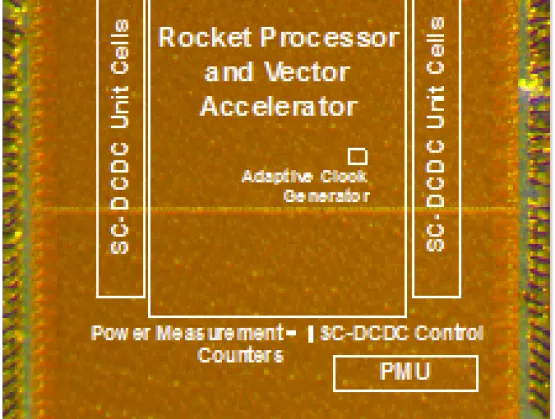
[caption id="attachment_11566" align="alignnone" width="768"] (Courtesy: CMP, ST, UC Berkeley)[/caption]
As we learned at SOI Consortium FD-SOI Tutorial Day in SiValley last year, Professor Borivoje “Bora” Nikolic of UC Berkeley is known as one of the world's top experts in body-biasing for digital logic (he and his team have designed more than ten chips in ST’s 28nm FD-SOI!) They presented the RISC-V chip here at ESSCIRC '16 and JSSC '17, in a paper entitled Sub-microsecond adaptive voltage scaling in a 28nm FD-SOI processor SoC (B.Keller, et al, on IEEE Xplore here). As they noted in the intro, a major challenge for mobile and IoT devices is that their workloads are highly variable, but they operate under very tight power budgets. If you apply adaptive voltage scaling (AVS), you can improve energy efficiency by scaling the voltage to match the workload. But in the current gen of SoCs, the AVS timescales of hundreds of microseconds is too slow. The chip the Berkeley team presented brought that down to sub-microseconds by aggressively applying body-biasing throughout the chip, including to workload measurement circuits and integrated power management units. The result is “... extremely fine-grained ( 1μs) adaptive voltage scaling for mobile devices.” (BTW, they expand on some of the details in another paper published in 2017.) These design techniques are now taught at UC Berkeley, as this kind of implementation is the subject of a course in SoC design (including the RF part of transceivers); a first educational chip has already been taped-out and successfully measured. (BTW, Professor Nikolic will once again join Dr. Cathelin and other luminaries in teaching at the SOI Consortium's FD-SOI Training Day in Silicon Valley, 27 April 2018 - click here for sign-up information.)More SOI Through CMPAt the meeting, CMP also made a presentation on all their MPW offerings – you can get it here. On ST's SOI (in addition to 28nm FD-SOI, of course), that includes the new 160nm SOIBCD8s: Bipolar-CMOS-DMOS Smart Power (for automotive sensor interface ICs, 3D ultrasound, MEMS micro-mirror drivers); and 130nm H9-SOI-FEM: Front-End Module (for radio receiver/transceiver, cellular, WiFi, and automotive keyless systems).CMP also provides tutorials that are used by institutions across the globe. A new update to the tutorial, RTL to GDS Digital Design Flow in 28nm FD-SOI Process is now available – you can see the presentation they did about that here. (It now includes LVS and DRC steps with Mentor/Calibre or Cadence/PVS.) Other services, like the 2-day, hands-on THINGS2DO FD-SOI training days at the end of March are always fully booked almost immediately, but don't hesitate to inquire, as they'll be adding more.
For some more examples of 28nm FD-SOI chips run through CMP over the years, see their website pages on Examples of Manufactured ICs. There are also some nice examples on pages 21 and 23 of their most recent annual report.
For those in the photonics world, CMP has teamed up with Leti to offer Si-310 PHMP2M, a 200mm CMOS SOI platform. CMP is cooperating with Tyndall for the photonics packaging – see that presentation here. Training kits and tutorials will be available in Q3 of this year.
And in partnership with MEMSCAP, CMP offers Multi-User MEMS Processes (aka MUMPs) for SOI-MEMS.So lots of terrific SOI resources for CMP – check it out!~ ~ ~Note: special thanks to Andreia Cathelin of ST and Kholdoun Torki of CMP for their help on this piece.