downloadGroupGroupnoun_press release_995423_000000 copyGroupnoun_Feed_96767_000000Group 19noun_pictures_1817522_000000Member company iconResource item iconStore item iconGroup 19Group 19noun_Photo_2085192_000000 Copynoun_presentation_2096081_000000Group 19Group Copy 7noun_webinar_692730_000000Path
Skip to main content
Default Banner Image

Fab Capacity

Region’s Fab Capacity Expansion Picks up PaceUnwavering in its drive to build a strong, self-sufficient semiconductor supply chain, China plans more new fab projects than any other region in the world from 2017 to 2020, and its expansion of fab capacity recently picked up pace on the strength of new foundry and memory projects from both domestic and foreign companies, according to SEMI’s 2018 China Semiconductor Silicon Wafer Outlook report. China’s installed fab capacity is forecast to grow at a 12 percent CAGR from 2.3 million wafers per month (wpm) in 2015 to 4 million wpm in 2020, faster than all other regions.Well known for its semiconductor packaging prowess, China in recent years shifted its focus to front-end semiconductor fabs and a few key material markets. In 2018, the region’s surge in fab investment thrust it past Taiwan as the second largest capital equipment market in the world, behind only Korea. However, China’s semiconductor manufacturing growth faces strong headwinds. Chief among them is the tight supply of silicon wafers over the past two years due in large part to the sector oligopoly’s firm control of global production, with the top five wafer manufacturers accounting for over 90 percent of market revenue. In response, China’s central and local governments has made the development of its domestic silicon wafer supply chain a key initiative, funding multiple silicon wafer manufacturing projects.According to the 2018 China Semiconductor Silicon Wafer Outlook report, many of China’s domestic silicon suppliers capably provide wafers 150mm in size and smaller. And the while the region lags peers in 200m and 300mm processing technology and capacity, strong domestic demand and favorable policies have fueled progress in 200mm and 300mm silicon manufacturing with some Chinese suppliers having reached key large-diameter manufacturing milestones.However, it will take these new suppliers several years before they can meet capacity and yield requirements of the larger-diameter silicon wafer market. Company plans and announcements indicate that by the end of 2020, total silicon supply capacity in China will reach 1.3 million wpm for 200mm, possibly leading to a slight oversupply, and 750,000 wpm for 300mm.China’s equipment suppliers, particularly crystal furnace vendors, are also investing in the development of 300mm wafer manufacturing, and domestic tool suppliers have developed most of the necessary tools for wafer manufacturing, except for inspection.While China’s silicon wafer suppliers continue to lag international peers in manufacturing capabilities, the region’s silicon manufacturing ecosystem is maturing and becoming better integrated. The sector’s growth is driven and accelerated by significant domestic market demand and favorable policies.About the China Semiconductor Silicon Wafer OutlookSEMI’s 2018 China Semiconductor Silicon Wafer Outlook is a comprehensive research report with a Microsoft Excel® workbook containing in-depth analysis of China’s silicon wafer manufacturing ecosystem as it relates to the global semiconductor wafer industry. The report covers the latest developments in China’s silicon wafer supply chain, including details on the rise of China’s silicon manufacturing, polysilicon, and silicon wafer-related equipment companies. The report also examines policies, funding and their implications for China’s silicon wafer supply chain.Clark Tseng is director in Industry Research and Statistics at SEMI.
Read More
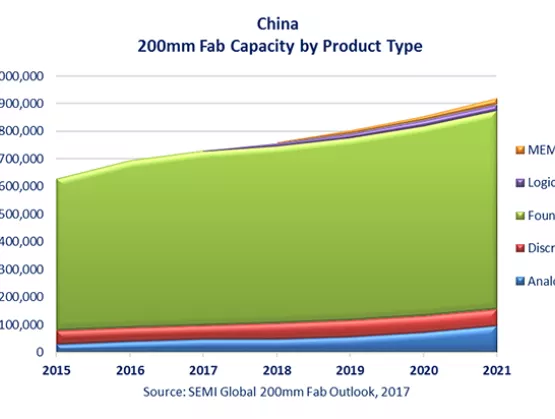
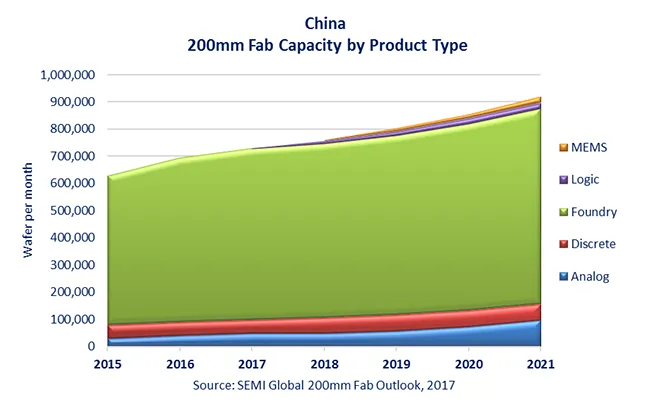
By Clark Tseng, Industry Research Statistics Group, SEMI China’s ambitious plans to build a world-class semiconductor manufacturing supply chain domestically certainly has the industry’s attention. With over a dozen new 300mm fab announcements lately from Foundries, DRAM, 3D NAND, and as well as CMOS image sensor companies (either from international semiconductor makers or from indigenous players), China has launched a huge investment in wafer fab capacity that is expected to ramp in the next five years. While advanced 300mm fab investment attracts most of the attention and resources, China does not skimp on the more “matured” 200mm fabs. China will have the most new 200mm fab projects and capacity additions in the next few years compared to other regions. According to SEMI’s latest 200mm Fab Outlook report, China currently has about 700,000 wafers per month (wpm) installed fab capacity, and this is forecasted to surpass 900,000 wpm by the end of 2021, or over 28 percent growth in five years. By then, China’s 200mm capacity is expected to surpass America, Japan, and Taiwan, and be second only to Europe. A further examination of China’s new 200mm fab projects shows a wide diversity in products. Beyond the usual 200mm foundry investment led by SMIC and Hua Hong Semiconductor, an increasing number of new projects are focusing on analog, power, and MEMS applications. According to SEMI’s latest 200mm fab Outlook report, China will add eight new 200mm volume fabs between 2016-2021: two for foundries, two for analog, two for MEMS, one for power, and one for logic. In the meantime, China is not limiting itself to adding wafer capacity. It is also developing material and equipment capabilities around 200mm wafer manufacturing. A number of silicon wafer suppliers are emerging in China targeting 200mm and smaller wafer markets. On the equipment side, the 200mm tool availability remains the biggest challenge for the industry in adding more 200mm capacity; some projects have been postponed because of it. China equipment suppliers are expected to take the opportunity to develop the tool sets needed to satisfy the upcoming demand for these fabs. China’s 200mm capacity will evolve to make more than “legacy” products, e.g., smart card, Analog IC, and Discrete IC. These manufacturers will become more versatile advancing into MCU, PMIC, CIS, fingerprints sensor, power, MEMS, and other devices. With the rise of China’s electronic OEMs and automakers, these 200mm fabs will play an even more important role supporting various manufacturing ecosystems in China. For more information, visit https://discover.semi.org/global-200mm-fab-outlook-registration.html
Read More