downloadGroupGroupnoun_press release_995423_000000 copyGroupnoun_Feed_96767_000000Group 19noun_pictures_1817522_000000Member company iconResource item iconStore item iconGroup 19Group 19noun_Photo_2085192_000000 Copynoun_presentation_2096081_000000Group 19Group Copy 7noun_webinar_692730_000000Path
Skip to main content
Default Banner Image

finFET

The Scaling Technologies TechXPOT at this year’s SEMICON West (Scaling Every Which Way! – Thursday, July 12, 2:00pm-4:00pm) will explore traditional scaling as the industry marches toward 3nm and beyond, as well as technologies that enable 3D architectures, die stacking, and interconnect scaling. The session will also provide an update on how the various players (foundry, IDM, fabless, and application developers) are jockeying for innovation leadership. As a prelude to the event, SEMI asked Priya Mukundhan, director, Technology Development and Applications, at Rudolph Technologies, and a speaker at the TechXPOT, to provide her insights into challenges associated with metrology and inspection.For a full list of speakers and program agenda, visit http://www.semiconwest.org/programs-catalog/scaling-every-which-way. Priya Mukundhan, director, Technology Development and Applications, Rudolph TechnologiesSEMI: What are the key challenges that need to be addressed to provide the kind of metrology and inspection solutions that will be needed by the industry as scaling – in all its forms (e.g., traditional, 3D ICs, interconnect, and different transistor architectures) – is pursued at 5nm and then at 3nm? Priya Mukundhan: With respect to metrology needed to scale FinFETs, the following will be key: Gate critical dimension (CD) at the fin sidewall, gate height, gate profile Fin CD, height and profile Dopant profiles Stress measurement in the fin Composition in thin film and interface These challenges are currently being handled using in-line CD solutions, CD scanning electron microscopy (CD-SEM) and CD atomic force microscopy (CD-AFM), along with optical critical dimension (OCD) measurements. There is no single technology that can take all of these measurements, and determining the right solution is application-dependent[1].Issues associated with inspection and scaling include the following: Bright-field inspection lacks the sensitivity to detect defects smaller than those found at the 20nm node Detecting defects that are 5nm or smaller is achieved using electron beam inspection tools, but these single-electron beam inspection systems are prohibitively slow and cannot meet the high-volume manufacturing (HVM) requirements for defect inspection Buried defects Void detection in 3D SiP structures, front and backside inspection Sidewall crack detection in packaging SEMI: Can you provide a summary of the R D roadmap for metrology/inspection tools that you see emerging in order to get to 3nm? PM: Hybrid metrology is currently in use, especially for CD metrology. To support the development efforts, techniques that provide complementary information as well as those that eliminate uncertainties will be required. Researchers at imec[2] have started exploring technology combinations to gain insight into how new structures function. Some of the findings in imec’s study include the following: The combination of transmission electron microscopy (TEM) and scanning probe microscopy (SPM) provides a unique approach of imaging combined with a functional analysis capability In situ SPM could potentially determine composition (SIMS) as well as functional properties (electrical) Fast Fourier transform scanning spreading resistance microscopy (FFT-SSRM) is a novel technique that measures carrier profiles in semiconductors. This overcomes the current SSRM limitations of signal distortions due to parasitic resistances while measuring on small volumes such as FinFET and nanowires Multi-electron beam inspection can be used for HVM for sensitivity to smaller SEMI: How will metrology and inspection be impacted beyond 3nm? What kinds of tools will be needed by that point in time?PM: There are several different transistor options that have been identified by leading edge wafer fabs and consortia looking beyond the 5nm node roadmap[3,4]. Some of the options on the table include the following: 1) Extension of the current FinFET in the form of gate-all-around FET2) Creating them with new materials by adding ferroelectrics (e.g., negative capacitance FET, or NC-FET) 3) Complementary FET4) Vertical nanowires and nanosheet FETsThese possibilities bring new challenges and require characterization at the material level. Also, the industry as a whole will have to redefine what it means to do composition at the nanometer level. This could be the beginning of a trend towards array-based metrology, i.e., measurements on an array of devices to gather statistically significant data[2].Regarding metrology needs at 3nm, it is too early to determine what kind of tools would be needed only for R D and how many of them would need to be extended to high-volume manufacturing (HVM). From an inspection perspective, there will be a continued migration towards computer aided design (CAD)-based inspection, as well as having the ability to deal with large image data sets (petabyte, big data). Furthermore, inspection algorithms should be improved, along with better staging for better image stitching.References Bunday, E. Solecky, A. Vaid, A. F. Bello, X. Dai, “Metrology capabilities and needs for 7nm and 5nm logic nodes,” Proc. Of SPIE, Vol. 10145, 101450G, pp. 1-41, 2017. Imec roadmap and imec magazine. Intel roadmap. https://semiengineering.com/transistor-options-beyond-3nm/ Debra Vogler, SEMI
Read More
With chipmakers looking toward 5nm manufacturing, it’s clear that traditional scaling is not dead but continuing in combination with other technologies. The industry sees scaling enabled by 3D architectures such as die stacking and the stacking of very small geometry wafers. Interconnect scaling also comes into play. This year’s Scaling Technologies TechXPOT at SEMICON West (Scaling Every Which Way! – Thursday, July 12, 2:00PM-4:00PM) will provide an update on the evolution of scaling and describe how the various players (foundry, IDM, fabless, and application developers) are jockeying for innovation leadership. As a prelude to the event, SEMI asked speakers to provide insights on important scaling trends. For a full list of speakers and program agenda, visit http://www.semiconwest.org/programs-catalog/scaling-every-which-way.Challenges for gate-all-around (GAA) and FinFET devicesDiederik Verkest, imec Distinguished Member of Technical Staff, Semiconductor Technology and Systems“During the processing of GAA devices, there are ‘non-line-of-sight’ hidden features that are difficult to control and characterize and may also lead to new defect mechanisms that would impact yield, and possibly product reliability.”Common performance boosters for gate-all-around (GAA) FETs and FinFETs include lower access resistance, lower parasitic capacitance, and stress. “However, one specific performance booster that only applies to GAA is the reduction of the spacing between the vertical wires or sheets,” says Diederik Verkest, imec distinguished member of technical staff, Semiconductor Technology and Systems. “This reduces parasitic capacitance without affecting drive current and hence benefits both performance and power.” He further notes that imec demonstrated the first stacked gate-all-around (GAA) devices in scaled nodes. “In fact, we are the only ones that published working circuits – ring oscillators in a scaled node using industry-standard processes – in our case replacement metal gate (RMG), and embedded in situ doped source/drain (S/D) epitaxy.”“There are two elements of the stacked GAA architecture that need to be addressed,” says Verkest. “The first is that this architecture uses epitaxially-grown layers of Si and SiGe to define the device channel. The use of grown materials for the channel and the lattice mismatch between the two materials represent a departure from the traditional fabrication of CMOS devices, so the industry needs to develop and gain confidence in novel metrology that allows for good control of the layers and also proves their low defectivity.” The second aspect is the three-dimensional nature of the GAA devices. “During the processing of these devices, we have ‘non-line-of-sight’ hidden features that are difficult to control and characterize and may also lead to new defect mechanisms that would impact yield, and possibly product reliability.”Huiming Bu, Director, Advanced Logic/Memory Research - Integration and Device, IBM Research, Semiconductor Group"A new device architecture beyond FinFET is required to provide a full technology node scaling benefit (i.e., density, power and performance) at 5nm and 3nm.”Huiming Bu, director, Advanced Logic/Memory Research - Integration and Device, IBM Research, Semiconductor Group, says that naming of technology nodes has been used extensively for marketing strategies in “foundry land,” but the designations have lost much of their meaning as technology scaling differentiators. “That said, when it comes to technology innovation and value proposition, IBM, in conjunction with Samsung and GLOBALFOUNDRIES, has developed the GAA NanoSheet transistor for 5nm to provide a full technology node scaling benefit in density, power and performance,” says Bu (Figure 1). The key parameters for intrinsic device optimization when scaling to the 3nm node, explains Bu, are the NanoSheet width for better electrostatic characteristics, and the number of sheets for increased current density. Also necessary are strain engineering for carrier transport enhancement, and interconnect innovations for parasitic RC reduction. “Beyond that, the industry needs to look into something different, something more disruptive.”Figure 1. TEM cross section of stacked NanoSheet transistors. SOURCE: IBM Research Materials challengesMaterials challenges are also a concern as the industry moves to 5nm and below. “We see increasing complexity in the material systems that are being used,” explains Verkest. One example he cites in scaled FinFET or GAA technologies is the use of two to three layers of different materials – typically metals such as TiN – to which small amounts of other elements are added to set device characteristics such as the threshold voltage. “At the same time, the requirements for the thickness of these materials, driven by gate dimensions for example, or the distance between the wires, are increasingly challenging.” Other examples of materials challenges are the use of two to three different types of insulators in the middle-of-the-line, each with different etch contrasts. “We use novel materials such as carbon containing oxides or oxynitrides that have lower dielectric constants in order to boost the performance of circuits,” he says, noting that the materials list “is quite long.”Several critical dimensions in transistors at advanced technology nodes have already reached a few monolayers of atoms, fueling expectations for innovation at the material level for transistor scaling, Bu notes. “The other argument is that there is a growing gap between computing demand and the slowdown of technology advancement driven by conventional scaling,” says Bu. One trend that addresses this gap is integrating more computing functions that make the technology solution more modular, which naturally leads to the incorporation of more materials for more applications. Bu cautions, however, that introducing new materials in semiconductor technology has never been easy. “It takes many years of R D to reach this implementation point, if it ever happens. So, do we need new materials when the industry moves to 5nm and 3nm? Yes, though I expect new material implementation to be a lot faster in interconnect and packaging at these nodes rather than intrinsic to the transistor.” Challenges in developing atomic-level processesThere will be challenges in developing atomic-level processes used in scaling, such as atomic layer depositions (ALD) and atomic layer etches, notes Verkest. “These classes of processes are both required to handle the scaled dimensions at the 5nm and 3nm nodes, and also the 3D nature of the scaled technologies – and here we are talking about logic and memories,” Verkest says. “With respect to depositions, we would need to develop thermal ALD processes (not plasma-based) that enable accurate and conformal depositions in non-line-of-sight structures.” Adhesion and wetting, smoothness, and throughput would also need to be addressed. “Longer term, these processes need to facilitate selectivity and self-alignment to address gap-fill challenges in highly scaled structures,” he says. Other concerns he notes with respect to atomic layer etches are selectivity to various materials, and fidelity requirements that increase the requirements for metrology accuracy. “Throughput is also a concern.”Bu believes that a new device architecture beyond FinFET is required to provide a full technology node scaling benefit (i.e., density, power and performance) at 5nm and 3nm. “Beyond 3nm, we may need to continue the transistor scaling in the vertical direction and start to stack them together,” Bu says. He also cites the need for parasitic R/C reduction in the interconnect to take advantage of the intrinsic transistor benefit at the circuit and chip levels. “We see a lot of opportunity in atomic-level processes, especially in atomic layer etch and selective material deposition, to address these challenges in the transistor and the interconnect.” Debra Vogler, SEMI
Read More
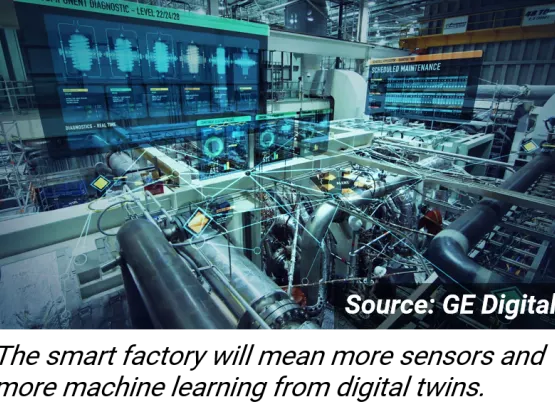
The fast-maturing hardware and software that are enabling practical applications of equipment intelligence and machine learning mean disruptive change for microelectronics manufacturing. But first comes the basic work of building the basic infrastructure, figuring out IP separation, and learning to solve physical problems in the digital world. Just how much can the semiconductor industry leverage industrial IoT practices from other industries? Common wisdom may be that industrial software solutions aren’t well suited to the IC sector’s complex needs. But GE Digital enterprise account executive Luke Smaul, currently working with Intel, argues that semiconductor fabs and toolmakers are dealing with similar issues as GE did when it first started working with Delta Airlines to monitor the GE engines on Delta planes. Smaul will speak at SEMICON West about GE’s work with Intel over the past few years and, in particular, how its solution for cloud security and IP separation can work for ICs. “GE learned to provide IP security and separation in the aviation space with its suppliers, which moved us all up the value chain, providing a big engine for growth,” says Smaul, who started his career as an IC engineer. “GE Aviation saw a 25 percent increase in issue detection rates by leveraging the same common platform. We’ve shown that we can protect Intel intellectual property in its own cloud space and control who can access what.” A toolmaker can access only particular fab data as needed for analysis, and then can reveal only the output from the analysis and a subset of supporting data. “IP separation has to happen, and it will unlock huge added value,” Smaul says. GE’s Predix solution aims to supply an easy-to-use, plug-and-play system for analytics to enable a yield engineer without a deep data background to select a supported sensor, a gateway to connect automatically to the cloud, and an analytics application to test a hypothesis of how the collected data relates to yield. “This empowers the yield engineer to use and unlock information for a quick improvement, even for simple things such as looking at the impact of degradation of fan performance over time on yield,” says Smaul. “Though the scope may be small, the impact on yield in aggregate, and when scaled, is large.” “There needs to be much more collaboration across the industry to make this work, and to share best practices,” says Smaul. “Just as GE moved from selling gas turbines to selling power-as-a-service, vendors of other big, expensive assets like IC equipment will likely change their business model from selling tools towards selling yield-as-a-service. This will simplify life for the fab while bringing the toolmaker more opportunity to sell improved capabilities on existing tools.” More human intelligence makes AI smarter Applying AI neural network approaches such as deep learning to predict outcomes from digital models is enabling disruptive advances in speech and image recognition, but applying it to complex IC manufacturing problems such as predictive maintenance has been a challenge. These neural networks require massive amounts of data to train, and the IC sector doesn’t really have big data, just a lot of little data clusters due to the dynamics and context richness of processes. This data is difficult to combine for analysis. In addition, the neural network provides only an answer but can’t explain why, notes Michael Armacost, managing director of advanced service engineering at Applied Materials. “We’ve learned that it works better if we do not ignore what we know already, but rather incorporate expert knowledge in a structured way to help us focus on the key features and the key data,” says Armacost, who will also speak in the program. This includes choosing the most important steps to include in the model, identifying the limited data to collect and how to filter the data for outliers, and then selecting the final parameters and features, adjusting the limits, and making adjustments as results drift change over time. The less data needed, the better for the complicated issue of IP protection as well. The big gains from these new analysis approaches will likely require data from more than one company and supporting security for remote connectivity. “Some end users are attempting to do the AI all themselves, but in the long term there will need to be collaboration across companies,” says James Moyne, University of Michigan professor and consultant to Applied Materials, another speaker. Collaboration will need to balance the value of the solution against the risk of compromising IP. “The low-hanging fruit are applications such as predictive maintenance in areas that do not involve high-priority IP. Another approach will be to limit the amount of shared data needed – to first build the model on a wide range of data, but then to use only a very small amount of data to operate the models.” Ready-made models could speed the process Coventor’s semiconductor process models are finding initial applications in R D whereby companies use the simulation to understand the effect of process variation on their complex designs. Instead of running dozens of actual wafers to optimize semiconductor processes, users can instead quickly simulate the results of complex process interactions on their design. Going forward, the process models could find a wide range of applications, from accelerating stabilization of new processes in the fab to enabling real-time co-optimized control across previously independent unit steps to improve wafer uniformity. “This improved uniformity across wafers and equipment could potentially reduce the need for costly physical silicon validation,” suggests Joseph Ervin, Coventor director, semiconductor process and integration, another SEMICON speaker. “Making use of in-situ metrology for real-time control also demands a digital model to process and analyze the collected data for quick response. This area has tremendous potential for improving semiconductor process control.” SEMICON West features a Smart Manufacturing Pavilion with displays and three full days of speakers on building the infrastructure needed to enable disruptive artificial intelligence in the microelectronics sector. www.semiconwest.org The SEMICON West Smart Manufacturing Pavilion features interactive Touch Liquid Crystal Displays (TLCD) and working production equipment on the floor from Bosch Rexroth, Cimetrix, Rudolph Technologies, Inficon/Final Phase Systems, OMRON, DISCO and Edwards Vacuum. For information on the SEMI Smart Manufacturing Initiative and how to get involved, please click here. Paula Doe, SEMI
Read More