downloadGroupGroupnoun_press release_995423_000000 copyGroupnoun_Feed_96767_000000Group 19noun_pictures_1817522_000000Member company iconResource item iconStore item iconGroup 19Group 19noun_Photo_2085192_000000 Copynoun_presentation_2096081_000000Group 19Group Copy 7noun_webinar_692730_000000Path
Skip to main content
Default Banner Image

Sandia National Laboratories

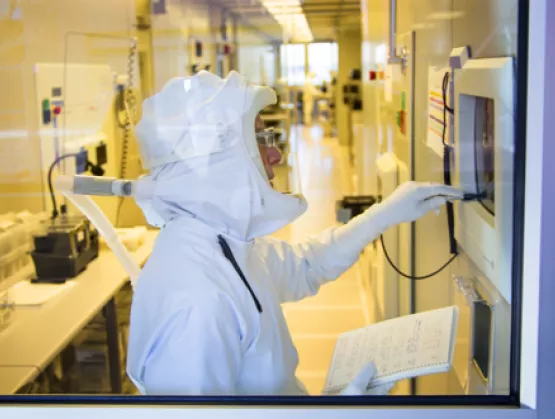
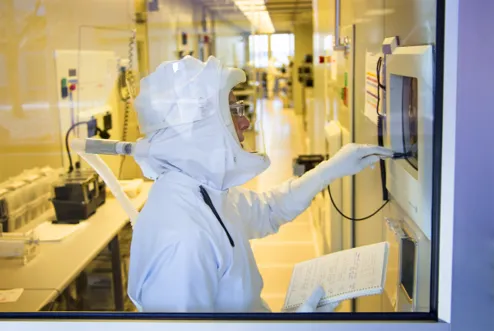
Sandia National Laboratories just finished updating equipment in its microelectronics fab, marking the completion of the first phase of a 3-year fab upgrade program. The transition from 6-inch to 8-inch wafer sizes will align the Department of Energy national lab with industry standards to ensure easier access to tools, spare parts and raw materials.Sandia is a prestigious member of the SEMI Fab Owners Alliance (SEMI FOA), an international group of semiconductor and MEMS fab managers and industry suppliers that meet regularly to solve common non-competitive manufacturing issues and improve their business results. SEMI spoke with Michael Holmes, senior manager of microfabrication at Sandia, about its approach to revitalizing the fab while developing new production processes and technologies.SEMI: What were the main challenges in moving into production with 8-inch wafers?Holmes: The goal of the conversion is to reestablish our 6-inch production processes on 8-inch wafers including our radiation hardened 350nm CMOS and MEMS technologies. This requires tuning hundreds of interrelated parameters to get the same end result as before but with different equipment and at a larger scale. In addition, during the conversion we are developing a new 180nm radiation hardened CMOS production process and re-establishing research work on 8” in our silicon photonics and ion trap technologies. Modifications to the facility have also been required including raising the ceiling to install the new implanter and relocating our gowning area to facilitate installation of new CMP tools. In addition to converting our Silicon fabrication facility, we are also converting select equipment in our compound semiconductor facility. We are one large team working toward these goals.SEMI: Were there any roadblocks in sustaining production of the 6-inch wafers while planning and implementing processes for the upgrade to 8-inch?Holmes: Six years of planning ensured the conversion would not affect production of components needed for national defense. This planning window was required to ensure production commitments were completed in advance of conversion start in August of 2018 and return to production for commitments starting in July 2021. This period provides time to complete the hardware conversion and steps review and requalify the production line to ensure products made using the new equipment are identical to ones produced by the old equipment. The hardware conversion phase completed on schedule and the fabrication of prototype and research components on 8-inch started in November of 2018.SEMI: Can you shed some light on the development of gold antennas that promise to improve the thermal infrared radiation capabilities in systems?Holmes: Sandia developed a new infrared detector design that breaks away from relying on thick layers of detector material and instead uses a subwavelength nanoantenna – a patterned array of gold square or cross shapes – to concentrate light on a thinner layer of material. This design uses just a fraction of a micron of detector material, whereas traditional thermal infrared detectors have a thickness of 5 to 10 microns. The nanoantenna-enhanced design increases the amount of an infrared radiation a detector can see while also reducing image distortion caused by background noise. It also allows for the invention of new detector concepts.SEMI: Sandia is known for producing high-reliability components. Several SEMI FOA members have customers in the automotive domain, where reliability is critical. Do you have any advice for them on their path to high-reliability, zero-defect systems?Holmes: High-reliability microdevices at Sandia’s MESA facility are paramount. A structured quality program is rigorously realized in each facet of the production process. Our processes and design rules are constructed around reliability, and we extensively leverage in-line metrology and electrical test to validate devices throughout production. SEMI: Are there any examples of how the FOA peer-to-peer dialogue and knowledge sharing helped in your upgrade from 6-inch to 8-inch?Holmes: Sandia is new to the FOA. Our initial interactions have been very valuable, and members have shared insights into metrics and process improvements that will benefit MESA moving forward. Relative to the 6-inch to 8-inch conversion, as part of our planning process, we did engage other foundries within the FOA to solicit feedback and lessons learned.The mission of the Fab Owners Alliance is to provide value to the fab management and operations community through collaborative platforms for device makers and solution providers.Nishita Rao is marketing manager for technology communities at SEMI.
Read More
Standing-room only keynote speeches. A future awash in data amassed by transformative technologies and applications, with semiconductors at their core. Smart everything: Cars, medicine, manufacturing, workforce, you name it. The sheer numbers impressed as a record lineup of SEMICON West keynote speakers offered a glowing portrait of the future: The semiconductor industry stands on the cusp of a breakout expansion. Standing and seated shoulder-to-shoulder in the packed-to-gills opening keynote, the audience learned, indeed, that the best was yet to come: “This is the best SEMICON West, ever,” observed SEMI CEO Ajit Manocha. Here’s a glimpse of the keynotes by the numbers, starting with the luckiest of all. 7 – The number of keynotes – among the brightest lights in technology – sharing their visions of the future through the lens of breakthrough technologies that are nearly ready to make their indelible mark. Dozens of expert panelists also weighed in at SEMICON West, the annual U.S. flagship microelectronics gathering in San Francisco. 90 – The percentage of all data ever generated has been created in just the past two years as the cloud mushrooms with tweets, texts, emails, Facebook posts, YouTube videos, medical records and all manner of business information, noted Bill Bottoms, president and CEO of Third Millennium Test Solutions. In the years ahead, an almost unimaginable wealth of data will require analysis by artificial intelligence (AI) embedded in semiconductors to enable applications that go well beyond smart. 12-18 – That’s how many months it will take for data volume to double, predicted John Kelly III, IBM’s Senior VP, Cognitive Solutions. And it will double again and again, every 12-18 months. Kelly foresees a scale of growth “that will dwarf previous eras of computing … the number of opportunities is enormous.” Kelly’s four decades in computing gave considerable weight to his point that “in the industry, there has never been a more exciting point in time than today.” First – Technology is being re-born. Using baseball lingo, several speakers noted that we are just in “the first inning,” “the top half of the first inning” or “the beginning of the first inning” to make clear in the most emphatic terms the duration of prosperity that lies ahead for the industry. AI embedded in chips and demand for real-time analysis of AI data will be its fuel. As SEMI Americas president Dave Anderson observed with a smile, “We all know how long baseball games can go.” Third – That’s the current wave of machine learning the world is now experiencing, according to Sandia National Laboratories’ Principal Member Conrad James. Computers are now capable of solving many increasingly complex problems on their own, with no human intervention necessarily required, he said. 1000x – As spectacularly fast as computing power already is today, the industry will need to double that the rate of performance in the years ahead, predicted Applied Materials president and CEO Gary Dickerson. Demand for this herculean processing capacity will spur a “tremendous focus on innovation” among SEMI members, their customers and their customers’ customers. 5 to 15 – The remarkable amount of silicon that power today’s mobile devices will be overshadowed by the chips – equivalent in computing capacity to 5 to 15 cell phones – that will be the engine of self-driving and other features in future automobiles, predicted Pierre Ferragu, New Street Research Managing Partner, during the SEMI Bulls and Bears session. Automobiles with this souped-up computing capacity will sell in the millions worldwide in the years ahead, generating never-before-seen opportunities for the chip industry, he noted. 10,000 – It’s not just cars. Ten thousand is the number of sensors that will be built just into the wings of new Airbus A380-1000 aircraft, AMD CTO Mark Papermaster explained during his keynote. 10 terabits – The staggering amount of Facebook data uploaded daily in to the cloud, Papermaster noted. 1 Trillion – SEMI’s 2020 forecast that the industry will reach $500 billion in revenues by 2020 was eclipsed by one analyst, speaking at the SEMI Market Symposium on the first day of the event, predicted that the industry would top $1 trillion in the foreseeable future. SEMI’s Manocha later added that $1 trillion in industry revenue is possible by 2030, “maybe sooner.” 1 (sexy) coda – Coders are hip and software applications are the apple of the world’s eye. Even the most casual mobile device user knows that software apps makes it whirl. But “hardware is becoming sexy again,” said Applied Materials’ Dickerson, adding that equipment and other semiconductor hardware developed by SEMI members will enable the next great wave of global economic growth. Scott Stevens, SEMI
Read More