downloadGroupGroupnoun_press release_995423_000000 copyGroupnoun_Feed_96767_000000Group 19noun_pictures_1817522_000000Member company iconResource item iconStore item iconGroup 19Group 19noun_Photo_2085192_000000 Copynoun_presentation_2096081_000000Group 19Group Copy 7noun_webinar_692730_000000Path
Skip to main content
Default Banner Image

RF generator

I recently was part of a group brought together by SEMI to redefine SEMI E135, the standard applied to test methods for determining the transient response of a radio frequency (RF) generator used in RF power delivery systems for semiconductor processing equipment. Comprised of RF generator suppliers and end users, the team of approximately 15 people embarked on a two-year effort to modernize the standard.The key goals were: Rewrite the test standards so that design engineers can choose the right power source for a given application, for example atomic layer deposition, etching or other short-run processes. Ensure tests reflect real-world conditions. Create more transparency and communication between suppliers and users about the true capabilities of the power supply. The original standard is over 10 years old. It was defined prior to the widespread use of digital communication to control RF generators and limited to testing RF generators designed to deliver power to a nominal 50-Ω load. However, today’s semiconductor fabrication processes are dynamic, requiring RF generators to be able to ignite plasma and respond instantly to changing plasma conditions. Wafer quality and yield are highly dependent on power remaining stable even as plasma characteristics change and by the ability to quickly respond to a change in set point and other commands which result in power level changes.According to Paul Trio, Senior Manager, Strategic Initiatives at SEMI and Inna Skvortsova, of SEMI Standards, some device manufacturers have reported that more than half of RF generators used in semiconductor fabrication plants (fabs) fail within the first two years of operation. That is expensive for fabs in terms of downtime, unscheduled maintenance and total cost of ownership.SEMI E135-0918: Updated and Expanded Related Information SectionWith all of that in mind, we began a spirited, thorough collaboration resulting in a community effort aimed at advancing the industry. Discussions began within the SEMI SCIS Technology Community, a SEMI group focused on addressing component defectivity, and then complemented by the SEMI Standards program for formal standards development. During a series of meetings, we worked to update the standard so that it is easier to qualify a generator, provides guidance on data processing as well as setting up and performing tests. These improvements inevitably provide users better procedural details that will help them operate these generators in a safer manner. If you are at all familiar with SEMI E135 or other such standards documents, you know that what I just described is only a fraction of the information contained in the standard. Schematics, examples, illustrations are also included to help test engineers specify and report on the performance characteristics of an RF generator under test.The Related Information section of the newly revised SEMI E135 standard document is very important as it provides users additional helpful information on how best to use the prescribed test method. In it, the group chose to describe the limitations of testing equipment designed to deliver power to highly nonlinear loads using only linear loads.You’ll also find rationale for testing procedures, equations to determine gain, forward power and delivered power and guidance on test points. Again, what I’ve described here is only a brief sketch of what’s included; there is a great deal more information in this section that original equipment manufacturer (OEM) engineering teams, process engineers and technical teams evaluating RF generators should find useful.Healthy Competition for the Benefit of the Industry Now and in the FutureWe often talk about rapid changes in technology for our semiconductor customers, and how those advances help them meet their goals for improving yield and wafer quality or reducing total cost of ownership. Sometimes, technology development races ahead of standards, making it difficult for them to select an RF generator that best meets the performance demands the tool in their process will encounter.Advanced Energy and the semiconductor community have mutual, vested interests in helping customers make fully informed decisions, even though some stakeholders are competitors. Considering how fast the semiconductor market is evolving, with the advent to the IoT, 5G communications and Industrie 4.0, it’s critical that SEMI E135 and other standards reflect the state of the industry today and set the stage for the next-generation of RF power and control.This blog was republished with permission from Advanced Energy.
Read More
Gas plasmas have become a fundamental building block in many semiconductor manufacturing processes. Plasma torches used to create these gas plasmas have three components: an induction coil, a plasma confinement tube, and a gas distributor or torch head that introduces multiple gases into the torch. RF generators supply the high-frequency electrical energy needed to transform the plasma-forming gases flowing through the torch, typically oxygen or a fluorine-bearing gas, into a plasma. The RF generators used for semiconductor manufacturing typically operate in the low megahertz or tens of megahertz frequency range and are expected to output high RF power at those frequencies for long periods. For example, ALD and CVD processes use RF generators with output powers on the order of a few kilowatts.About three years ago, a major semiconductor device maker experienced a recurring problem with its RF generators. The company found that more than half of the RF generators it deployed in its manufacturing lines were failing within the first two years of service. Further, the same model RF generators obtained from the same RF generator vendor simply were not behaving similarly when used for exactly the same processes under exactly the same conditions. Nor were these supposedly identical generators operating for consistent lengths of time before failing. Clearly there was variation from one generator to the next, even within the same model.A further complication occurred during procurement of these RF generators. Procurement people were acquiring generators using general specification requirements and these requirements were, at times, opaque to the intended process application. In some cases, equipment was being purchased in bulk quantities and then assigned to different processes on the semiconductor manufacturing lines. When these generators were deployed, they had not been designed or optimized for the specific task to which they were assigned, exacerbating the reliability problem.The RF generator suppliers felt that they would be able to supply more reliable generators if they could collaborate with their customers so that they could purpose-build their generators for the intended uses. However, the semiconductor makers preferred to keep the specifics of the manufacturing process applications for these generators proprietary, for obvious reasons. To make matters worse, customers did not always return failed units to RF generator vendors for analysis. Instead, the RF generators were sometimes sent out to be refurbished by third parties or repair depots, and then redeployed. As a result, failure analysis proved challenging to obtain.This is exactly the type of situation that SEMI’s Semiconductor Component, Instrument and Subsystem (SCIS) technical community exists to address. SCIS develops test methods aimed at measuring component defects for the greater semiconductor manufacturing community. SCIS tackled this RF generator problem and developed a standard test method for measuring specific RF generator characteristics. Using this test method, RF generator manufacturers can publish results for their generators in a standardized way that allows their customers to make fair, application-specific comparisons among models and vendors.Many aspects of an RF generator needed to be considered. A key aspect that interested integrated device makers (IDMs) and capital equipment OEMs was a transient-response test for RF generators.A transient-response test standard established by the SEMI-E135 standard did exist, but its tests were run only with 50-ohm RF output loads. SCIS decided to expand this transient-response test by adding high- and low-impedance load tests to the existing 50-ohm load test.The initial response to this plan was not enthusiastic. The semiconductor makers feared that this simple expansion of an existing test standard would not produce a test regimen that would help solve what they considered to be the real problem: RF generator reliability. However, a major semiconductor equipment OEM differed, and felt that the two additional load conditions would provide a much better understanding of an RF generator’s capabilities. A second major semiconductor equipment OEM also got involved by providing additional, valuable feedback on the developing RF generator testing standard.In the end, the general feeling in the community is that this newly revised standard levels the playing field and makes it easier for customers to compare RF generators from different generator vendors. Now that this revised SEMI-E135 standard with the additional output load resistances has been published, the SCIS technical community has gained broader support and is now digging into the creation of a reliability test standard for RF generators to meet the greater semiconductor manufacturing community’s strong need for such a standard.How SEMI Standards are MadeThis sequence of events illustrates how standards are developed at SEMI. The SCIS technical community (or some other technical community within SEMI) develops and incubates test methods until a document is ready for standardization. At that point, a SEMI Standards task force is created. Companies within SCIS work with the task force (or become the task force) to ready the document for standardization. For the SEMI-E135 revision, the list of participating companies encompassed the entire semiconductor manufacturing community including RF generator suppliers, semiconductor capital equipment OEMs, and IDMs. All stakeholders participate.Figure 1 illustrates the sequence of events that occurred during the revision of the SEMI-E135 standard, after the test methods had been developed by SCIS as discussed above. Figure 1: Timeline for SEMI-E135 RF generator test standard revision after SCIS had developed the new load tests. Balloting, as illustrated in Figure 1, is the main way that SEMI obtains global consensus in the standards-making process. To achieve this, SEMI sends out the standard ballot proposal, or in this case a major revision of an existing standard. The changes to SEMI-E135 were sufficiently extensive that it was treated as a complete rewrite to this standard.On first ballot, the revised SEMI-E135 standard received several rejection votes, which also included suggested modifications that would remove the objections. These ballot rejections caused the proposed standard to be further revised, with both technical as well as editorial changes, triggering a SEMI Standards process called a Ratification Ballot. This approach takes less time than starting the balloting process over again. The final revised standard was published in September 2018.Having all stakeholders participate in the early development of the revised standard helped move the standard through the balloting process immensely, but customer participation was especially important. In the end, the semiconductor device makers and equipment OEMs are the ultimate beneficiaries of a standard like SEMI-E135. When end customers help to drive a standard’s development, there’s added pressure to move the standard along in the standardization process and the standard is far more likely to be useful for their purposes.And that’s a very good thing.For those looking to learn more about SCIS or engage in ongoing efforts, please contact Paul Trio, senior manager of Strategic Initiatives at SEMI, at [email protected].
Read More
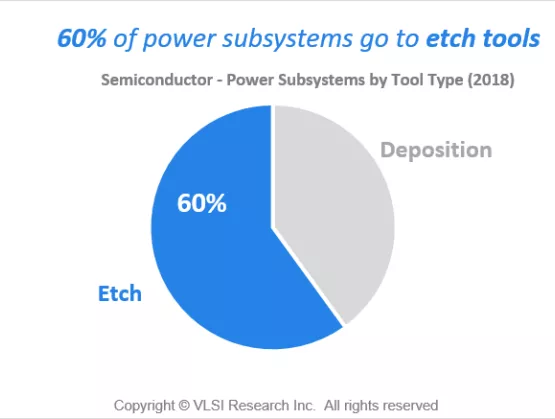
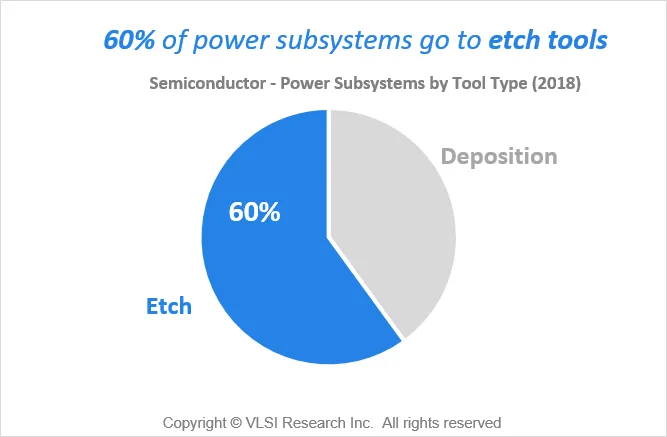
Process power and reactive gas subsystems for semiconductor manufacturing equipment have grown at a CAGR of 21% since 2013. The segment growth is considerably above the critical subsystems industry average of 9.5% and is attributable to higher demand for vacuum processing equipment over the period.Process power and reactive gas subsystems now account for approximately 12% of all expenditures on critical subsystems used on semiconductor manufacturing equipment, up from 7% in 2013. The main driver of this exceptional growth has been the rise in vacuum processing steps (deposition and etch) during the manufacturing processes of both logic and memory devices. Most deposition and etch processes require an RF generator to provide a plasma energy source in the chamber, increasing demand for tools with power subsystems such as RF power supplies and matching networks.Multiple patterning and the advent of 3D NAND in high-volume manufacturing have significantly increased the number of deposition and etch processing steps and, in the case of 3D NAND, longer and more difficult etch processes are requiring a wider range of power solutions. Further analysis shows that 3D NAND has been the principle growth catalyst, with the total share of power subsystems going to memory applications increasing 8 percentage points since 2013. Memory applications now account for almost half of all power subsystems demand in 2018. Interestingly, investigation of power subsystems by tool type reveals that a clear majority of power subsystems (60%) find their way on to etch tools with only 40% on deposition tools. This can be explained by the fact that more delicate etch processes can require multiple RF power solutions per tool, whereas deposition does always use plasma energy sources, for example in thermal deposition processes.Despite the staggering growth performance of the power subsystems segment over the past five years, we expect the growth rate to moderate significantly in the run-up to 2023. Now that 3D NAND has been adopted in high-volume manufacturing, we expect the rate of increase in vacuum/plasma processing steps to slow down. The introduction of EUV also has the potential to taper demand for vacuum processing equipment. However, it is not expected the reverse the trend as multiple patterning techniques will still be needed in conjunction with EUV to achieve the desired improvements in device density and performance. The future growth trend for power and reactive gas subsystems is forecast to be in line with the critical subsystems industry average at approximately 2.0% CAGR until 2023.For more information about Critical Subsystems and VLSI Research, please visit www.vlsiresearch.com/public/csubsJulian West is a technical and market analyst at VLSI Research Europe.
Read More