downloadGroupGroupnoun_press release_995423_000000 copyGroupnoun_Feed_96767_000000Group 19noun_pictures_1817522_000000Member company iconResource item iconStore item iconGroup 19Group 19noun_Photo_2085192_000000 Copynoun_presentation_2096081_000000Group 19Group Copy 7noun_webinar_692730_000000Path
Skip to main content
Default Banner Image

Julian West

Critical subsystems for the IC equipment market continued to grow to a new record of $11 billion in 2018. While 2019 is expected to be a downturn year, the long-term outlook remains unchanged with an average growth rate of 3 percent. Last year may have been a new high for revenues, but it will be remembered as a year of two parts: record quarterly revenues in Q1, followed by rapidly falling orders in Q3 and Q4. Normally, this would not be a problem as suppliers are used to managing volatility in their businesses. However, encouraged by solid end market drivers and optimistic customers, the timing of this downturn was particularly bad as it coincided with the addition of significant new manufacturing capacity for critical subsystems that will be needed to supply the industry into the next decade. The resulting step change in costs against the backdrop of falling revenues has put strain on the financials of these suppliers. Although current visibility is poor, the order decline appears to be stabilising and the worst is nearly over. Revenues are expected to recover in the second half of 2019 followed by a promising outlook for the following three years. Critical Subsystems for IC equipment history and forecast to 2022. After a pause in 2019, the trend is expected to continue to reach new industry records. Suppliers of subsystems used in vacuum process tools, such as deposition and etch, have benefited the most from critical subsystems growth since 2012. Vacuum intensity of semiconductor processing continues to grow and in 2018 the value of vacuum process tools exceeded the value of non-vacuum process tools for the first time. This trend is expected to continue with vacuum based semiconductor process equipment accounting for over 60 percent of wafer fab equipment revenues by 2023. In summary, 2019 is expected to be down 10 percent to 20 percent as the industry digests the recent large additions to semiconductor manufacturing capacity, followed by a new cycle starting in 2020.Julian West is a technical and marketing analyst at VLSI Research Europe.
Read More
Orders for critical subsystems evaporated in the second half of 2018 after a very strong start to the year. Subsystems suppliers have been left with depleted order books after OEMs accumulated large inventories as the market for wafer fab equipment cooled off. Although overall critical subsystems revenue growth for 2018 is forecast to come in at +5% YoY, this year has been a tale of two halves with a bumpy ride for the critical subsystems supply chain along the way.The year started very strongly with overstretched OEMs switching from a “just in time” ordering strategy to panic buying and over ordering critical subsystems “just in case” as they battled to keep up with equipment demand from chipmakers. However, falling memory prices and technology push outs from major chipmakers in Q2 saw a sharp reduction in capex and demand for equipment. The whiplash effect through the supply chain has been severe and critical subsystems suppliers running at full capacity were unable to stop fast enough.Comparing inventories of vacuum processing OEMs (major consumers of advanced critical subsystems) and critical subsystems suppliers, warning signs for subsystems suppliers were apparent after the Q2 quarterly earnings reports. After OEM inventories surged in Q2, critical subsystems supplier inventories spiked in Q3. The overproduction of subsystems leading to this spike suggests that the OEMs had been promising orders to subsystems suppliers but turned off the buying as they too struggled to shift their own products earlier in the year. Suppliers of highly customised subsystems such as vacuum valves and power supplies were particularly badly hit. Whereas other subsystems such as vacuum pumps, which can generally be repurposed on other tools or applications, have fared better as the oversupply can be consumed by a wider variety of applications.The bad news does not appear to be finished for subsystems suppliers as Q3 OEM inventories as a percentage of revenue remained at historically high levels, which is a concern in the short term. Nevertheless, the underlying drivers for the industry remain strong and there is light at the end of the tunnel as major fab building projects in Asia appear to be continuing without delay – a promising sign that chipmakers are still intending to increase capacity. There will be a lot of empty fab shells and upgraded clean rooms ready for equipment installations at short notice if required, ensuring that orders for equipment and subsystems will pick up again soon. Although 2018 will appear in the historical data as a flat, if not slightly positive year, it does not quite reflect the bumpy ride that has been experienced by the supply chain along the way.For more information about VLSI Research and Critical Subsystems, visit www.vlsiresearch.com/public/csubs/. Julian West is a technical and market analyst at VLSI Research Europe.
Read More
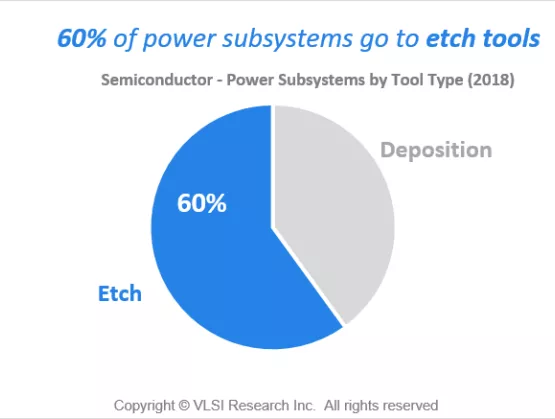
Process power and reactive gas subsystems for semiconductor manufacturing equipment have grown at a CAGR of 21% since 2013. The segment growth is considerably above the critical subsystems industry average of 9.5% and is attributable to higher demand for vacuum processing equipment over the period.Process power and reactive gas subsystems now account for approximately 12% of all expenditures on critical subsystems used on semiconductor manufacturing equipment, up from 7% in 2013. The main driver of this exceptional growth has been the rise in vacuum processing steps (deposition and etch) during the manufacturing processes of both logic and memory devices. Most deposition and etch processes require an RF generator to provide a plasma energy source in the chamber, increasing demand for tools with power subsystems such as RF power supplies and matching networks.Multiple patterning and the advent of 3D NAND in high-volume manufacturing have significantly increased the number of deposition and etch processing steps and, in the case of 3D NAND, longer and more difficult etch processes are requiring a wider range of power solutions. Further analysis shows that 3D NAND has been the principle growth catalyst, with the total share of power subsystems going to memory applications increasing 8 percentage points since 2013. Memory applications now account for almost half of all power subsystems demand in 2018. Interestingly, investigation of power subsystems by tool type reveals that a clear majority of power subsystems (60%) find their way on to etch tools with only 40% on deposition tools. This can be explained by the fact that more delicate etch processes can require multiple RF power solutions per tool, whereas deposition does always use plasma energy sources, for example in thermal deposition processes.Despite the staggering growth performance of the power subsystems segment over the past five years, we expect the growth rate to moderate significantly in the run-up to 2023. Now that 3D NAND has been adopted in high-volume manufacturing, we expect the rate of increase in vacuum/plasma processing steps to slow down. The introduction of EUV also has the potential to taper demand for vacuum processing equipment. However, it is not expected the reverse the trend as multiple patterning techniques will still be needed in conjunction with EUV to achieve the desired improvements in device density and performance. The future growth trend for power and reactive gas subsystems is forecast to be in line with the critical subsystems industry average at approximately 2.0% CAGR until 2023.For more information about Critical Subsystems and VLSI Research, please visit www.vlsiresearch.com/public/csubsJulian West is a technical and market analyst at VLSI Research Europe.
Read More
Years of industry consolidation in the critical subsystems market appears to be coming to an end.The top 10 suppliers’ share of the critical subsystems market has stabilised at around 50 percent after many years of industry consolidation. Through a combination of acquisitions and organic growth, this percentage has been increasing steadily from 38 percent at the turn of the millennium. However, in recent years the trend has slowed considerably as medium and smaller sized suppliers are starting to provide stiffer competition for incumbents. Driven by a number of factors, consolidation produces a number of benefits that accrue to the resulting larger suppliers, including the following: Economies of scale Combined research and development budgets Improved access to global markets through strategic regional acquisitions Stronger financial backing that can facilitate any required rapid scale up in production For their part, buyers must rely on a smaller pool of larger suppliers and face these downsides: Less innovation Less flexibility In some cases, dependency on a single supplier for a particular subsystem that can lead to supply chain bottlenecks Until 2014, the balance was clearly in favour of consolidation, but since then the trend has stalled and there is strong evidence that over the next few years the trend may even revert, favouring medium and smaller sized suppliers. The current industry upswing has already allowed these companies, versatile and nimble enough to quickly develop and deliver innovative solutions, to gain market share from overstretched incumbents. What’s more, OEMs and chipmakers, increasingly concerned about having to rely on a single or dominant source for their most critical subsystems, are effectively imposing a spending cap with some large suppliers while collaborating with medium and smaller sized suppliers and encouraging them to step up.The data supporting these observations suggests that the main beneficiaries are companies ranked between 11th and 30th in size, with many of these organizations’ market share growth slightly outpacing that of the top 10 in recent years.For more information about VLSI Research and Critical Subsystems, visit www.vlsiresearch.com. Julian West is a technical and marketing analyst at VLSI Research Europe.
Read More