

Smart Manufacturing at SEMICON Japan 2025
Shared Challenges Identified from Multiple Perspectives and the Next Step Forward
By Akiko Yoshida, SEMI Japan
Background: Why Smart Manufacturing Is Gaining Attention
In the semiconductor industry, continued investment in advanced technologies and capacity expansion is progressing rapidly. At the same time, multiple structural challenges are becoming increasingly apparent, including workforce shortages, growing complexity of manufacturing facilities, rising energy consumption, and the need to address sustainability requirements. These challenges do not exist independently; rather, they interact with one another on the manufacturing floor, making it difficult to address them through incremental improvements alone.
Against this backdrop, Smart Manufacturing has attracted growing attention as an approach to address multiple challenges simultaneously through the digitalization, automation, and advancement of manufacturing operations.
Overview and Objectives of the SEMICON Japan Smart Manufacturing Session
With these industry conditions in mind, a Smart Manufacturing Session was organized as part of SEMICON Japan 2025. The purpose of this session was not to define Smart Manufacturing as a single technology or solution, but rather to share and discuss real-world initiatives and challenges observed in semiconductor manufacturing from different perspectives.
Specifically, the session brought together insights from three viewpoints: users (device manufacturers) operating manufacturing facilities, suppliers providing equipment and systems, and an industry and ecosystem perspective that looks across company boundaries.
Through these perspectives, the session aimed to foster an open discussion on the current state of Smart Manufacturing, the challenges encountered in practice, and realistic directions for future implementation.
Details of the session agenda, speakers, and session outline are available on the official SEMICON Japan 2025 Smart Manufacturing Session page.
Practical Insights Shared Through the Presentations
During the session, representatives from KIOXIA, Intel, Tokyo Electron, and the SEMI Korea Autonomous Fab Working Group presented their respective approaches to Smart Manufacturing.
From the device manufacturer perspective, speakers highlighted the necessity of achieving space efficiency, labor reduction, and high equipment availability simultaneously, and shared visions of next-generation fabs enabled by robotics, AI, and digital technologies. From the supplier perspective, challenges associated with deploying maintenance robots and expanding automation were discussed, particularly the lack of alignment in safety requirements, communication specifications, and equipment interfaces.
In addition, industry-wide initiatives were introduced, including maturity models toward Autonomous FABs and a back-end automation project involving multiple companies. These discussions underscored the growing number of challenges that can no longer be effectively addressed by individual companies alone.
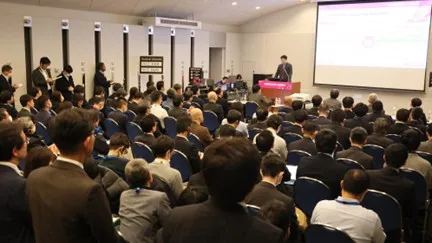
Strong audience turnout at the Session, with the venue filled to capacity
A Common Key Emerged Through Discussion
One of the most notable outcomes of the session was that, despite differences in perspective among users, suppliers, and industry groups, the discussion naturally converged on a shared conclusion.
To implement and scale Smart Manufacturing in practice, common frameworks are essential—particularly in areas such as safety requirements for human–robot coexistence, communication and data specifications across systems, and standardized equipment interfaces and modularization. As a result of the discussion, participants reached a shared understanding that standardization is an indispensable enabler for advancing Smart Manufacturing.
Importantly, standardization was not positioned as an explicit objective at the outset of the session. Rather, it emerged organically as the key factor that could not be avoided once real operational challenges were examined across different viewpoints.
Next Steps: Moving Toward Concrete Standardization Activities
Building on the shared understanding fostered through this session, activities are now underway within the SEMI Standards framework to organize Smart Manufacturing–related challenges and initiate Task Force (TF) activities focused on practical, implementation-driven topics.
The Smart Manufacturing Session at SEMICON Japan 2025 was therefore not an endpoint, but a meaningful starting point—connecting real-world challenges to concrete next steps toward industry-wide collaboration and standardization.
Get Involved
SEMI Standards development activities take place throughout the year in all major manufacturing regions. To get involved, join the SEMI International Standards Program at: www.semi.org/standardsmembership.
For more information, please visit our main Web site and current events page. If you have any questions regarding SEMI Standards activities, please contact your local SEMI Standards staff.
Standards Watch
SEMI
www.semi.org
April 16, 2026