

Unlocking Equipment Data Potential: Introducing New SEMI Standards from the Equipment Data Publication (EDP) Task Force
By Jae Yong Park , Tata Electronics, Shuba Viswanath, UNISERS, and Albert Fuchigami, PEER Group
Big Data from semiconductor equipment and its subcomponents – such as chillers, sensors, and chambers – is critical for Integrated Device Manufacturers (IDMs) to effectively perform online and offline analysis.
Despite the immense volume of data being generated, studies show a startling gap; less than 30 per cent of available equipment parameters are actively utilized within advanced node fabs (J. Park, "The SEMI Equipment Data Publication (EDP) Task Force Initiative", APCSM 2023). What’s more, the semiconductor industry recognizes and utilizes only a limited subset of this vast amount of data.
Unlocking the full potential of equipment-generated data requires industry-wide collaboration to define comprehensive standards that will enable the seamless access, categorization, and utilization of all available data. Once realized, productivity, transparency, and innovation across semiconductor manufacturing will be significantly enhanced.
To help achieve this, the North America Equipment Data Publication (EDP) Task Force under the North America Information & Control (I&C) Technical Committee is developing a new set of SEMI® Standards to define the infrastructure to facilitate this work. SEMI E190 – Specification for Equipment Data Publication (EDP) is the core standard that provides a framework for equipment suppliers on how they can categorize equipment data for specific components on their manufacturing equipment and the minimum set of data that needs to be supported.
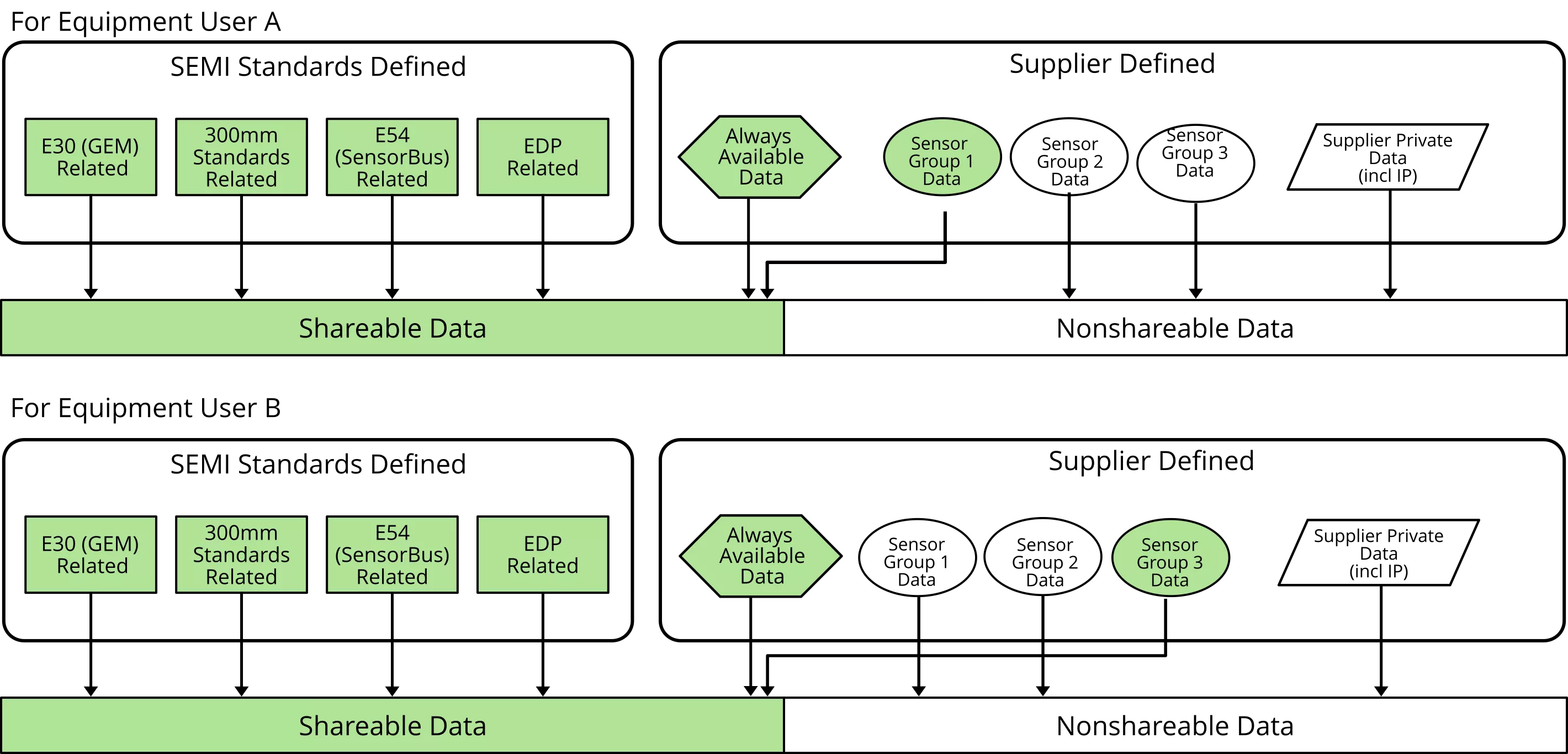
Debates over who should have access to data from the equipment are common. A key element of this new standard is the definition of shareable and nonshareable data concepts. This provides a framework that equipment suppliers and equipment users can use for their discussions about who has access to what equipment data.
- Shareable Data – Accessible from the manufacturing equipment through software interfaces (streaming interfaces and local data sources).
- Nonshareable Data – Equipment data that is not shareable; equipment supplier does not make this data accessible to the equipment user. This data can include the supplier’s private information, intellectual property (IP) and information that is only accessible through graphical user interfaces (GUIs) and hardware instrument panels.
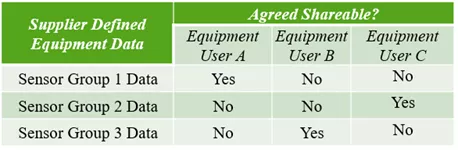
Equipment suppliers and each equipment user negotiate what equipment data is considered shareable and nonshareable through agreements between these two entities.
For example, an equipment supplier has an agreement with Equipment User A to share data from Sensor Group 1. That data, along with all other shareable data, is included in the Shareable Data bucket, along with data defined by various SEMI Standards that the equipment supports, such as SEMI E30 (GEM), 300mm Standards, and EDP-related Standards. However, the equipment supplier does not have a similar agreement with Equipment User B, so Sensor Group 1 Data is not included in the Shareable Data for Equipment User B.
Another challenge for equipment users is the volume of data that the equipment supplier can expose to the equipment user. For example, there may be 5,000 parameters accessible for a particular chamber type. There can be a lot of back and forth by the equipment user to understand which of these parameters are of interest to them. SEMI E190 Subordinate Standards define standard Category Levels for a particular component type to help everyone understand how the data is grouped and the data’s relationship to each other.
For example, the new SEMI E190.1 – Specification for Common Data for Etch Components, defines top-most Level 1 categories such as Optical Emissions Spectroscopy (OES), Plasma, Gas and Temperature. An equipment supplier can document the accessible data from an etch component into these Level 1 categories, and if appropriate, group them into more detailed Category Levels defined by the SEMI Specification, e.g., Level 1 OES data could be further grouped into Level 2 Raw Wavelength and Level 2 EndPoint Detection categories. This categorization of data helps everyone understand what type of equipment data is available, without having to list every possible variable.
The EDP Task Force continues to expand SEMI E190.1 and develop additional subordinate standards to support deposition and common tool platform functionalities. We invite industry stakeholders to actively participate in shaping these crucial standards. Your involvement can directly influence advancements that improve efficiency, transparency, and innovation across semiconductor manufacturing. Please join us in this important collaborative effort.
Get Involved
SEMI Standards development activities take place throughout the year in all major manufacturing regions. To get involved, join the SEMI International Standards Program at: https://www.semi.org/standardsmembership
For more information, please visit the Standards website and events page. If you have any questions regarding SEMI Standards activities, please contact your local SEMI Standards staff.
Authors

Dr. Jae Yong Park is the Vice President and Head of AI & Smart Manufacturing at Tata Electronics. With over 25 years of extensive experience as an AI and process control expert in the semiconductor industry, he leads fab-wide data analytics and AI/ML solution development to enhance process and equipment control through advanced analytics and machine learning techniques. Actively involved in the SEMI Standards community, Dr. Park co-leads the SEMI Equipment Data Publication (EDP) Task Force and serves as Chair of the Smart Manufacturing Group at SEMI Korea. He is committed to driving innovation and standards adoption to optimize manufacturing operations and promote the widespread integration of AI-driven smart manufacturing solutions.

Shuba Viswanath is a product manager at UNISERS. She has been in the semiconductor industry for over 26 years focusing on automation enablement for manufacturing and the backend Assembly. She has led the integration of several analytics & AI solutions in the factories for yield improvements. She is actively engaged in SEMI standards community and was co-leading the Equipment Data Publication Task Force (EDP TF) to establish standards for equipment data access. She is passionate about establishing and driving industry adoption of standards.

Albert Fuchigami is a Senior Standards Specialist at PEER Group. He is active in the SEMI Standards Program, co-chairs the North America Information & Control (I&C) Technical Committee, and co-leads the Data Diagnostic Acquisition (DDA) Task Force. Fuchigami enjoys demonstrating how standards provide factory host systems with a way to optimize their operations through automation and cybersecurity resilience. He is a champion for integrating HTTP/2 with gRPC and Protocol Buffers technology into the Equipment Data Acquisition (EDA) / Interface A standards.
Standards Watch
SEMI
www.semi.org
April 17, 2025