

Interest Survey for EMI Workshop
Take the survey here!
By: Vladimir Kraz (OnFILTER) and Michelle Sun (SEMI)
As demand continues to grow for more compact chips with smaller and denser internal structures, so does the chip’s susceptibility to electromagnetic interference (EMI) due to faster device speeds, smaller signals and the higher degree of precision required for automated handling equipment.
Left unchecked, EMI can cause a number of issues, from equipment malfunction to errors in data communication to device damage due to noise from motors, actuators, power supplies, and other external factors. This issue is particularly prevalent in testing, where EMI can cause signal artifacts, resulting in false positives. Even in cases where the noise is not severe enough to interfere with tests, EMI may still decrease productivity, as additional efforts would be needed to isolate any crosstalk before analyzing the results. Outside of test, EMI is also cited as one of the strongest sources for electrical overstress (EOS), which is “the number one cause of damage to IC components” according to the Intel® Manufacturing Enabling Guide.
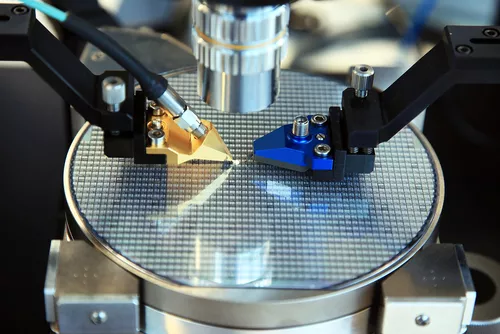 In response, several regulations have been put in place to ensure that individual equipment does not disrupt neighboring devices. Of these, the most well-known is probably the European EMC Directive, which features a comprehensive set of technical requirements for electromagnetic emission and immunity. While this Directive is flexible in that it is not tied to any specific device or application, its effectiveness can be somewhat limited in situations involving complex power and ground networks, as is often the case for most automated semiconductor facilities. Therefore, technical experts at SEMI Standards, using guidance from IRDS (International Roadmap for Devices and Systems) developed SEMI E176, Guide to Assess and Minimize Electromagnetic Interference (EMI) in a Semiconductor Manufacturing Environment. This document addresses EMI on a factory level, providing practical and effective guidance for assessing the EMI environment and implementing mitigation strategies. With this guide, readers will be well on their way to becoming proficient at identifying key EMI issues and will be equipped to meet specific numeric goals for establishing safe EMI environments at a factory.
On December 18, 2023, an overview webinar was held to introduce the concept of EMI, as well as the solutions proposed by SEMI E176. (For those who were not able to participate or would like a recap, the recording is available to view here. The password is: EMISTANDARDS2023). Given the high level of attendance, SEMI is considering offering a more in-depth course which will cover engineering-level topics about EMI in the semiconductor manufacturing space, including:
- EMI Influence on Semiconductor Manufacturing
- Reduction of EMI in Equipment and Factory Level Installations
- EMI Management in the Semiconductor Manufacturing Process
To help us shape our course offering, we have created a survey to assess the level of interest. The workshop would take place either at SEMI Headquarters in Milpitas or at SEMICON West, depending on the number of responses.
We look forward to hearing from you about your interest in this exciting new course.
Get Involved
SEMI Standards development activities take place throughout the year in all major manufacturing regions. To get involved, join the SEMI International Standards Program at: www.semi.org/standardsmembership.
For more information, please visit our main Web site and current events page. If you have any questions regarding SEMI Standards activities, please contact your local SEMI Standards staff.
Standards Watch
SEMI
www.semi.org
March 7, 2024