

New Activity Proposed for Measuring Surface Particle Contamination on Critical Chamber Components
By Yitzhak Vanek (Persys), Pedro Godoy (Teilch), and Michelle Sun (SEMI)
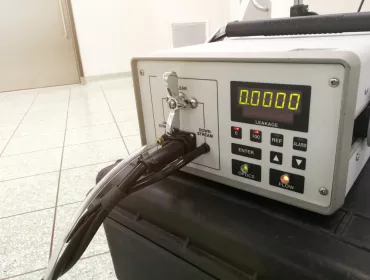 Particle contamination in critical chamber components (CCC) for different process modules, including manufacturing equipment and inspection tools, can have significant negative effects on production yield, reliability, and lifetime of the semiconductor production device. To successfully reduce the amount of particles deposition on critical components, an important first step is to identify potential contamination sources by isolating and studying the types of particles found in the chamber. While liquid particle counting (LPC) has an established reputation, there are several limitations associated with liquid sampling solutions. Hence, an airborne-based sampling and analysis method has been put forth.
Proposed by Yitzhak Vanek (Persys) and Pedro Godoy (Teilch), this new method utilizes air jets to aerosolize particulate contaminants from various surfaces within a dry sampling chamber or portable probe. Once airborne, the particles can then be counted by airborne particle counters (APC) attached to the chamber or probe. The results are reported as an absolute particle count with a time profile of particulate contaminant release.
Since aerosolizing media is either clean dry air (CDA) or nitrogen and liquid submersion is not needed to dislodge the particles, this makes it an ideal non-destructive method for testing finished assemblies, graphite parts, and other objects with porous coatings which cannot be tested by liquid-based methods. Nonetheless, depending on the methodology and particle counter sensors used, it stills offers a high percentage of particulate contamination removal with a range of particle detection from 10 nm to 10µm.
During the Fall North America Standards Meetings, the method was proposed as a new activity at the Metrics North America Technical Committee Chapter Meeting on November 9, 2023. If you would like to participate in the development of SEMI Draft Document 7167, new activity proposed for measuring surface particle contamination on critical chamber components, please contact Michelle Sun at [email protected].


Authors: Yitzhak Vanek, Persys (left) and Pedro Godoy, Teilch (right)
Get Involved
SEMI Standards development activities take place throughout the year in all major manufacturing regions. To get involved, join the SEMI International Standards Program at: www.semi.org/standardsmembership.
For more information, please visit our main Web site and current events page. If you have any questions regarding SEMI Standards activities, please contact your local SEMI Standards staff.
Standards Watch
SEMI
www.semi.org
December 18, 2023