

A Further Look at NISO and the Standards Tag Suite
By Tim Turley, SEMI
In the last Standards Watch newsletter, I mentioned the work of ISO-chartered NISO to develop Standards for Standards, and in this article, I thought I would review NISO’s Standards Tag Suite (STS) and look at how SEMI might leverage this specification to increase its own Standards sales.
First a little history on how NISO and the STS standard evolved.
Around 2010, ISO was in the midst of trying to improve its internal workflow for publications bottlenecks caused by the cumbersome process of converting Word documents to PDFs, often causing publishing times in excess of six months. The goal was to decrease the time-to-publish and enable publishing in multiple formats (PDF, HTML, and EPUB). This resulted in a project to look at ways to leverage open document types based on XML (extensible markup language) and led to an internal specification referred to as ISOSTS—ISO Standards Tag Suite—defining data types for titles, sections, and reference links that are common to all types of Standards documents.
Next, ISO added conventions for document schemas (formats) in the so-called Journal Article Tag suite (JATS), which basically defines the structure of a Standards document so they can be easily shared. Finally, in the last step, NISO was founded with the charter to merge ISOSTS and JATS into a formal Standard—NISO Standards Tag Suite 1.0— published in 2017.
At a high level, the STS Standard defines document elements and schema using XML.
What is the advantage of XML-based documents? One advantage is XML allows the separation of content and style, meaning documents are stored as metadata, which can easily be converted to another document file type such as PDF, DOC, or EPUB.
Another advantage of XML is the metadata tags enable rich search capabilities. Basically, anything defined with an XML tag in a document, can be searched using HTML queries. This is useful for enhancing content’s Internet presence through search engine optimization (SEO) by exposing key metadata tags to Web bots that build searchable indexes.
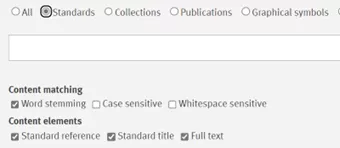
Another use of XML based documents is building a searchable document database. One example is the one ISO developed for their Internet portal for Standards— the Online Browsing Platform (OBP), which enables advanced searches for Standards using content matching on words and XML elements.
Another way XML comes into play is the interlinking of Standards within an SDO and to others. This is especially useful when Standards from different organizations are used together. Inter-standard linking allows users to access referenced Standards using tagged links.
Here’s an example of referencing another Standard in an XML document using the NISO STS tags— reference <ref> and Standards <std>.
<ref><std> // defines a reference and standard type
<std-ref>ISO 2041:1990</std-ref> // defines the particular Standard being referenced
</std></ref> // closing tags
Given these capabilities, it may be worth investigating how metadata tags could enhance SEMI Standards usage through:
- Linking SEMI Standards to other related standards to enhance cross-referencing.
- The use of links to form bundles of SEMI Standards that are commonly purchased together.
- Defining STS keyword tags in SEMI documents that would increase their searchability (SEO index).
In summary, the NISO STS has become a mature Standard defining metadata and the structure of Standards documents, and SEMI may be able to leverage a portion of this specification to increase the marketability of its documents. We welcome your comments on this article and exploring other innovative ways of optimizing your standards usage.
Get Involved
SEMI Standards development activities take place throughout the year in all major manufacturing regions. To get involved, join the SEMI International Standards Program at www.semi.org/standardsmembership.
For more information, please visit our main Web site and current events page. If you have any questions regarding SEMI Standards activities, please contact your local SEMI Standards staff.
Standards Watch
SEMI
www.semi.org
September 1, 2022