
Newly Published Standard on Data Sharing and Streaming
By Mark Roos, co-leader of the Rich Interactive Test Database (RITdb) Task Force, Roos Instruments
The first Rich Interactive Test Database (RITdb) Standard from the RITdb Task Force of the Automated Test Equipment Committee has been published. Titled SEMI E183, Specification for Rich Interactive Test Database (RITdb), this Standard describes a framework for transmitting live data and events for semiconductor test and related operations.
The RITdb effort started in 2010 when a group of seventy people met at to discuss the future of test cells. After a few meetings an initial model for transferring data was created. Along with STDF+, HSEM, TSEM, PSEM and E142 were referenced as tools for the data interchange. A key goal was to allow the plug and play of features without the barriers of proprietary interfaces and systems.
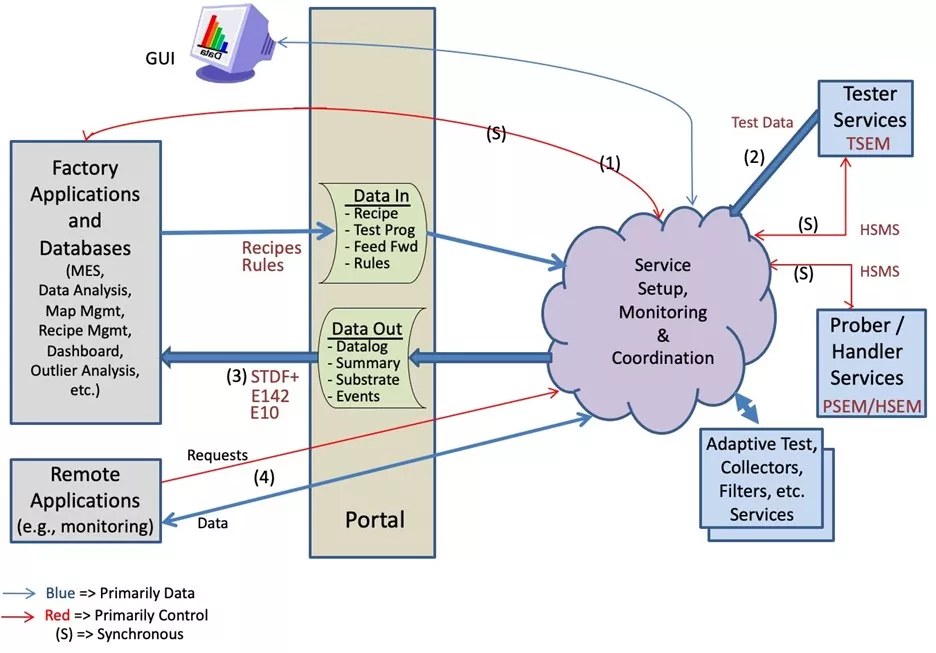
Following a survey this group decided to form two Task Forces: the RITdb Task Force for handling data and the Test Cell Communications Task Force for handling communications. In order to better understand user requirements, especially those pertaining to the support of adaptive tests, members of the newly formed RITdb Task Force decided to join the ITRS (now HIR) adaptive test working group. From there they learned of two requirements: the breadth of data required and the need for low latency.
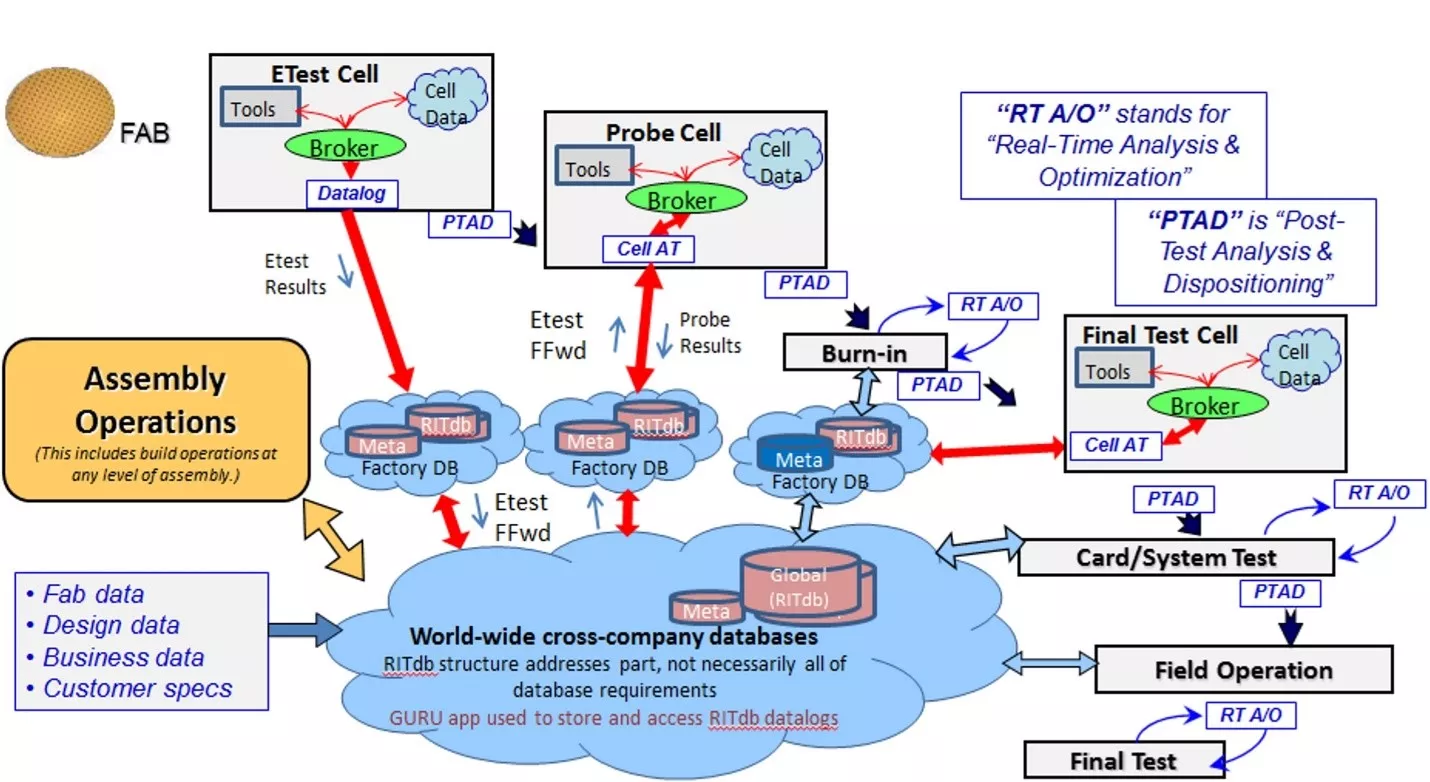
The next two slides are based on the adaptive test white paper.
First, we see that data from all steps, in both forwards and reverse direction are necessary. There is an implied need to share which includes issues of security, data matching and trust. From this first drawing came the definition of the RITdb containers, standardized holders of data combined with identifying metadata.
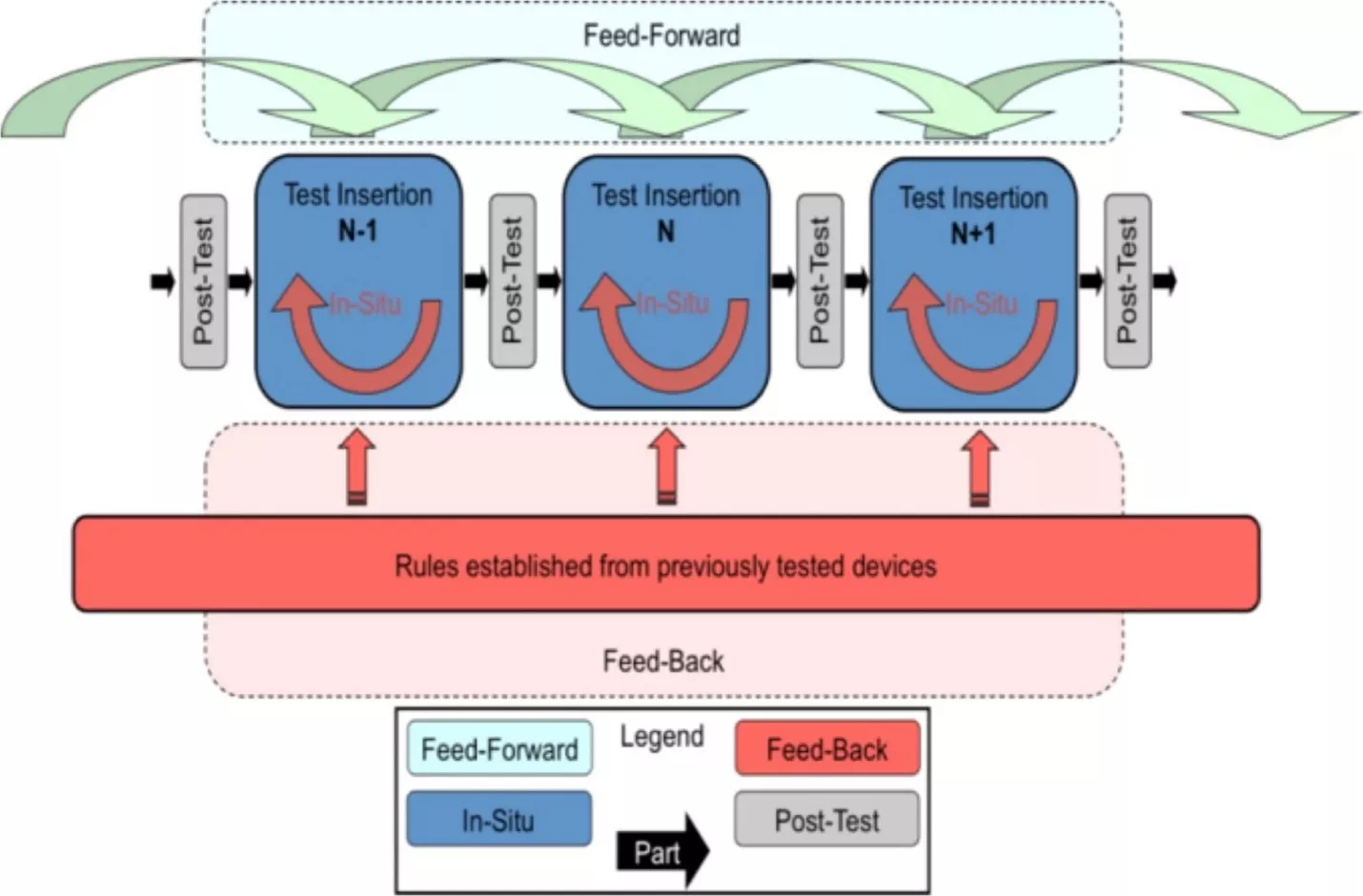
The next figure shows the real time nature of adaptive test. Data flows both with the devices and from device history to each test insertion. Decisions are made per device and per batch. From this we added the ability to stream RITdb containers. This would match the current paradigm of maintaining the flow of data as streams and windows (in motion and at rest).
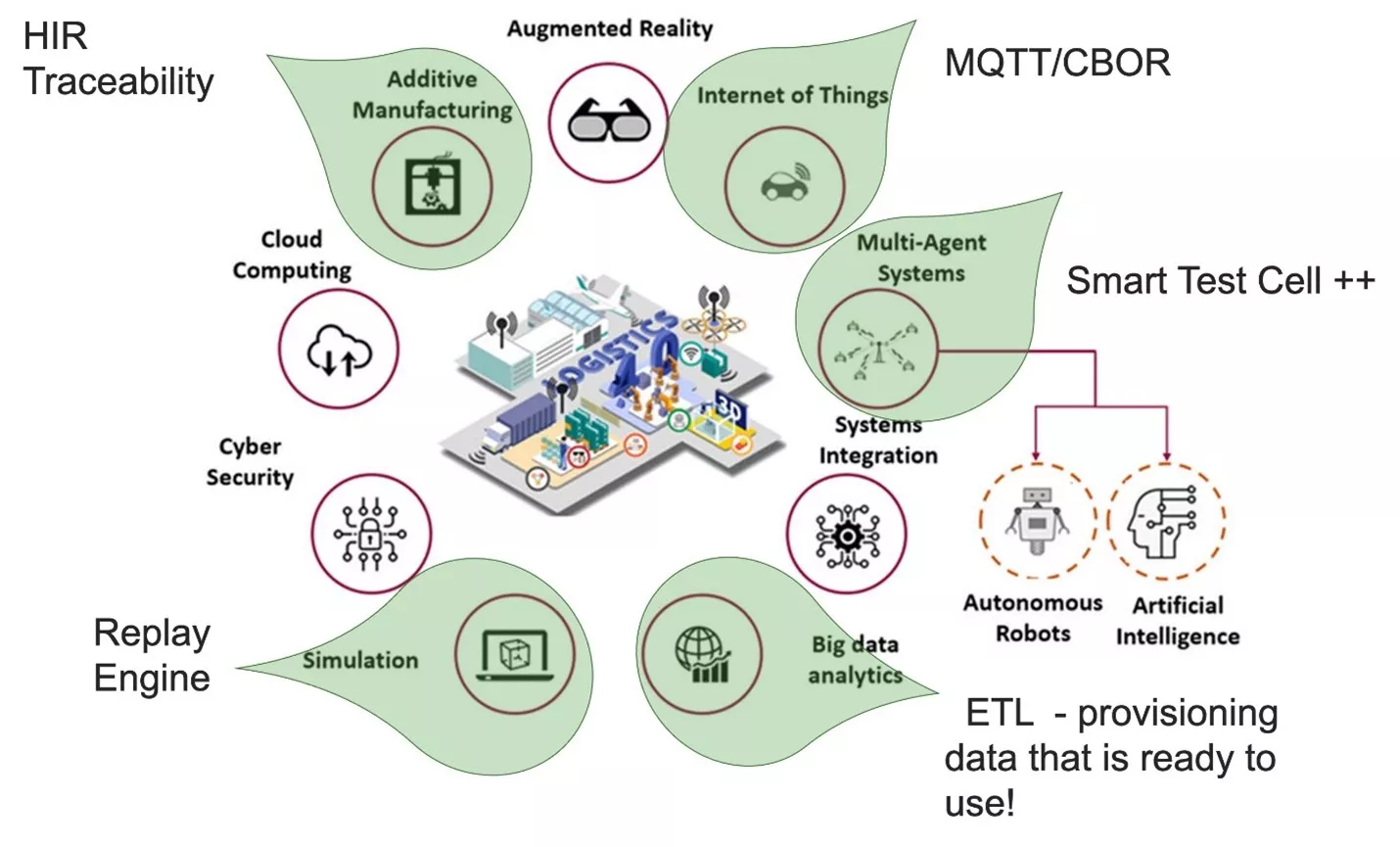
At this point, around 2019 or so, Smart Manufacturing was starting to become a buzz word. The RITdb Task Force had to review the RITdb design and ensure it could support the needs of a smart manufacturing test operation. This led them to embrace the need for machine-to-machine internet of things (M2M-IOT) as a core capability of the design, as well as MQTT and CBOR as the means for communication. This decision effectively removed the need for a test cell communications task force.
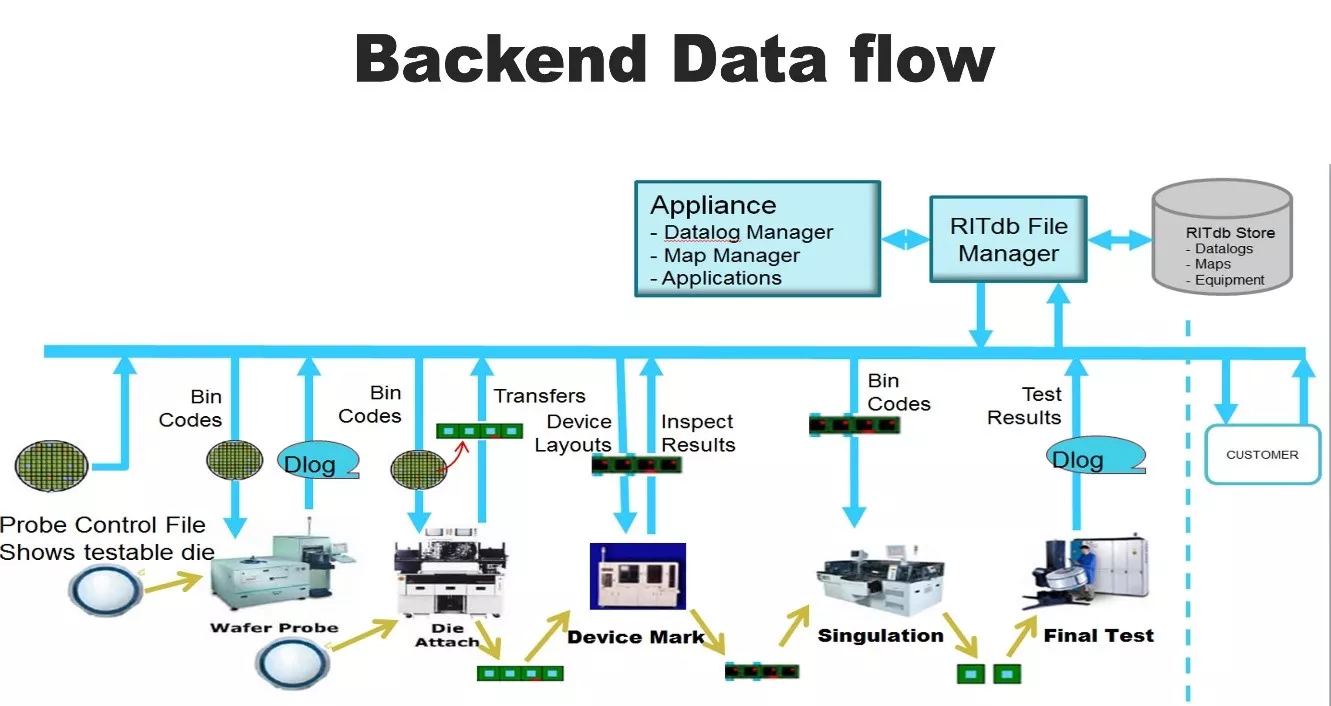
Now that we have a basic design in place we needed to step back and look at how it overlays with a typical test floor. The first thing we notice is that test is not a standalone function. Test is spread between various other process steps which can be at different locations. With this we discover that just handling test related data and events is not enough (see the above diagram) and so we are now evaluating how to interconnect these steps. Below is a high-level view of a typical assembly and test floor. Currently each step has its own data formats and event types. The diagram is simple as it does not show parametric test, burnin or SLT.
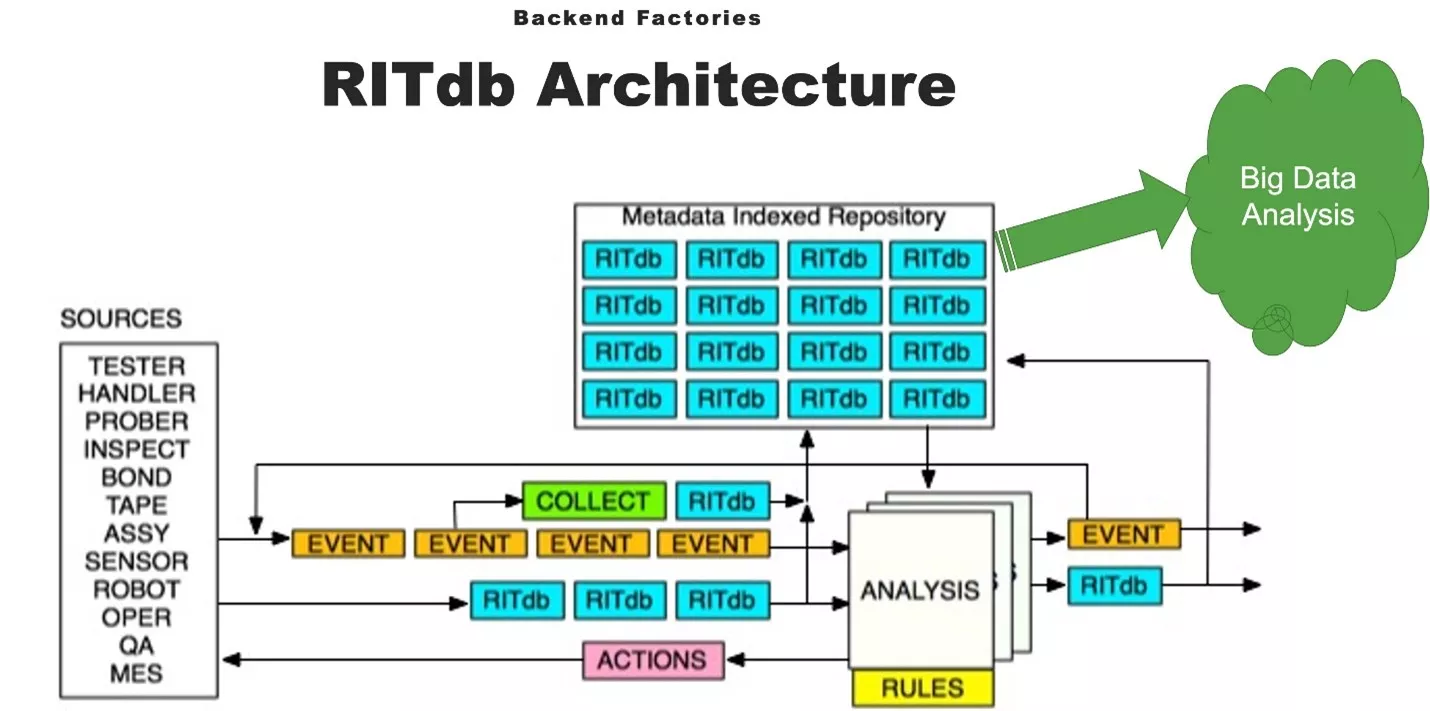
The current proposal is to use the RITdb container concept (metadata indexed repository) along with a wide selection of events. Based on the above discussion we arrived at the current high-level diagram for a RITdb supported environment shown below. A key contribution is to support rule monitors. Rule monitors are expert systems which can make decisions in real time based on events and history. For this we need to have access to everything in a machine understandable manner.
Benefits
With this Standard, the SEMI RITdb Task Force hopes to enable real-time notifications on the test cell, which can be monitored remotely as well as on location. It would support new data types as they appear while also maintaining backward compatibility with the existing formats such as SEMI G85, SEMI E142 and STDF. Most importantly, the Task Force hopes to present a modern high-performance, royalty-free, open format that does not require special tools to generate and consume. It is well known that a major stumbling block of the sharing and usage of data is in acquiring data which is both appropriate to the analysis and of good quality. This initial step, referred to as ETL (extract, transform load) can use up to 75% of a data projects person power. RITdb addresses this inefficiency by providing a standard means to collect, validate, and share semiconductor test operations data. Not only does RITdb allow data engineers to work more efficiently, but it also provides the data more quickly than before, enabling real time decision-making.
Get Involved
SEMI Standards development activities take place throughout the year in all major manufacturing regions. To get involved, join the SEMI International Standards Program at: www.semi.org/standardsmembership.
For more information, please visit our main Web site and current events page. If you have any questions regarding SEMI Standards activities, please contact your local SEMI Standards staff.
Standards Watch
SEMI
www.semi.org
March 7, 2022