

Newly Published Standards Supporting Water Reuse
By Paul Kerr (Intel Corporation), Slava Libman (FTD Solutions), and Laura Nguyen (SEMI)
Two recently published standards from the SEMI Standards Liquid Chemicals North America Global Technical Committee and its Task Forces, show again that there is still new territory to cultivate within the industry’s need for documented methods and guidelines for water conservation and reuse. As the effects of climate change start to bite around the globe, this is severely impacting both the availability of water and the costs associated with providing the large volumes of water to sustain semiconductor manufacturing facilities. A new standard, SEMI F116, Guide for Drain Segregation for Semiconductor Manufacturing Tools to Support Site Water Reuse, was published in August 2021, to provide guidance on how to incorporate wastewater segregation and water reuse and recycle into semiconductor tool and facility design. Existing standard SEMI F98, Guide for Treatment of Reuse Water in Semiconductor Processing, recently underwent revision in May 2021 to provide overarching guidance on the water management and reuse strategies that can be adopted to reduce a facility’s water footprint, as well as methods and indicators for benchmarking water usage at a semiconductor facility.
Why Are These New Standards Needed?
Water Management Challenges: water is a precious resource and access to readily available water is becoming a significant challenge, a fact starkly demonstrated by the severe droughts experienced this past year in Taiwan and the Western United States, locations which are home to large and growing semiconductor facilities. This is exacerbating the already significant challenges the industry is facing in the sphere of water management. Advanced fabs are become progressively more complex; new and exotic chemistries are being qualified to support manufacturing; environmental compliance requirements are becoming more stringent; external and internal infrastructure is becoming more constrained at mega-sites; pressure of time to market for products is increasing, driving fast paced construction and problem solving – all these factors require intelligent data driven solutions for water conservation measures.
The SEMI Standards Water Management Task Force conducted an extensive survey across the industry and found that there were significant differences in the approach to water management, including how goals were set, how data was managed, how decisions were made, how specifications were developed, and the approach to conserve or reuse water at facility and tool level.
The industry needs to develop consistent and reliable water conservation practices and solutions, whilst ensuring high quality and reliability of factory operations and remaining within the site’s boundary conditions (compliance with environmental limits, reaching water conservation goals, within system and infrastructure capacities, and budgetary restrictions). Balancing these requirements is a major challenge for semiconductor facility engineers and managers.
How the New Standards Address These Challenges
SEMI F98 provides high level strategy recommendations for water management and conservation, including Key Performance Indicators, typical solutions, consistent terminology, etc.
SEMI F116 addresses the standardization for provisions enabling water conservation at the tool level: segregation and POU treatment/recycling. The standard includes the following chapters:
- Water Conservation Strategy Implications – determining if a centralized or decentralized system meets business needs, and how to integrate the system into the facility.
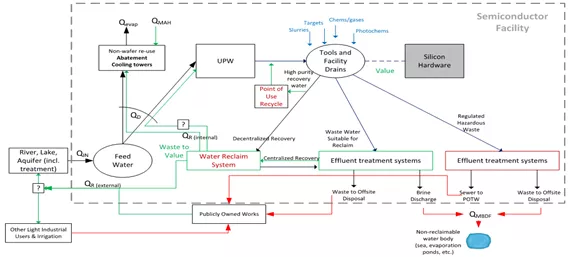
- Implication of Tool States on Water Conservation Strategy – The quality and quantity of the water available for reuse or recycle from the tool or equipment depends on its state of operation.
- Metrics and Measurement of the Useful Water Consumption and reuse by the Tool – Which quality parameters to measure in water streams considered for reuse or recycle, and how to measure them.
- Scope and the Basis of Design for Engineering of the Water Reuse Systems
- Capability (performance expectations) of the Reuse or Recycle System
- Engineering Deliverables – Documentation enabling integration of water reuse.
- Labeling – Best practices for communicating piping and equipment contents, hazards, and other key process information.
- Sample Ports and Sampling Recommendations – Sampling methods are an important consideration for water quality monitoring of a waste reuse system.
- Risk Management – Measures and strategies required to mitigate potential hazards and risks arising from water reuse or recycle.
- Commissioning Considerations – Including a commissioning plan during design and streamlining its execution to support facility needs and project timelines.
- Training – Guide to determine the training necessary for all affected operators, engineers, and managers to ensure safe and reliable system operation.
The SEMI Standards Water Management TF believes that use of these two standards will streamline decision-making and will help facilities to meet numerous operations and construction challenges, if used early enough in the planning of the future and upgraded water systems.
Get Involved
SEMI Standards development activities take place throughout the year in all major manufacturing regions. To get involved, join the SEMI International Standards Program at: www.semi.org/standardsmembership.
For more information, please visit our main Web site and current events page. If you have any questions regarding SEMI Standards activities, please contact your local SEMI Standards staff.
Standards Watch
SEMI
www.semi.org
September 2, 2021