

New Curvilinear Format Task Force
By Kevin Nguyen, SEMI
For years, the advanced integrated circuit (IC) manufacturing industry has been relying on SEMI P39, Specification for OASIS® – Open Artwork System Interchange Standard as the standard data format for integrated circuit mask layout information.
Today’s masks, including those based on optical and extreme ultraviolet (EUV) lithography, contain tiny rectangular features, so-called “Manhattans”. Currently, SEMI P39 is widely used for Manhattan shapes. In some cases, photomasks have simple curve or rectilinear shapes.
At advanced nodes 7nm and beyond, however, chipmakers want more advanced masks to more efficiently capture curvilinear shapes on circuit layouts.
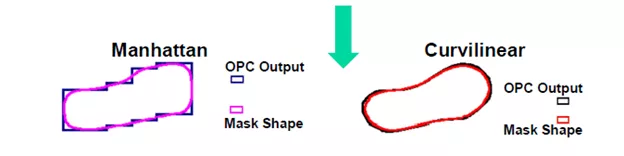
At the July 14, 2021 Microlithography NA TC Chapter meeting, a major effort was proposed by Siemens to formalize a new task force (TF) for Curvilinear Format. This TF is led by the largest chip makers in the world (i.e., TSMC, Intel, and Samsung). The goal is to develop a new Specification for Improved Curvilinear Layout Representation (Draft Doc 6821). Electronic Design Automation software providers, e-beam writers, mask suppliers, tool suppliers, and foundries including ASML, Synopsys, D2S, NCS, and ASELTA have also joined this TF.
Adopting complex curvilinear shapes on advanced photomasks using inverse lithography technology (ILT) will not only provide the accuracy on the pattern fidelity, but also enable the most difficult features, such as tiny contacts in IC designs. A majority of the members support the curvilinear format, but a few have concerns on the increased data volume required, as much as 20x more than for the traditional Manhattan mask, posing a challenge for data storage as well as computing power.
The challenging task will be developing an acceptable curvilinear method. Initial discussion reveals b-spline, Bezier, curvilinear path, and other approaches to be considered. The TF will discuss further details with members in upcoming meetings.
The ultimate goal is to develop a curvilinear file format extension to SEMI P39. It will not only be backward compatible but will also aim to avoid disruption to the existing supply chain including mask suppliers, EDA makers, and tool vendors.
If you would like to participate in the SEMI Standards Curvilinear Format Task Force, please contact Kevin Nguyen at [email protected].
Get Involved
SEMI Standards development activities take place throughout the year in all major manufacturing regions. To get involved, join the SEMI International Standards Program at: www.semi.org/standardsmembership.
For more information, please visit our main Web site and current events page. If you have any questions regarding SEMI Standards activities, please contact your local SEMI Standards staff.
Standards Watch
SEMI
www.semi.org
September 2, 2021