

Stream 21 Messages Are Coming to SECS/GEM Standards
By Albert Fuchigami, The PEER Group
More sophisticated fab data requirements and equipment configurations have led to rapid growth in the data transfers between the Factory Automation (FA) host and tools.
When SEMI E5 (SECS-II) was first published in 1982, only the SEMI E4 (SECS-I) serial communication protocol existed to transfer messages. SEMI E37 (HSMS) was developed later to work over TCP/IP networks and is now the more common of the two protocols. Unfortunately, both of these transmission protocols, as well as the SECS-II standard itself, impose a size limit on the data that can be represented in a single SECS-II data item.
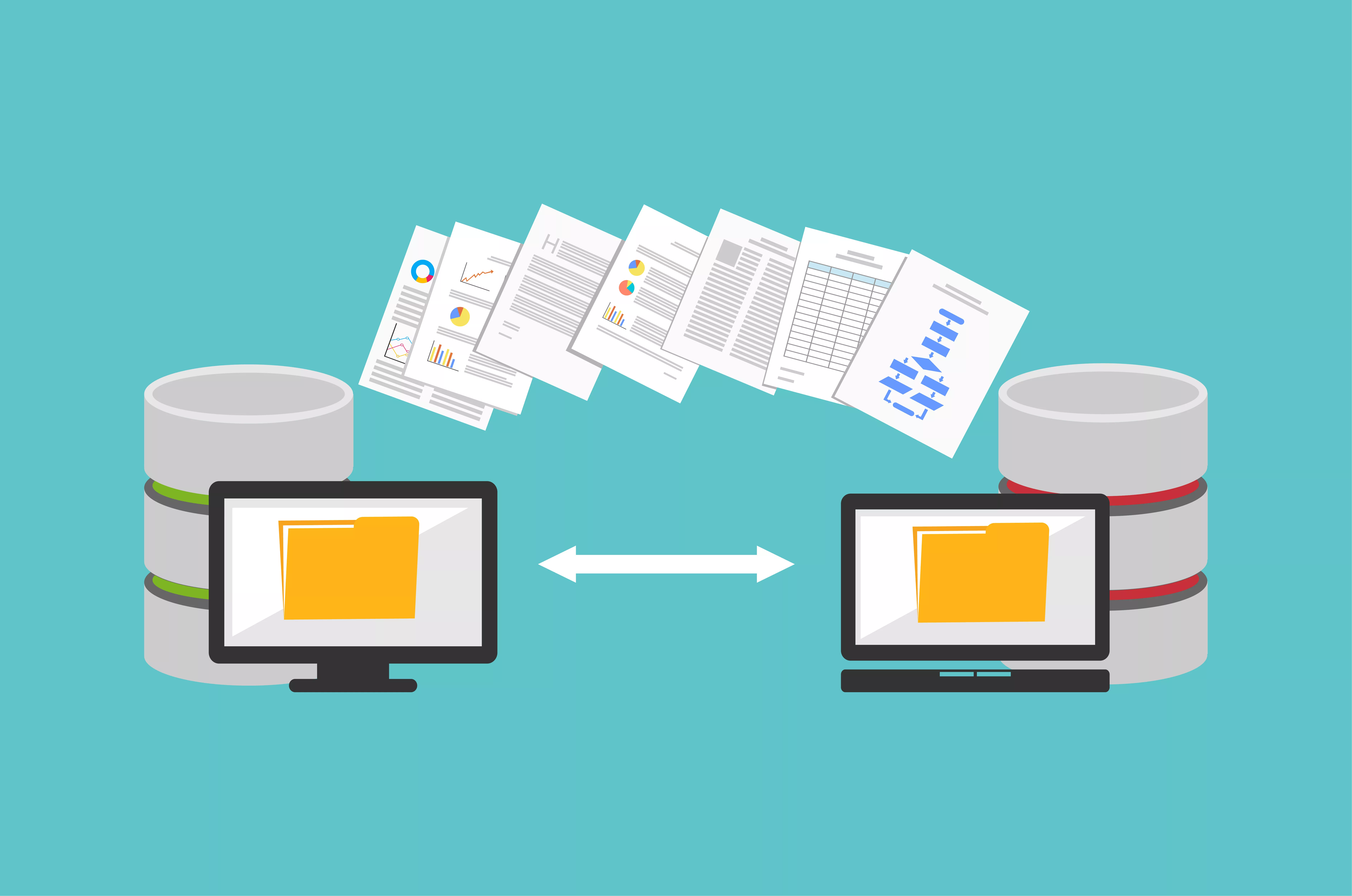
Software applications using SECS-II are running into these size limits more often. To address this issue, SEMI E5-0220 introduced Stream 21 messages to more easily transfer potentially large items. This is accomplished by splitting the item to transfer into smaller pieces that will fit within the 16MB size limit of SECS-II data items. These smaller pieces are stored sequentially in ITEMPART data items in the Stream 21 message. When the receiver gets these messages, they can concatenate the individual ITEMPARTs to restore the original item.
Stream 21 messages can be sent by either the equipment or the host. These messages include an ITEMTYPE value that lets the receiver know what type of item it has received so it knows how to process the data correctly.
Stream 21 messages can be used to send small data, extremely large data, and everything in between. There are two techniques the sender can use to transfer the entire item to the receiver.
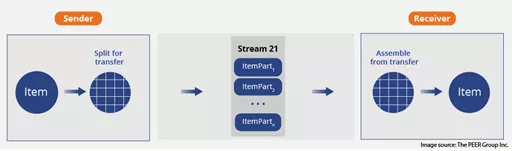
- Single Message Technique – The sender uses one single Stream 21 message to transfer all of the item parts. This approach is easier for both the sender and receiver since they only have to work with one SECS message, but they are still limited to the maximum message size of the underlying transmission protocol, which is approximately 4GB for SEMI E37 (HSMS) and 7.9MB for SEMI E4 (SECS-I). When working with large data, the sender needs to consider the impact to other SECS messages in the queue while this message is being transferred, since the SECS communication channel will be blocked by it.
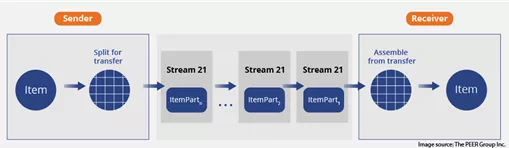
- Multiple Message Technique – The sender uses a separate Stream 21 message to send each item part. This approach requires some more effort by the sender and receiver since they are working with multiple Stream 21 messages, but there are no size limits on the data that can be sent. Recovery scenarios are possible if the receiver asks the sender to retry sending an individual message because it wasn’t successful. Most importantly, by using multiple messages, the SECS channel is not blocked by a single, very large Stream 21 message. This allows other messages to be interleaved, so there is less impact on the SECS messages in the queue behind the Stream 21 messages. This is an important consideration to ensure critical control and information messages are not delayed.
How will Stream 21 messages be leveraged in the real world? Task Forces under the North America Information & Control (I&C) Technical Committee are already working on incorporating Stream 21 into their standards to take advantage of this new functionality. For example,
- The Advanced Backend Factory Integration (ABFI) Task Force is working on a new Subordinate Standard to SEMI E142 that uses Stream 21 to transfer wafer map data. (Ballot 6804A - Revision to Add a New Subordinate Standard: Specification for SECS II Protocol for Substrate Mapping With Item Transfer to SEMI E142-0820: Specification for Substrate Mapping).
- The GEM300 Task Force is working on updates to SEMI E30 to support Stream 21 as an official way to transfer recipes (Ballot 6348 - Revision to SEMI E30-0418: Specification for the Generic Model for Communications and Control of Manufacturing Equipment (GEM)).
As this work progressed, Task Force members found some gaps in the Stream 21 functionality. These were recently addressed in SEMI E5 as part of Ballot 6802 - Line Item Revision to SEMI E5-0220: Specification for SEMI Equipment Communications Standard 2 Message Content (SECS-II). SEMI E5 now defines a new set of Stream 21 messages (S21,F19/F20) that lets the other side of the SECS channel know which Stream 21 features are supported for each ITEMTYPE (single message technique, multiple message technique, listing and deleting ITEMTYPEs, etc.). For example, an implementation may support the Stream 21 Multiple Message Technique for custom substrate result data (ITEMTYPE CUSTOMRESULT), but not for unformatted recipes (ITEMTYPE SEMI:UNFORMATTEDPROCESSPROGRAM).
Many different solutions have attempted to address issues around the high-data needs of complex tools in modern fabs; some develop custom SECS messages built for specific purposes, while others abandon SECS-II messaging for certain capabilities and rely on file transfers or custom communication interfaces. Both approaches can be costly to implement. A generation ago, Stream 13 Data Sets were developed for transferring large amounts of data. Though Data Sets are robust and flexible, they are cumbersome to implement, especially when the data to transfer was just a little bit larger than the 16MB capacity of a SECS-II data item. And while the EDA (Interface A) standards are a great option for pumping out a huge amount of tool-side data, some hosts want to use the SECS channel for this transfer so they don’t need to merge data from a different source using a different communication protocol.
With the introduction of Stream 21 messages, we now have a better way to support bi-directional transmission of large messages through the SECS channel in a consistent, scalable manner, simplifying the integration efforts of both OEMs and factories.
Get Involved
SEMI Standards development activities take place throughout the year in all major manufacturing regions. To get involved, join the SEMI International Standards Program at: www.semi.org/standardsmembership.
For more information, please visit our main Web site and current events page. If you have any questions regarding SEMI Standards activities, please contact your local SEMI Standards staff.
About the Author
Albert Fuchigami is a senior software developer at The PEER Group Inc. He participates actively in the SEMI Standards Program, co-leads the North America Data Diagnostic Acquisition (DDA) Task Force, and contributes to the Information & Control Technical Committee. Albert enjoys demonstrating how standards can maximize data communication with factory host systems. He is a champion for integrating HTTP/2 with gRPC and Protocol Buffers technology into the Equipment Data Acquisition (EDA) standards.
Standards Watch
SEMI
www.semi.org
December 2, 2021