

New Japan Automation Technology Standards Activity
By Albert Fuchigami, PEER Group and Terry Asakawa, VistaIdeal Consulting
As posted on the SEMI Blog in June of this year, SEMI estimates there exist about 80,000 surface mount technology (SMT) and printed circuit board assembly (PCBA) manufacturing lines globally. With that many lines, standards are incredibly important to adding and implementing upgrades and harnessing the power of the data going into and out of the equipment on those lines in the pursuit of efficiency and productivity. SEMI® is developing a suite of standards for assembly line scenarios, like SMT and PCBA. The new SEMI SMT Equipment Link Standards (SEMI SMT-ELS) address Horizontal Communication (HC) between different equipment on the line and Vertical Communication (VC) between equipment and higher-tier hosts (for example, a line controller/equipment host or a factory automation host).
The SMT-ELS Standards suite consists of:
- SEMI A1 – Specification for Production Equipment Smart Connection Interface (PESCI)
This standard handles point-to-point communications and propagation of messages down the equipment line (similar to a bucket relay), as well as simultaneous material and material data transfer between two pieces of equipment next to each other. SEMI A1.1 - Specification for TCP/IP Interface for PESCI outlines how to implement SEMI A1 with TCP/IP. - SEMI A2 – Specification for Surface Mount Assembler Smart Hookup (SMASH)
This standard defines how to apply SEMI A1/A1.1 to an Equipment Host (provided by Placement Equipment Suppliers) and equipment communication, as well as equipment to equipment communication.
At the July 2020 Automation Technology Japan Technical Committee Chapter meeting, the following new activity was formally approved.
This new standard will be developed by the F-GEM Task Force members. It will define an extended use of SEMI A2 SMASH and add extended scenarios and messages to support vertical communications with higher-tier host such as the factory automation, making SMT assembly factory management smarter on the single communication protocol SEMI A1/A1.1.
This new standard will describe the different communication topologies the Factory Host can use to communicate with the line equipment, including when a Local Host is provided by an equipment supplier.
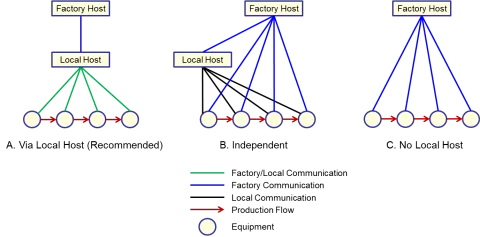
Additional scenarios and messages between the Factory Host and the line to support high level equipment utilization management and panel tracing will be developed. For more information about the SMT-ELS standards, visit the SEMI SMT-ELS website or explore the broader SEMI Standards program.
SEMI Standards activities are open to all interested parties, but you must be a registered SEMI Standards Program Member to participate in SEMI Standards meetings. SEMI Standards Program Membership is independent of the Corporate, Associate or Affiliate SEMI memberships, but participants are encouraged to join to help support this vital work for the continued growth of the industry.
Get Involved
SEMI Standards development activities take place throughout the year in all major manufacturing regions. To get involved, join the SEMI International Standards Program at: www.semi.org/standardsmembership.
For more information please visit our main Web site and current events page. If you have any questions regarding SEMI Standards activities, please contact your local SEMI Standards staff.
Association Contact
Hirofumi Kanno, Manager, Standards & EHS, SEMI Japan Email: [email protected]
About the Authors
Terry Asakawa (Principal, VistaIdeal Consulting) has been involved in developing SEMI Standards for over 25 years, focusing on equipment physical interfaces and communication for semiconductor factories. In recent years, he has turned his focus to communication protocol standards for flow-shop manufacturing. Mr. Asakawa currently co-chairs the Japan Automation Technology Committee and leads the F-GEM Task Force.
Albert Fuchigami is Senior Software Developer, at The PEER Group Inc. He is involved in the SEMI Standards development of SMT-ELS so that the effort takes into consideration the differences between front end processing and flow-based assembly lines in collecting data and communicating with factory host systems. He hopes to identify the different use cases and control scenarios, and help users understand the differences, so they know when SECS/GEM and SMT-ELS standards are appropriate.
Standards Watch
SEMI
www.semi.org
September 10, 2020