

Major Revision to SEMI F104 for Allowable Particles Contribution
By Laura Nguyen, SEMI
Ability to control particles within advanced semiconductor industry is becoming extremely difficult due to limitations of the existing particle metrology. SEMI F104, Test Method for Evaluation of Particle Contribution of Components Used in Ultrapure Water and Liquid Chemical Distribution Systems, is a valuable standard used in the industry for particles control in the critical components.
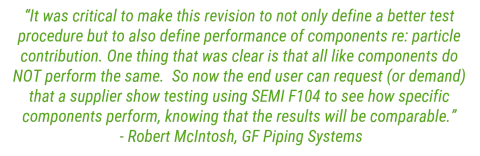
SEMI F104 was completely rewritten for allowable particles contributed by components used in conveying ultra-pure liquids used in the semi-conductor process. The rewrite was to update both the procedure to include larger components than in previous documents and to add testing procedures specific for the larger components as well as add specified values for allowable contributed particles. The significant difference between liquid bulk volume to component surface area when comparing small (1/4”) components to large (2”) components means that there needs to be different protocols in place for testing. Thus, the standard includes specific requirements for flow rates used across the range of parts to be tested. Further clarifications to existing testing procedures and addition of new procedures are incorporated into the revised standard as well as specified values for components across the size range.
The new IRDS (International Roadmap for Devices and Systems) reflects a major shift in device manufacture. Requirements for much tighter control of particles are included in these new requirements for both UPW and UHP chemicals. In the past the specification for measuring system rinse up resided in SEMI F57, Specification for Polymer Materials and Components Used in Ultrapure Water and Liquid Chemical Distribution Systems. The specification for rinse up was written around 100 nm particles. Current process requirements are now at 20 nm and below. Future requirements are in the single digit nanometer range. It was deemed inadequate for current industry needs. It was decided to move the allowable particle contribution specification from SEMI F57 into SEMI F104.
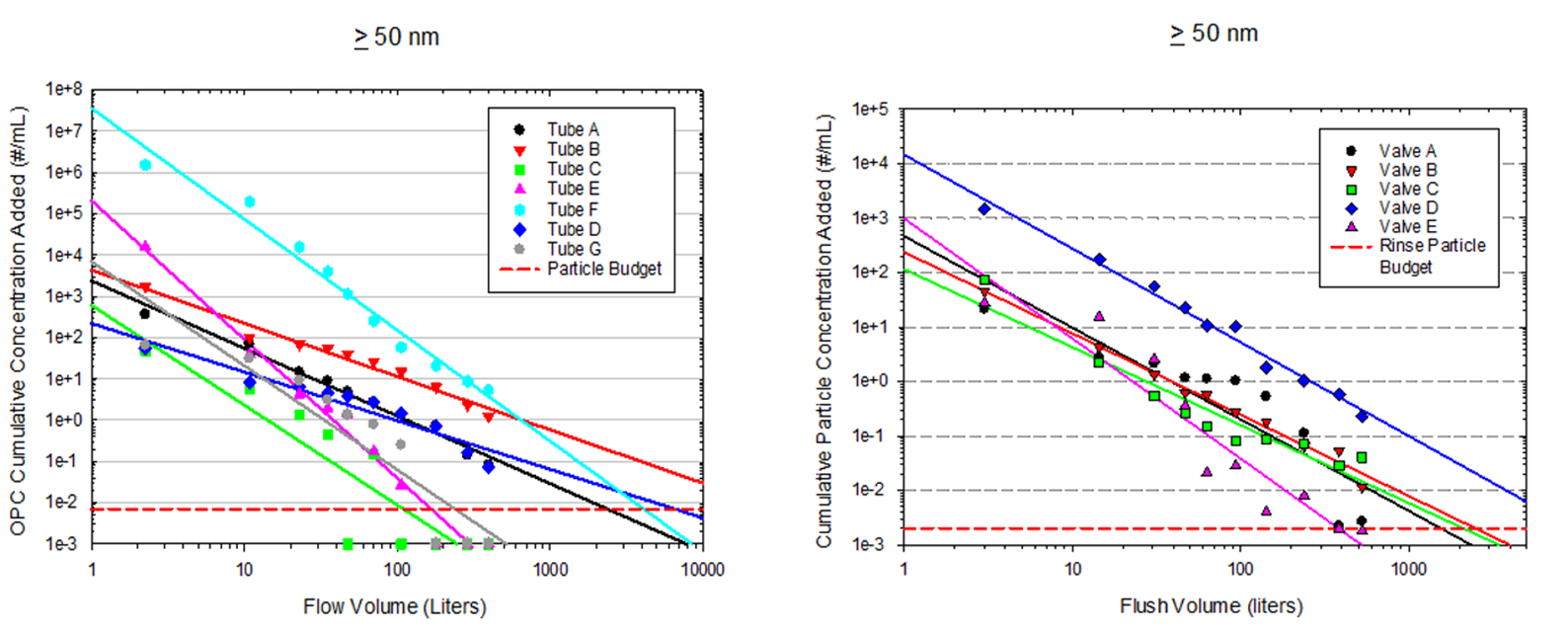
Comparative Results Using SEMI F104
Get Involved
SEMI Standards development activities take place throughout the year in all major manufacturing regions. To get involved, join the SEMI International Standards Program at: www.semi.org/standardsmembership.
For more information please visit our main Web site and current events page. If you have any questions regarding SEMI Standards activities, please contact your local SEMI Standards staff.
Standards Watch
SEMI
www.semi.org
September 10, 2020