

More Data, Faster, with the Next Generation of SEMI Equipment Data Acquisition (EDA) Standards
Delivering high-speed data collection with new technologies for leading edge microelectronics manufacturing facilities
By Albert Fuchigami, PEER Group and Inna Skvortsova, SEMI
COVID-19 changed the world in many ways, including how we consume information and the volume of data we consume, both at a personal level and at an industry level. The demand for Big Data is growing even faster than anticipated and it’s unlikely that it will revert back to previous levels.

In microelectronics manufacturing, this demand was actually expected and identified years ago as a key requirement for Smart Manufacturing (Industry 4.0) and Advanced Process Control. As a result, many leading edge production facilities are currently running in lights-out mode, even while shelter-in-place orders kept factory personnel out of the buildings. This transformation is made possible by continuous investment in equipment automation based on industry standards.
Technology experts within the microelectronics industry are continuously addressing the challenges of Big Data by building upon the foundation of more than 1000 published SEMI Standards. One area of focus is the Equipment Data Acquisition (EDA) Standards Suite, a high-speed data collection framework to gather large volumes of data from manufacturing equipment. As a first step towards boosting EDA capabilities to meet modern throughput requirements, SEMI has published a new standard, SEMI E179-0320: Specification for Protocol Buffers Common Components. This standard was written by the Data Diagnostic Acquisition (DDA) Task Force under the SEMI Information & Control Standards Technical Committee as part of the EDA Freeze 3 development.
New Standard
SEMI E179 is the first SEMI Standard to leverage Protocol Buffers technology, and it is anticipated that other new standards will build upon it. Protocol Buffers is a programming language-neutral Interface Definition Language, making it ideal to share information across different systems and platforms. Protocol Buffers encodes structured data. Smaller and much faster than Extensible Markup Language (XML), it achieves this by using a binary protocol and only sending required data values.
Integrating gRPC® (gRPC Remote Procedure Calls) with Protocol Buffers into the EDA Standards to leverage HTTP/2 technology provides better network performance, more efficient data transfers, and improved computer resource management. HTTP/2 is a major revision to HTTP/1.1, focused on performance. It continues to gain adoption and major cloud vendor services (e.g., Amazon CloudFront® and Microsoft Azure® Content Delivery Network (CDN)) support HTTP/2.
Performance Improvements
Prototype testing demonstrated that the proposed technology (i.e., HTTP/2 with gRPC/Protocol Buffers) has significant performance benefits compared to the existing technologies used today (i.e., HTTP/1.1 using SOAP/XML). One key difference comes from SOAP/XML sending all data over the channel as string text, which is not as efficient as sending it in a binary format.
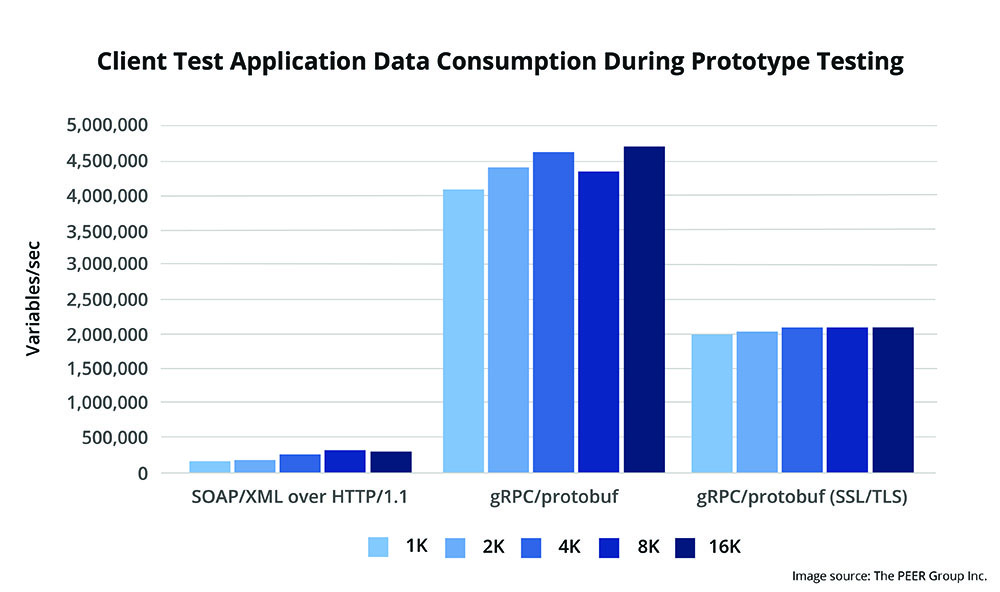
gRPC takes the neutral interfaces defined with Protocol Buffers and creates programing language-specific components that can be integrated into implementations. These components look after serializing and deserializing messages sent over the communication channel per the gRPC, Protocol Buffers and HTTP/2 protocols, letting implementers focus on their core functionality. gRPC supports most major development languages and platforms. Major gRPC adopters include SalesForce® and Google® among others, illustrating that this technology is already being deployed en masse in several industries.
Moving Forward
In addition to integrating gRPC and Protocol Buffers, the DDA Task Force is also updating other SEMI Standards in the EDA Standards Suite (SEMI E125, E132, E134 and E164) as part of the proposed Freeze 3 to streamline functionality and better reflect customer use cases.
“When EDA Freeze Versions 1 and 2 were developed more than 10 years ago, HTTP/1.1 with SOAP/XML were stable technologies that let different systems components communicate with each other. Since then, technology has advanced significantly, and HTTP/2 with gRPC/Protocol Buffers have reached a level of maturity where deployment at scale is possible for the microelectronics industry,” says Scott Ritchie, Director of Product Engineering, PEER Group®.
Security remains a major factor when transferring data. The cryptographic protocols SSL (Secure Socket Layers) and TLS (Transport Layer Security) provide authentication and data encryption between components operating over a network; they ensure malicious actors cannot read or modify the information transferred. gRPC supports SSL/TLS to protect equipment and factory data in transit, satisfies strong security requirements and makes it scalable for enterprises.
Fast, efficient and secure data exchanges are the foundation to support the industry’s growing appetite for data. HTTP/2 with gRPC and Protocol Buffers provide significant performance benefits and can handle the Big Data challenge. Deployment of standards based on robust technologies is key to meeting the continuously evolving requirements of leading edge microelectronics manufacturers.
Get Involved
SEMI Standards development activities take place throughout the year in all major manufacturing regions. To get involved, join the SEMI International Standards Program at: https://www.semi.org/standardsmembership
For more information please visit our main Web site and current events page. If you have any questions regarding SEMI Standards activities, please contact your local SEMI Standards staff.
About the Author
Albert Fuchigami is a senior software developer at The PEER Group Inc. He participates actively in the SEMI Standards Program, co-leads the North America Data Diagnostic Acquisition (DDA) Task Force, and contributes to the Information & Control Technical Committee. Albert enjoys demonstrating how standards can maximize data communication with factory host systems. He is a champion for integrating HTTP/2 with gRPC and Protocol Buffers technology into the Equipment Data Acquisition (EDA) standards.
Standards Watch
SEMI
www.semi.org
June 11, 2020