
Chip policy shifts from writing rules to enforcing them as the calendar runs short
THE MONTH IN BRIEF
Washington spent the month closing gaps in its chip controls. The Department of Commerce now requires licenses for advanced AI chips bound for five countries and for data centers that serve Chinese companies. Leaders of both parties in Congress are using the moment to call for tighter export rules. Taiwan, Malaysia, and the EU are tightening their own regimes, while Beijing builds a control toolkit that mirrors Washington’s.
Voters gave Democrats both chambers in the U.S. Congress, so tariffs and export enforcement will face oversight starting in January. Before then, Congress must fund the government by December 11 and decide the Section 48D credit by December 31, and the U.S.-China truce and China’s rare earth pause both run only to January 10.
Demand is not the constraint as global chip sales grew 24.1 percent in the third quarter. Financing costs and capacity allocation now set the pace.
NOVEMBER BY THE NUMBERS
$517.7B
Global chip sales in Q3 2026, up 24.1% from Q2
5
Countries newly requiring a U.S. license for advanced AI chips
42 days
From issue date to the December 31 Section 48D begin-construction deadline
52 days
From issue date to the January 10, 2027 truce horizon
DEADLINES AHEAD
APEC Economic Leaders’ Meeting, Shenzhen; Trump-Xi bilateral and a first Trump-Xi-Putin trilateral on November 19
Bureau of Industry and Security (BIS) remote-access rule in the Federal Register and takes effect
EU Export Control Forum on dual-use controls
Scheduled end of China’s suspension of its U.S.-specific ban on gallium, germanium, and antimony exports (Announcement No. 72), unless extended
On-demand designation opens under the American SI Exports Program
House Foreign Affairs invitation to BIS Under Secretary Kessler to testify
Section 232 polysilicon minimum import prices and 15% derivative tariff begin
Comments due on Treasury’s outbound investment (COINS Act) proposed rule
Senate Banking invitation to Commerce Secretary Lutnick to testify
Government funding expires; Fiscal Year 2027 NDAA still in negotiation
G20 Leaders’ Summit in Miami; EU package on forced labor, trade secrets, and foreign subsidies due by mid-month
Section 48D begin-construction deadline
Truce horizon: U.S. Affiliates Rule stay and China’s rare earth control pause end absent action
Comments due on the remote-access rule
What we expect over the next 90 days
- The truce rolls forward again. Both governments have aligned their suspensions to January 10 and set no terms beyond it. We expect another short extension around the December G20 rather than a lapse.
- The license list grows. The new rule lets the U.S. Commerce Secretary designate more countries, and early reporting on the draft also named Norway and South Africa. We expect additions and Entity List designations in 2027.
- Oversight leads the new Congress. Lawmakers have already invited the Commerce Secretary and the head of BIS to testify in December. From January, a Democratic majority will add document requests on licensing decisions, CHIPS equity deals, and tariff exclusions.
- Chip export provisions decide the NDAA endgame. Party leaders in both chambers back them and the White House has not taken a position. We expect tracking and oversight language to survive more easily than broad new licensing mandates.
- 48D becomes a 2027 fight if the lame duck misses it. Projects that have not begun construction by December 31 lose eligibility, which turns the credit into a retroactive fix the new majority would have to agree to fund.
Global Trends Shaping the Semiconductor Industry
Outside the United States, governments spent the month copying U.S. controls, building their own, and committing multi-year budgets to domestic capacity.
Allies Converge on Chip Enforcement
Taiwan’s Legislative Yuan held a November 2 hearing on a Foreign Trade Act amendment that would bar unlicensed exports of specified chips, wafer materials, parts, and manufacturing equipment to China, including through third countries. The Ministry of Economic Affairs backs it as a way to coordinate with Washington. Malaysia is weighing tighter chip trade controls and working with Singapore and U.S. authorities as it investigates a data center tenant linked to Singapore-based Megaspeed.
The EU’s annual dual-use list update, adopted September 14, adds semiconductor manufacturing equipment and advanced computing chips, and takes effect once published in the Official Journal. At a November 15 Pax Silica retreat, the United States and nine partners signed the San Francisco Declaration, which defines sensitive technologies across the advanced computing supply chain and creates five working groups. Germany, Sweden, the Netherlands, and the European Commission are expected to sign next, and Paraguay became the 26th Pax Silica signatory. The U.S. Department of Commerce is reportedly blocking South Korea and Vietnam from a program that rewards governments for matching U.S. controls.
Beijing Builds a Toolkit That Mirrors Washington’s
China’s commerce and science ministries proposed adding 40 technologies to the catalogue of technologies restricted from export: 23 in AI, including large models, agents, and computing clusters; 12 in photovoltaics; and five in biomedicine. Fourteen would be prohibited outright and 26 licensed, and an interim pre-export registration requirement took effect immediately. The commerce ministry also released draft rules targeting foreign entities that infringe trade secrets, and Beijing proposed local content rules for government procurement of five product categories, including robots.
On November 9, a day before the deadline, the commerce ministry extended its suspension of the October 2025 rare earth, battery, and graphite controls to January 10, 2027. Licensing on seven medium and heavy rare earths, in place since April 2025, was never suspended. The ministry condemned the new U.S. remote-access rule and vowed countermeasures.
Europe Moves From Strategy to Spending
The EU committed €525 million to chip startups: €440 million in grants and €85 million for a European Chips Design Platform. Member states are working through a first compromise text on the Chips Act 2.0, which floats requests to companies for value chain information. The Commission approved €319 million in Austrian state aid for Infineon’s €1.1 billion Villach upgrade, which Infineon says will be the first high-volume gallium nitride power chip line on 300-millimeter wafers. Japan and Germany signed a five-year semiconductor ecosystem partnership with an annual dialogue and emergency meetings during supply incidents.
On trade, the Commission is preparing safeguards on Chinese chemicals, furniture, and machinery, with proposals possible in the first quarter of 2027, and plans a mid-December package on forced labor, trade secrets, and foreign subsidies.
Korea and Japan Lock in Decade-long Chip Bets
Seoul’s 2027 budget proposes 820.9 trillion won, up more than ten percent, including 21.3 trillion won for chips and AI, nearly double this year. Regarding the Gwangju military airport site, Samsung will take about 1.2 million pyeong in the south and SK Hynix about 1 million pyeong in the north, with two fabs each. The four fabs will need 6.3 gigawatts, and the government will begin power line construction in January. SK Hynix will open its 874.6 billion won Trinity Fab in May 2027 so smaller equipment and materials suppliers can validate products on production-grade lines.
In Tokyo, the Growth Strategy Council on November 6 picked 28 priority technologies for more than ¥370 trillion in public-private investment, including ¥68.0 trillion for semiconductors and ¥10.5 trillion for physical AI by fiscal 2040, with an execution plan due by year-end.
Emerging Hubs Compete on Incentives, Inherit Compliance Costs
India opened applications under Semicon 2.0 for machines and materials, fabs, and packaging, and IT Minister Ashwini Vaishnaw warned that the program has no room for “placeholders.” Andhra Pradesh now offers combined support of up to 80 percent for silicon fabs and up to 70 percent for compound semiconductor, display and advanced packaging units, plus a 5,000-acre park in Tirupati. Odisha began construction on a $4.7 billion compound semiconductor fab and 3D packaging plant.
In Southeast Asia, the United States and Thailand substantially concluded a reciprocal trade agreement. Taiwan suspended investment talks with Malaysia. The new U.S. license requirement covers Malaysia, Singapore, Thailand, and Indonesia, and regional data center shares fell after its release.
Materials Chokepoints Widen, States Take Ownership
The U.S. Department of Energy designated helium a critical material, citing chipmaking. Taiwan’s Industrial Technology Research Institute plans a rare earth demonstration plant producing 500 tons a year, about half the island’s needs, by the end of 2030. Malaysia eased its ban on raw rare earth exports for research and processing commitments and agreed to export raw rare earths to France in exchange for processing collaboration. Mitsui Chemicals agreed to buy photoresist maker JSR jointly with the state-owned Development Bank of Japan for about $8.8 billion.
U.S. Updates
Washington closed enforcement gaps while voters reset Congress. The next 52 days carry the truce horizon, a funding deadline, and the 48D cliff.
Remote-access Rule Reaches Data Centers, Foundries, OSATs
The Bureau of Industry and Security (BIS) released an interim final rule on November 16 that it says was written by and at the direction of the U.S. Department of the Treasury and the National Security Council. A new end-use control requires a license when an exporter knows covered items will go to a data center, anywhere, that provides more than 12,000,000 aggregate TPP to companies headquartered in Country Group D:5 or Macau. A non-D:5 customer that trains models for a D:5 company counts, and a data center that will not share know-your-customer information creates a red flag.
Foundries and OSATs need a license to ship applicable advanced logic chips from designers that are neither approved nor authorized, and their own transistor count attestations no longer overcome the presumption for designers tied to D:1, D:4, D:5, or the five new countries. The rule replaces the worldwide license requirement with one covering D:1, D:4, and D:5 destinations and the UAE, and formally rescinds the AI Diffusion Rule, including its country tiers and model weight controls.
Export Enforcement in the Spotlight
Nvidia’s board reinstated Jensen Huang as president, CEO, and director on November 23. The move came eleven days after he resigned, and six days after board chair Harvey Jones said the company did not intend to bring him back. The board said input from senior levels of the U.S. government left it confident Huang’s return poses no national security risk. Its independent investigation will proceed to conclusion. Colette Kress returns to her role as CFO, and Jones remains chair. Department of the Treasury Secretary Scott Bessent had urged the board to hire an outside CEO. Senators Elizabeth Warren (D-MA) and Chris Coons (D-DE) asked the Administration to preserve records on Nvidia’s China exports. Huang and general counsel Tim Teter are scheduled to answer questions in closed sessions with the House Foreign Affairs, Intelligence, and China Select Committees on December 1-2. Nvidia now requires Southeast Asian cloud partners to enroll in its chip location tracking system. The company reported third-quarter revenue of $115.8 billion on November 17, up 103 percent from a year earlier.
Voters Reset Congress, Trade Oversight Starts in January
Democrats won both chambers on November 3, with 56 Senate seats and at least 257 House seats; Republicans keep control through the end of the year. Ranking Members Richard Neal (D-MA) and Ron Wyden (D-OR) are running to chair the Committees on Ways and Means and Finance, and Sen. Wyden named Canada tariffs as the first target. House Democrats plan a vote within their first 100 hours to end the tariffs. Rep. Frank Pallone (D-NJ), seeking the Committee on Energy and Commerce gavel, is expected to seek limits on data center expansion to cut ratepayer costs. Sen. Warren, widely expected to chair the Committee on Banking, said Commerce Department leaders “must explain why they have not closed export control loopholes.”
Agenda Includes Funding, NDAA Chip Provisions, and 48D
Government funding expires December 11, and Senate Republicans proposed a $1.072 trillion Pentagon spending bill. Senate Majority Leader John Thune (R-SD) put the odds of new chip export restrictions on China at “high probability,” Speaker Mike Johnson (R-LA) cited a developing consensus, and House Minority Leader Hakeem Jeffries (D-NY) backs the Senate NDAA provisions. Minority Leader Chuck Schumer (D-NY) called for the AI OVERWATCH Act, MATCH Act, and Chip Security Act. Banking Chair Tim Scott (R-SC) asked Secretary Lutnick to testify December 10, and Foreign Affairs Chair Brian Mast (R-FL) invited BIS Under Secretary Jeffrey Kessler for December 3.
The Section 48D credit does not apply to projects that begin construction after December 31, 2026. Finance Committee leaders Mike Crapo (R-ID) and Wyden have backed an extension. The Senate advanced its permitting bill on a 70-27 cloture vote.
U.S.-China Truce Holds as Leaders Meet in Shenzhen
The Office of the U.S. Trade Representative (USTR) suspended its Section 301 maritime and shipbuilding action through January 9 and extended all 178 remaining Section 301 exclusions to the same date. BIS stayed the Affiliates Rule, which extends restrictions to entities 50 percent or more owned by listed parties, until January 10; absent further action, it returns after that date. China kept its six October 2025 export control announcements suspended and kept the ten percent tariff while suspending the additional 24 percent. The first U.S.-China Board of Trade meeting took place, with each side listing about $30 billion in goods for possible duty elimination. President Trump meets President Xi on November 19 at APEC, followed by a first trilateral with President Putin.
Section 232 Shifts to “Negotiate First”
On October 28, President Trump found that imports of robotics and industrial machinery threaten national security but imposed no tariffs. Commerce and USTR must negotiate with partners and report within 180 days, by about April 26, 2027, and the proclamation keeps tariffs, quotas, fees, and a domestic investment incentive in reserve. The wind turbine proclamation follows the same model. Polysilicon measures begin December 4: minimum import prices of $21 per kilogram for polysilicon and $100 per kilogram for ingots and wafers, plus a 15 percent tariff on covered derivatives.
USTR’s excess capacity determination is due by March 11, 2027, and its Vietnam intellectual property investigation now runs to February 28, 2027. Thailand’s agreement is concluded, India targets a first tranche by March, and Mexico says a deal is very close. A nationwide class action seeks refunds of tariffs collected under the International Emergency Economic Powers Act (IEEPA), which are expected to total roughly $166 billion.
Federal Capital and Economic Security Tools Expand
The Department of Commerce signed letters of intent for $389 million in CHIPS R&D awards to four companies, each giving the government a minority, non-voting equity stake. The awards were for $73 million for vertical gallium nitride power chips and $56 million for Sibelco’s high-purity quartz. The Department of the Treasury’s proposed COINS Act rule sets prohibited and notifiable technologies in semiconductors, AI, quantum, high-performance computing, and hypersonics, adds biotechnology, and applies to deals above $50,000; comments are due December 7. The Defense Logistics Agency committed $2 billion in FY 2026 to the National Defense Stockpile.
The FCC will limit recognition of equipment test labs from December 2028 to those in the United States or reciprocal economies. The Commerce Department designated 33 consortia under the American SI Exports Program.
Policy Analysis of Market Data
Chip sales keep compounding. Money and capacity now set the pace, and both are becoming policy questions.
$517.7B
Global chip sales in Q3 2026, the third straight quarter of 20%+ growth
+146.8%
September 2026 sales vs. September 2025 ($172.6B, three-month average)
$115.8B
Nvidia Q3 fiscal 2027 revenue, up 103% year over year
$165.9B
SEMI’s 2026 forecast for global equipment sales, up 23.2%
Growth now runs into allocation and financing limits
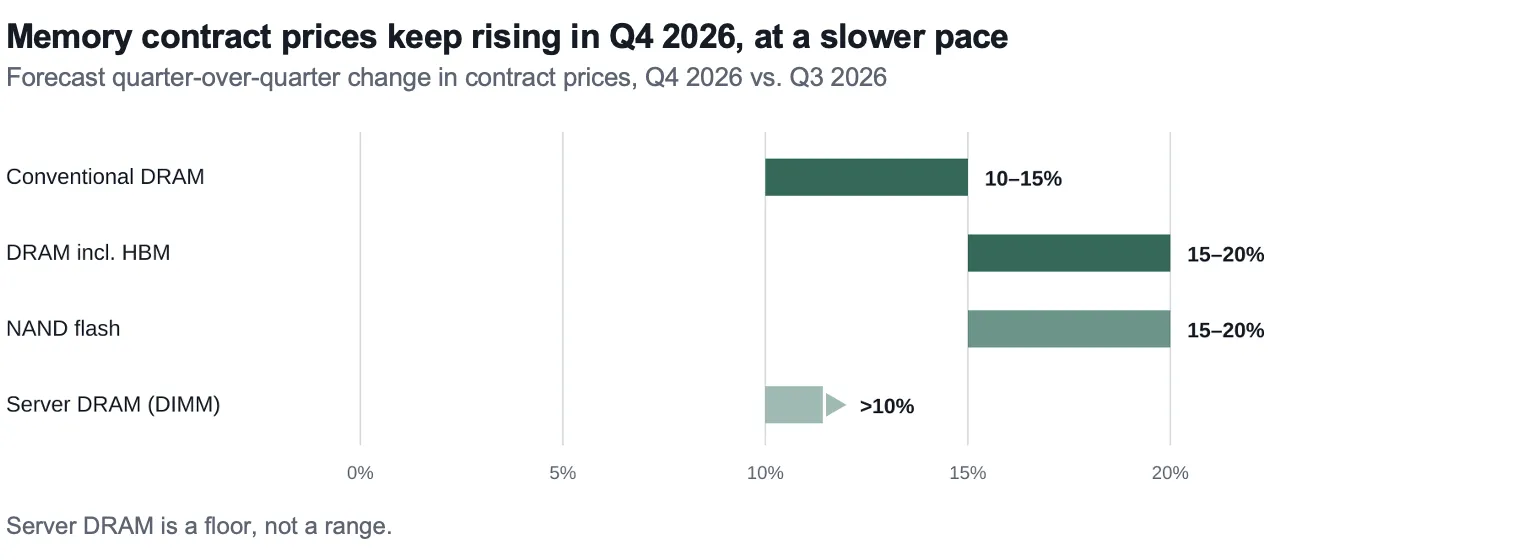
Global chip sales reached $517.7 billion in the third quarter, up 24.1% from the second, and September sales were 146.8% above a year earlier. Cumulative sales passed $1 trillion by August, and full-year 2026 sales are expected to exceed $1.6 trillion. Memory prices are still climbing in the fourth quarter, though more slowly than earlier in the year.
Two limits now matter more than demand. The first is allocation. Siltronic’s CEO said AI is “generating a certain weakness” in other end markets, Nexperia’s interim CEO called his company “totally oversubscribed,” and STMicroelectronics’ CEO said foundries and packagers are shifting resources away from automotive and industrial products. The second is financing. Suppliers are now underwriting customers, with Broadcom arranging a $63 billion vehicle to lease chips to Anthropic with partial residual value support, Nvidia is in talks to guarantee credit for an Nscale data center, and TSMC approved up to $500 million each in Anthropic and OpenAI. China’s CXMT, meanwhile, reported revenue of 269.02 billion yuan for January through September, more than eight times a year earlier.
THREE IMPLICATIONS FOR MEMBERS
Allocation as a Policy Fight
As AI absorbs wafers, memory and packaging, carmakers and industrial buyers face shortages. Expect them to press governments in Washington and Brussels for allocation transparency and expect domestic priority proposals to return.
Financing is the New Bottleneck
Supplier-backed leases, guarantees, and equity stakes tie revenue to a few borrowers. Tighter credit can slow orders before end demand falls.
Chinese Memory Gains Share in the Shortage
CXMT is adding conventional DRAM capacity while prices are high. When supply catches up, pricing pressure in commodity memory will feed 2027 debates over trade remedies and export controls on Chinese memory chips.