downloadGroupGroupnoun_press release_995423_000000 copyGroupnoun_Feed_96767_000000Group 19noun_pictures_1817522_000000Member company iconResource item iconStore item iconGroup 19Group 19noun_Photo_2085192_000000 Copynoun_presentation_2096081_000000Group 19Group Copy 7noun_webinar_692730_000000Path
Skip to main content
RITdb is a semiconductor manufacturing database project organized as a Working Group under SEMI’s CAST (Collaborative Alliance for Semiconductor Test) Technology Community. Originally, RITdb was the “Rich Interactive Test Database” and the original goal was to create a shared architecture that supports smart adaptive testing for semiconductor makers by providing ready access to integrated, consistent, easy-to-use data across the entire manufacturing and test process. Figure 1 illustrates this process for making integrated circuits and how RITdb will collect data from the entire manufacturing flow. Figure 1: Manufacturing Flow for Making Integrated Circuits RITdb’s end goal is to enable access to any sort of manufacturing data across the life of a product from inside or outside of the factory that made the product.Adaptive test has two scopes: The Historical Scope: Make disparate data obtained from many different sources available on demand while dealing with issues of sharing, trust, and data security amongst all database users. The Immediate Scope (Now): Enable real-time decision making about processes and parts moving through the manufacturing process based on process history, results, and feedback. Figure 2 illustrates a manufacturing flow that takes advantage of the RITdb database to make real-time decisions based on test results for devices as they move onward from the immediately preceding process step and from rules that have been developed over multiple manufacturing runs using previous test data in the historical manufacturing record. Figure 2: Real-Time Manufacturing Flow that Makes Decisions based on RITdb data. Image Source: IEEE Electronics Packaging Society HIR (Heterogeneous Integration Roadmap) One of the development issues that the CAST RITdb Working Group has wrestled with is how to make data as easy to extract from the database as it is to put into the database. Many previous manufacturing database development efforts have stumbled over this goal, yet it’s imperative that data be easily accessible if it’s to be used for real-time decision making.The end goal is for RITdb to become an “interplanetary” file system, which means that the database should be distributed over both time and distance. It should be available everywhere it’s needed. In addition, the data in the database has attached metadata to permit content-aware access. The metadata allows a data-consuming application to extract just the data it needs from the database, which reduces the amount of traffic over the manufacturing networking system and speeds database transactions.Further, the database must maintain data integrity, which means that it uses hash-based naming and immutable files to make the data easy to find, so that the data-consuming application knows that the data it obtains from the database is correct, and to prevent data deletion. The database must also be secure, with access controls and encryption to protect data. Finally, the RITdb database employs versioning so that any changes made to the database can be easily tracked and traced over time.RITdb GoalsThe RITdb project has been driven by several goals: Enable plug-and-play database access so that many types of testing tools can feed data into the database in support of diverse test and manufacturing applications. Support generation of and access to real-time streaming data as well as to data previously stored in the database. Allow data from different producer tools to be merged, synchronized, and then delivered to data-consuming applications. Permit new data types to be easily added to the database without adversely affecting the existing database model. This goal allows new data types to be added to the database even before there’s an idea of how to use this new data. Integrate cleanly with the Adaptive Test Model. The Data in the LakeTo meet all of these objectives, RITdb employs a “data lake” instead of a “data-warehouse” model. The data-warehouse model is a more traditional “big data” approach to databases where data is cleaned and normalized when it’s imported into the one, large database. A database using the data-lake model stores a pool of disparate but related data, which is cleaned and normalized at the point of creation. This approach better serves the goals of the RITdb database project by allowing real-time decision making based on prepared, good data with provenance.Data provenance encompasses many data characteristics that require answers to many questions regarding: Identity: What is this data? Integrity: Who created this data, where was this data created, and is this truly the data that was created? Security: Who can access this data? Locality: Is this data grouped with other data based on some characteristic? Lineage: Where did this data come from? In addition, RITdb incorporates other features to satisfy the “Now” scope. It supports a streaming data-flow model using RITdb packets and events. It uses a real-time messaging infrastructure based on IOT bidirectional, machine-to-machine communications and the MQTT (Message Queuing Telemetry Transport) protocol, an ISO standard (ISO/IEC PRF 20922) for publish-and-subscribe messaging, and the CBOR (Concise Binary Object Representation, a serialized, binary data format loosely based on JSON) format for payload data within the messages. Finally, the RITdb streaming protocol permits real-time rules checking so that an application program can look at data streaming in from a test cell and make real-time decisions based on that data.Currently, planned submission for RITdb specification to SEMI for balloting is scheduled for 1Q19. To learn more about the SEMI CAST Technology Community, its RITdb activity, and/or to engage in this effort, please contact Paul Trio, senior manager of Strategic Initiatives) at SEMI, at [email protected] Ajouri is a systems integration engineer at Texas Instruments.
Read More
Jason Jelinek, a software technical manager at John Deere Electronics Solutions, has parlayed his more than two decades of embedded software engineering experience into commercializing controls and sensing technologies for rugged/harsh environments, including agriculture/off-road and aerospace. During his keynote at the upcoming FLEX and MEMS Sensors Technical Congress 2019, February 18-21 in Monterey, Calif., Jelinek will address the driving need for advanced sensing technologies that will fuel the continued growth of autonomy in agriculture.SEMI’s Maria Vetrano asked Jelinek to help FLEX/MSTC attendees understand his vision of autonomy in agriculture, which heavily leverages advanced sensing technologies to help farmers master equipment logistics, handle vehicle- and fleet-level operational efficiency, and manage the entire lifecycle of crops.SEMI: Did autonomy in agriculture start with autonomous equipment, such as tractors and combines?JELINEK: Automation, the first step on the road to autonomy, has been occurring in agriculture for a long time. Over the past 100 years, automation has dramatically reduced manual effort and simplified jobs in farming, allowing operators to focus more on administrative and other aspects of their work.The evolution of the combine is a good example of automation in agriculture. Long ago farmers would use a scythe to cut down the crop before bundling or stacking it up. Later they would manually thresh and winnow the crop to get the grain. Over time, we developed windrowers to cut the grain, threshing machines to separate the grain from the chaff, and winnowing machines to get only the grain. Combines now “combine” all those steps to go from grain on the stalk in the field to grain in the hopper. One person in a combine can do the work that once required many people and animals — all in a much shorter timeframe. We are now looking at automating harvesting to maximize yield and reduce fuel consumption. The AUTOTRAC feature on John Deere machines is a recent example. AUTOTRAC divides a field into rows based upon the parameters of the machine in operation, supporting hands-free driving with very high accuracy. It allows consistent, accurate rows for tilling, planting, crop treatment and harvesting, saving considerable time, improving overall quality and freeing the operator to do other work while in the vehicle.The Exact Emerge and Section Control features (which also use AUTOTRAC) will spur greater future autonomy. Control over both the seed spacing (Exact Emerge) and when the machine drops seeds (Section Control) prevents overseeding and provides the right seed-spacing for optimal crop production.As we look to the future, sustained growth in automation of jobs will enable the development of fully autonomous equipment. Currently, however, skilled operators are still closely involved in job management and execution. To realize greater autonomy, we will need machines that make the decisions once made by people.SEMI: How will autonomy in agriculture change the ways that we grow and harvest food — and even affect when we sell it?JELINEK: Autonomy will lead to more efficient production, reducing fuel, fertilizer, herbicide and water requirements. It will also enable fewer people to do more of the work.Let’s start with conditions that are hard, even impossible, to control: weather and staffing.While farming is still tied to the weather — and will remain so for some time — more efficient operations will allow tilling, planting, spraying and harvesting of fields to occur in shorter time windows that more easily match conducive weather conditions.There is also a human-resource issue: The agricultural industry must compensate for population decline in the rural areas where farmers operate. Doing more with less is essential for agriculture to continue to meet the rising food and clothing demands of the world’s population.SEMI: To what degree will we see artificial intelligence in autonomous agricultural systems?JELINEK: While autonomous systems had their start at the vehicle level, they will one day move to the entire fleet, providing suggestions on when the owner should execute operations. Autonomous systems may also help owners to decide when to store or sell crops, based on market conditions, operating costs and desired margin levels. That’s the initial level of artificial intelligence that I foresee.SEMI: How can sensing improve autonomy in agriculture?JELINEK: The challenges we face in agriculture are many, but technology will help us meet them. We must transfer responsibility for operations and decision-making from the skilled operator to the intelligent machine. Through increased use of sensing, we can gather large amounts of data, which autonomous agricultural systems will process, communicate and interpret to streamline jobs and boost agricultural production.SEMI: What would you like FLEX/MSTC attendees to take away from your presentation?JELINEK: I would like FLEX/MSTC attendees to understand the environment in which agricultural sensors need to operate. We need sensing solutions that will survive and thrive in rugged, outdoor variable environments to support the automation that will fuel autonomy.I would also like to engage suppliers in the application of current technology to meet our sensing needs.Jason Jelinek will present Autonomy in Agriculture at FLEX/MSTC on Tuesday, February 19 at 9:00 am.Register today to connect with him at the event. To learn more, click here.MSTC Flex 2019 is organized by the MEMS Sensors Industry Group (MSIG) and FlexTech. Maria Vetrano is a public relations consultant at SEMI.
Read More
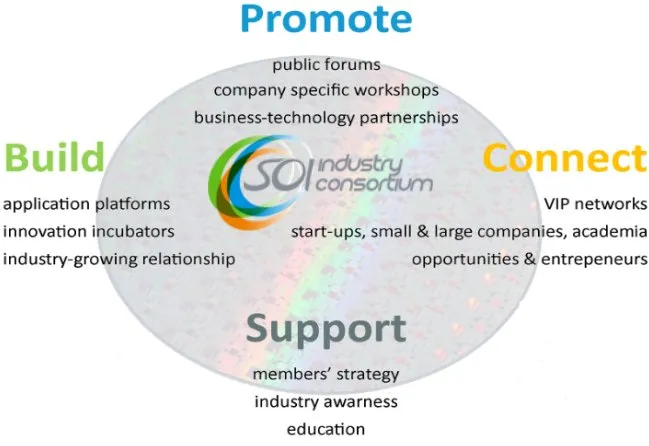
Welcome to our first post for 2019 here at the SOI Consortium's Advanced Substrate News. First and foremost, may we wish you and yours a safe, happy, healthy and prosperous year. It should be a good year across the SOI ecosystem, with new products, players, IP, technologies and tools -- and high volumes. What's new? Let's start with the people, as the Consortium welcomes new team members. Jon Cheek of NXP will join Carlos Mazure as Executive Co-Director. He'll be replacing ST's Giorgio Cesana in that role – and goodness knows those are some big shoes to fill. Giorgio has given of his time and expertise so tirelessly over many years. He'll of course still be a key resource for the SOI ecosystem, and though we'll miss him here at the Consortium, we know he'll be doing great things in SOI at ST. So a heartfelt thanks to Giorgio Cesana from all of us. Jon Cheek has a long history in engineering management at companies that have been leading users of SOI: AMD, Freescale and now NXP. As such, he understands what companies need to design great products, and how the Consortium can help further build, promote, connect and support the ecosystem. The Consortium team also welcomes Jean-Eric Michallet of Leti, who'll bring deep bizdev expertise and a keen sense of what it takes to reach further into the ecosystem. (Astute long-time ASN readers might remember his post from five years ago about 3D monolithic integration – now dubbed “Cool Cube” by Leti.) And finally, look to hear more from and about the Consortium, as our team is rounded out with the addition of the comm marketing savvy of Erin Berard of Soitec. In addition to new team members, the Consortium is very pleased to welcome new member Applied Materials. Though new to the Consortium, AMAT has a long history in the heart of SOI ecosystem – in fact they've been working with SOI wafer-leader Soitec for over 25 years. AMAT ion implanters are a key enabler to what became and is Soitec's industry-leading Smart CutTM SOI wafer manufacturing process. And of course AMAT equipment is used to make virtually every chip in the world, so their breadth of vision as a consortium member is clearly a fabulous addition. 2019 will also be marked by the expansion of the highly successful SOI Academy series, the first of which was held this past fall in Shanghai. We'll keep you posted as these and other Consortium events are announced throughout the year. In fact, 2019 marks a decade of (excellent!) SOI Consortium events events around the world: our first symposium was held back in 2009. Kicking off this year, save April 9th on your calendar for our Annual SOI Silicon Valley Symposium. Then watch this page for more events across the globe. What will the year bring? On the product side, RF-SOI for 5G is of course super hot. Last summer, a SemiconductorEngineering headline proclaimed RF-SOI Wars Begin. And what we heard at the International RF-SOI Workshop last fall in Shanghai (presentations here) certainly confirmed that in the coming year the race will continue unabated. [caption id="attachment_14476" align="alignright" width="300"] Part 3 in SemiconductorEngineering's "Experts at the Table" series on FD-SOI featured James Lamb of Brewer Science, Giorgio Cesana of ST, Olivier Vatel of Screen, and Carlos Mazure of Soitec. (Image courtesy: SemiconductorEngineering.com)[/caption] And for FD-SOI, you might want to read the SE series published over the last six months. The latest, published a couple of weeks ago looks at FD-SOI at the Edge. There are some great insights from SOI Consortium members there. In terms of products, too, there's lots of activity. Last summer, Samsung indicated they'd taped out over 60 products since they first began offering 28FDS three years ago. It's a trend they see accelerating. Full production of 18FDS is slated for this fall. And also last summer GlobalFoundries indicated they had over 50 client designs on 22FDX. “We’re only just beginning,” said GF CEO Tom Caulfield at the time. “We have found a way to separate ourselves from the pack by emphasizing our differentiated FD-SOI roadmap and client-focused offerings that are poised to enable connected intelligence. " For its part, ST, as we learned at the last SOI Consortium Japan Workshop, has been doing FD-SOI for five years now. And while we don't have number, we learned that some of those products are now in their second and third generations, and that some big FD-SOI chips coming out this year with embedded memory and RF, with especially good traction in mmWave, automotive and IoT. So while the outlook for the overall industry is anyone's guess for the coming year, the outlook for chips built on SOI technologies is very good indeed.
Read More
SEMI’s Environment, Health Safety (EHS) Advocacy program has been helping the semiconductor manufacturing supply chain collectively address common challenges for over 20 years. Now, as national and regional governments worldwide increasingly weigh legislation that could impact the industry, SEMI continues to ensure that microelectronics industry understands the potential impact and provides an effective platform for taking collective member-led action.Olivier Corvez recently joined SEMI to focus exclusively on shaping SEMI’s EHS Advocacy program to meet escalating demands on the industry. He recently sat down with SEMI’s communications team to discuss SEMI's evolving EHS Advocacy program. SEMI Communications: As senior manager of EHS Advocacy, based at SEMI’s Milpitas, California, headquarters, what do you see as the major issues impacting EHS Advocacy for electronics manufacturing worldwide?Corvez: EHS is a vast topic that cuts across many different types of issues such as regulatory compliance obligations, management systems performances, as well as sustainability related public disclosures. SEMI’s global members are engaged on all these fronts, while creating advanced materials, sophisticated tools and managing a complicated and extensive supply chain.On the regulatory side, there has been exponential growth in the number of EHS laws considered and adopted by legislatures worldwide. Often these new regulations generate shockwaves across the globe as member companies are required to adapt to new requirements that spread across the entire manufacturing supply chain.Many new regulations are originating from Europe and demand much of my attention. We are paying especially close attention to the Stockholm Convention on eliminating persistent organic pollutants. A chemical called PFOA has been a subject of much effort at SEMI for years now and we are heartened by the reception of our position by the European Commission.SEMI Communications: What do you find most interesting about operating the EHS Advocacy program at SEMI?Corvez: The first word that comes to mind is “variety.” This role involves a blend of strategy, regulatory interpretation skills, project management, communication and even accounting. There is always something new to learn and positions and strategies to develop.SEMI, as a member-driven, collaborative platform, needs a high level of knowledge sharing and communications. I am working to establish a workspace where members can share previously-created analyses and minimize “recreating the wheel.” We have ambitious plans to deploy additional tools and a redesigned website that will improve our knowledge-sharing capabilities and best serve our members.We also plan to renew collaboration with other industry associations such as SIA and SESHA. Partnering with other associations means our voice is stronger, our messaging is reinforced, and our efforts are coordinated. Last but not least, I believe that maintaining a sense of geographical proximity for SEMI’s worldwide efforts is important. SEMI’s local advocacy efforts are facilitated by SEMI regional staff and I look forward to collaborating with them as they maintain ongoing dialogue with our local members and their local, state and national governments. SEMI Communications: What is the most challenging part of your role?Corvez: The most challenging aspect will be to reinvigorate participation in all of our EHS activities and find ways to create a state of fruitful collaboration among members worldwide. Secondly, establishing a new EHS governance structure is a significant challenge, but it is incredibly important to have a strong leadership group and decision-making mechanism that will efficiently help define our vision and priorities.Our new direction will require members to lead our activities at all levels. We believe there is a strong ROI for companies to dedicate resources to address the issues or topics we need to pursue to keep them and their products, accepted, profitable and the industry to grow. While SEMI provides the platform for collaboration, we must supplement our efforts with members providing the manpower to ensure our activities are a success.SEMI Communications: Tell us about your background. Corvez: I bring 20 years of diverse experience as a consultant, auditor and corporate EHS program management across most economic sectors on a global scale. Recently, I managed an EHS team distributed across 10 countries, dedicated to providing EHS compliance support to Cisco facilities worldwide.In addition to compliance experience, I have worked on implementing EHS Management systems at ABB or Total while in France (primarily) in the late 1990s. While at KPMG in Paris I was involved in over 400 due diligence projects for transactions services for electronics, chemicals, auto industry, aeronautics, etc. On the sustainability reporting side, I was lucky to be involved with large corporations and spent five years verifying EHS and social performances disclosed in sustainability annual reports. I received my formal training and received a Masters of Science in Environmental Sciences from Universite de Rouen, France, and my Bachelors of Science in Environmental Geology from Northeastern University in Boston. I also trained as an ISO 14001 auditor at DNV Sweden.All of these experiences have led me to this current position at SEMI, where I look forward to making effective and meaningful impact.Have questions or suggestions for Olivier? He can be reached at [email protected] or at +1.408.943.6957. To learn more about the EHS advocacy program at SEMI, please click here.Heidi Hoffman is senior director of Technology Communities Marketing at SEMI.
Read More
SEMI met with Martin Schrems, director of Strategy and Business Development at AT S AG, to discuss Fan-Out technology trends ahead of SEMI 3D Systems Summit in Dresden, Germany.SEMI: What are the AT S AG mission and vision and your role within the company?Schrems: AT S AG is evolving from a pure PCB manufacturer towards an interconnect solution provider. We can clearly see a continued trend towards miniaturization and modularization by (3D) integration of components such as integrated circuits and passives. Module sizes tend to increase by integrating more functions and system-level requirements. As a PCB maker, we have served such system-level requirements for a long time. Further integration offers opportunities to embed components in PCBs or substrates, offer layout and simulation services, as well as provide assembly and test services depending on specific customer requirements. As director of Strategy and Business Development, I work with my colleagues in AT S, customers, and partners across the industry towards understanding and leveraging this major transformation in the electronics industry.SEMI: What project are you currently working on that you think will make a difference in 2019?Schrems: There are number of very exciting projects, many of them already involving AT S contributions to module integration. Some of these projects involve key customers directly. We see exciting opportunities for integration of larger multi-function modules by combining PCB, substrate, and embedding core competences.SEMI: The focus of your presentation at the 3D Systems Summit will be on "Fan-Out System-in-Board technology enabling module and system-level integration.” What do you see as the key trend in this area?Schrems: Fan-Out technologies are used to distribute I/O pad connections of nanoCMOS ICs over a larger area. This relaxes bump pitch and feature size requirements for subsequent system-level PCB interconnects. In some cases, Fan-Out layers already provide a substitute to currently used Flip-Chip substrates. Well-known examples are Fan-Out packages for application processors for smartphones. There is definitely a trend in the market towards Fan-Out for high-end processor applications. Advantages of such Fan-Out packages are shorter electrical connections and a reduced thickness.However, one weakness of current Fan-Out packages is that only a limited number of components can be integrated due to mechanical stability challenges – a barrier to further component integration in larger modules. Currently, the only way to integrate more components is to use laminate-based PCBs and substrates with conventional Surface Mount Technology. Recent proposals like our “Fan-Out System-in-Board” (FO-SiBTM) technology are expected to provide an alternative Fan-Out packaging option at the board-level in the future.SEMI: Please elaborate. Schrems: Fan-Out capability and integration of more components – typically up to the 100 and more needed for electronics integration at system level – can be achieved simultaneously by combining technologies from the PCB and the packaging world. PCB laminates such as glass particles and organic materials provide mechanical stability for large boards. The recent introduction of substrate-like PCBs (mSAP) has already paved the way to cover applications that were reserved for substrates and classical packaging in the past.With FO-SiBTM technology, we have taken it a step further and offer the option to integrate SAP substrate layers onto the PCB with lines/spaces below 10µm. FO-SiBTM makes it possible to directly contact nanoCMOS chips on PCBs without any intermediate substrates. Further adding Cu pillar technology at panel level will enable Fan-Out structures even for surface-mounted components, making recent R D on panel-level Cu pillar technology very important. Through joint R D, we can drive progress in the industry to further enable cost-effective heterogeneous 3D integration.SEMI: What are your expectations for the 3D Systems Summit in Dresden, and why do you recommend your members and other industry leaders to attend?Schrems: The 3D summit is the high-level conference where key electronics industry players discuss major heterogeneous integration trends. Therefore, we very much appreciate the opportunities to exchange ideas across the supply chain including users, developers of integrated electronics hardware and tool manufacturers. Serena Brischetto is a marketing and communications manager at SEMI Europe.
Read More
Francois Jeanneau, president and CEO of Novasentis, has spent the last two decades building strategic relationships, increasing revenues and catapulting growth at leading consumer OEMs and ODMs. Jeanneau will present the world’s thinnest haptic actuator technology at the upcoming FLEX and MEMS Sensors Technical Congress 2019, February 18-21 in Monterey, Calif. SEMI’s Maria Vetrano interviewed Jeanneau to give FLEX and MSTC attendees a preview of this new technology that will enable rich, customizable haptic experiences with virtual reality (VR), hand-held game controllers and flexible wearable devices such as wristbands.SEMI: What do consumers want from haptic feedback? How can the technology industry improve the user experience with haptics?JEANNEAU: In many applications such as VR and gaming, our visual and auditory senses are satisfied by high-resolution displays and good-quality speakers, but they lack the sensation of realistic touch. That’s because haptic technology has lagged the technological advancements that we have made in displays, microphones and speakers. It’s also fallen far behind what is possible on the software side. At the same time, consumers are demanding more from their VR and gaming experiences.Through improvements in haptics, prospective home-buyers touring a home via VR headset will be able to “feel” those granite countertops in the kitchen, assess whether their couch will fit in the living room and check out the view from the back porch, all from the comfort of their own home. Virtual travelers will be able to touch the marble walls of the Taj Mahal, and sports enthusiasts will feel the impact of a tennis ball when they use their haptics 2.0-enabled controller.Haptics will dramatically improve what’s possible in wearable devices as well. From their smartwatches, consumers will discern hundreds of different sensations, from a mild heartbeat to a sharp reminder that they are steering a car through an intersection. This is all possible through new haptic actuator technologies that can accept hundreds of inputs to generate an entire haptic language of outputs.SEMI: What are some major obstacles to realizing improvements in haptics for flexible devices such as wrist-worn devices?JEANNEAU: The best wrist-worn devices today offer a rudimentary haptic output that merely says, “hey, pay attention to me.” To comprehend the alert, the user must look at the display, press a few buttons and then interact with the device. This distracts the user while riding/driving, creating potentially dangerous situations. It’s also frowned upon, particularly in the middle of a meeting!The legacy haptic technologies – eccentric rotating mass (ERM) motors and linear resonant actuators (LRAs) – that are currently used in today’s devices are problematic on multiple levels. They are bulky, sometimes occupying a third of the real estate in a smartwatch. As they are generally made of metal, they are also heavy and too thick for many devices. Their output tends to be slow, lagging the output in the display, making the whole experience clunky. They tend to be power-hungry as well.SEMI: How is Novasentis approaching these technical challenges?JEANNEAU: Novasentis has created an extremely thin (150 um), flexible and low-power polymer film actuator that is small enough to be easily embedded into the next generation of smarter wearable devices and garments; the actuator can provide hundreds of different types of vibrating feedback to the wearer for improved notification and/or suggested actions. The film actuator (that can replace a mechanical motor vibrator found in smartphones and smartwatches) is made by stacking layers of electroactive polymer and metal to create the piezoelectric structure. Upon power-up via a modulated waveform, the molecules move to align themselves in response, which elongates and relaxes the polymer. This causes the attached substrate (wristband in a watch, for example) to bend and relax, thus, causing the vibration effect, or haptic and audio feedback (which is unique to our material).SEMI: How will you demonstrate your technical approach at FLEX 2019?JEANNEAU: We will bring examples of designs incorporating our technology as we share live demos of wearables, game controllers and other applications. We will also bring actual haptic actuator materials for show and tell.Francois Jeanneau will present Flexible Actuators for Sensational Haptics at Flex and MSTC on Wednesday, February 20 at 8:00 am. Register today to connect with him at the event. To learn more, click here. MSTC Flex 2019 is organized by the MEMS Sensors Industry Group (MSIG) and FlexTech. Maria Vetrano is a public relations consultant at SEMI.
Read More
OSATs (outsourced assembly and test companies) currently handle the bulk of assembly and test activity for the worldwide semiconductor industry. These companies’ factories have a manual operation legacy: Decision-making is manual. Materials and WIP (work in process) movement is manual. Practically everything in these factories is done manually. In addition, OSAT factory environments typically present many physical constraints with respect to equipment layout, material carriers and storage. All of these constraints present challenges when trying to automate material handling in these factories. OSATs also operate with far smaller gross and operating profit margins than IDMs, yet the percentage of worldwide semiconductor product handled by OSATs is currently increasing from year to year while the IDM share is decreasing. The combination of increased business volume with lower margins encourages OSATs to automate their factories, but there are challenges that must be overcome. Technical challenges abound OSATs face many technical challenges when trying to automate production. First, installed legacy equipment in these factories is typically 25 to 30 years old. This older equipment was simply not designed to accommodate automated materials handlers. For example, access doors on older equipment make automated WIP delivery and pickup nearly impossible without significant modifications to the equipment. Second, these factories are not equipped with the infrastructure needed to support automation. To start with, most of this older equipment is not SECS/GEM compliant. (SECS/GEM is the semiconductor industry's standard equipment interface protocol for equipment-to-host data communications.) This capability must either be retrofitted to the existing equipment or some other means of extracting required data from the equipment – getting it from the PLCs controlling the equipment, for example – must be employed. Similarly, the WIP carriers currently in use – wafer carriers, trays, magazines, and the like – are not designed for automation. In contrast to the semiconductor wafer fab industry, it seems that almost every company in the OSAT domain has a different idea concerning what a carrier should look like. In particular, there’s no such thing as the standard 300mm FOUP (Front Opening Unified Pod), which carries wafers from one tool to the next inside of semiconductor fabs. The variations in carrier shapes, configurations, and even gripping handles in the OSAT domain thwarts progress in OSAT factory automation. How do you design a materials-handling robot with the grippers and flexibility needed to adapt to all of these different carriers? It’s a difficult question and an expensive proposition. OSAT facilities themselves are designed for human-based materials handling, not automated materials handling, simply because they were designed at a time when automation was not contemplated. As a result, the equipment in these facilities is packed very closely together (to reduce floor space costs), as shown in Figure 1. Figure 1: Equipment in a test facility is often tightly packed, which impedes the adoption of automated materials handling. It’s very difficult to add automated materials handling equipment at floor level or even at ceiling level in these OSAT factories, as is frequently done inside of a semiconductor wafer fab. You will not see AGVs (automated guided vehicles) moving around inside of legacy OSAT factories because there’s simply no room for them to move around. Tackling the challenges So, what can be done to handle these all of challenges? You must start by understanding the nature of the operations taking place inside of the factory. As stated above, most of these operations are currently performed manually. All of the decisions and the materials transport is performed by humans. There’s simply no way to transition from a fully manual operation to a fully automated operation in one jump. It’s too far a reach. A significant amount of work is needed just to reach the level where automated decision making is possible. Key systems must be added to enable this level of automation. Many companies tried and failed to automate assembly and test in OSAT facilities about 25 years ago. They failed because the required data could not be extracted from the equipment in use and, therefore, there was no data to drive good decision-making. Too many required systems were simply lacking. For example, when AGVs were added, one or two operators had to walk along with the AGV to tell it what to do. There was no benefit from the automation in this example. There was no successful path to automation at the time. Standards needed One of the major obstacles to automating assembly and test in OSAT facilities is a lack of standards for carriers, robotics, layout, and facilities. Many front-end standards exist. The SEMI-E82, SEMI-E84, and SEMI-E88 standards designed for semiconductor fab front ends might apply, but they need to be adapted to requirements for OSAT back-end facilities. In addition, OSATs have special needs that may demand new standards. This is a real opportunity for SEMI and its constituents. An architecture for full assembly and test automation involves four layers, as shown in Figure 2. Figure 2: Full automation for assembly and test involves four layers. Starting with the data layer at the top of Figure 2, a fully automated facility needs to have database systems in place that can supply all of the data needed for making smart scheduling and dispatch decisions. These databases then feed smart, automated scheduling and dispatch applications in the logic layer. The scheduling and dispatch applications then send control commands to the automated transport and materials controllers and the automated equipment handlers in the control layer. You need to start at the top of the diagram to put all of this automation in place. The automated equipment and equipment controllers need commands from the scheduling and dispatch applications, which in turn need data from the databases to make smart decisions. So it’s the data layer and the systems that feed data to this layer that constitute the starting point for the journey to full automation. A significant amount of simulation is needed to develop optimal facility workflows. These simulations are driven by data extracted from the databases. One of the frequently ignored facets of automation is the need for backup plans. For example, what is the backup plan when an AGV fails and cannot deliver material as scheduled? Simulation helps create contingency plans for such events. A case study Applied Materials has worked with assembly and test factories in deploying full automation. Towards this objective, the factories have worked on many modifications (physical and systems) to enable this automation. For example, a die-attach machine was retrofitted for automation by removing all of its equipment doors so that an AGV could load the machine and extract completed work. Additional modifications permitted the mounting of multiple magazines on the die-attach machine’s input and output to provide the buffering needed to smooth the flow of work through the machine. Finally, simple instrumentation and networking was added to the machine to aid in making WIP delivery and pickup decisions. These machine modifications addressed only the bottlenecks in this particular machine, but even these simple modifications helped to reduce the incidence of manual handling errors, such as the misalignment of magazines or trays. Modifications like these also reduce the need for human operators, which in turn reduces operating costs. Such types of incremental enhancements in automation capability have been implemented by leading-edge companies over the past few years. Conclusion Deploying full automation for assembly and test is not only feasible, it’s necessary for future profitability. OSATs must address the challenges of rising manufacturing volumes and thin margins by reducing manufacturing errors and increasing quality. (The quality requirement is increasingly driven by the automotive industry.) Trailblazing deployments have shown that it’s possible to automate these manufacturing lines successfully. While IDMs have a longer history for manufacturing automation, OSATs are now traveling along the same path due to their rising share of worldwide manufacturing volumes. On that path, they’ll need to develop experience and new standards tailored to their unique needs. Shekar Krishnaswamy is a senior manager at Applied Materials responsible for business development and pre-sales of factory automation products and solutions. He has over 27 years of experience in all aspects of semiconductor manufacturing including wafer fab manufacturing, bump, assembly and test. His specific areas of expertise are traditional industrial engineering methods as well as systems-related methodologies such as modeling, scheduling, dispatching and factory automation. Prior to Applied Materials, Shekar held senior technical and management positions at IBM, Motorola and AMD, including management of corporate operations research departments supporting factory and service groups. Shekar has a bachelor’s degree in mechanical engineering and a master’s degree in industrial engineering and operations research. Note: SEMI has a Smart Manufacturing Technology Community. For more information or to get involved, click here.
Read More
Last year the industry posted another remarkable double-digit revenue growth year. IC shipments eclipsed one trillion units for the first time and continued to enable an ever-expanding array of silicon intensive-applications.2018 was also a pivotal year of transformation at SEMI. Setting our sights firmly on building more value for SEMI members, we doubled down on priorities I established this time last year. We advocated intensively on global trade policies, industry talent needs, and critical environment, health and safety (EHS) concerns. To underpin our efforts around talent, we took the bold step to reinvigorate the industry’s identity with a dynamic image campaign. Above all, we targeted critical industry-wide issues to help us realize the ambition of becoming a trillion-dollar industry in the next decade. Workforce DevelopmentRedefining our approach to talent development in 2018 was and remains a top priority. A diverse, highly skilled workforce is crucial to the industry’s ability to innovate. Last year we ramped up a number of SEMI High Tech U (HTU) programs to inspire young people and attract them to careers in high-tech manufacturing. To date, more than 130,000 students have been touched by HTU – through student or teacher programs.Over the past year, we designed a new university outreach program and established partnerships with 100 institutions. We established Workforce Pavilions at SEMICON events in Southeast Asia, the U.S., Taiwan, Europe and Japan for students to explore career opportunities and meet with recruiters. We thrilled at seeing sponsors hire young talent at SEMI events. This year, all SEMICONs worldwide will feature Workforce Pavilions.SEMI also formalized its commitment to Diversity and Inclusion (D I) with the establishment of a D I council to shape new programs including the recently launched Spotlight on SEMI Women. To localize and fully optimize our D I programs, we established regional workforce councils in every region we serve. We unveiled the SEMI Mentoring Program to support students and young professionals on this journey by facilitating one-on-one mentoring relationships with industry professionals. Hundreds of mentees have enrolled. But we still need more mentors. I urge you to join the program. During the year, SEMI also expanded its workforce staff and developed a comprehensive workforce strategy with programs that engage students as early as elementary school and inspires them through high school and college. The program provides pathways to professional careers, building a pipeline to fill the short-term and long-term talent needs of the industry. Industry Image CampaignAs we developed the comprehensive workforce development program, we knew we had to refresh the industry’s image and appeal to the next generation through contemporary media and communications channels. So we recently launched a bold, innovative campaign to raise industry awareness and attract students and recent graduates to careers in semiconductor manufacturing.Our You’re Welcome campaign is a novel, creative approach that blends entertainment, media and storytelling to excite students about the industry. The campaign went viral immediately and within weeks had more than 5.5 million social media impressions and 2.3 million video views.Trade Policy AdvocacyRising trade tensions between the U.S. and China catapulted global trade policy to the forefront of industry concerns in 2018. Since the tariffs have taken force, semiconductor companies have faced higher costs, greater uncertainty, and difficulty selling products abroad. The tariffs have forced many SEMI member companies to pause or rethink their investment strategies.SEMI quickly engaged U.S. policymakers and provided resources for SEMI members. We formed a member trade task force, staged trade compliance seminars in China, and convened meetings with over 110 U.S. congressional, agency and administration officials, and provided testimony on the importance of the free trade to the industry.SEMI continues to educate policymakers about the critical importance of free and fair trade, open markets, and respect and enforcement of IP for all players in the global electronics manufacturing supply chain. As part of this initiative, we distributed “10 Principles for the Global Semiconductor Supply Chain in Modern Trade Agreements” and encouraged their adoption in various trade negotiations. These principles outline the primary considerations for balanced trade rules that benefit SEMI members around the world, strengthen innovation and perpetuate the societal benefits of affordable microelectronics.Environment, Health and SafetyEnvironmental regulations are proliferating globally even as advanced semiconductor manufacturing technology relies increasingly on a host of new materials. With dozens of new fabs and fab line upgrades, our industry must align on best practices, sensibly respond to materials restrictions, and renew efforts toward sustainable manufacturing.That’s why the revitalization of SEMI EHS efforts became another priority in 2018. Two months ago, we hosted the inaugural EHS Summit at SEMI Headquarters. Fully, 70 EHS professionals and company executives met to form the basis for the future SEMI EHS program.The Year AheadDespite a softening in the market, compounded by Apple’s first-ever announcement of a revenue decline in 16 years, a geopolitical whirlwind on trade and an extended shutdown of much of the U.S. government, the future is bright.At SEMI’s annual Industry Strategy Symposium (ISS 2019) in Half Moon Bay, Calif. in early January, the sense of optimism was palpable. In her keynote address, Dr. Ann Kelleher, Sr. VP and General Manager, Technology and Manufacturing Group, at Intel, observed that data is powering the fourth industry revolution and the expansion of compute. With customers expecting continual improvements in applications, Kelleher highlighted the tremendous opportunity for the chip industry to meet these expectations.At ISS 2019, we announced a Memorandum of Understand between SEMI and imec. The MOU will enable us to accelerate our members’ engagement in SEMI’s Smart vertical market platforms, in particular Smart MedTech and Smart Transportation. Our partnership with imec will also allow us to boost SEMI Standards activities in non-CMOS technologies, deepen technology roadmap efforts and augment our SEMI Think Tank initiative in thought leadership at a global level.Over the course of this coming year, will we begin our global rollout of key building blocks of our comprehensive workforce development program to engage schoolchildren as young as 10 and learners all the way to veterans who return to the workforce. We are now able, with the invaluable help of our Workforce Development Council and the passionate engagement of many SEMI member companies, to offer a solution to the talent crisis in our industry.We will continue to be the leading voice for our members and the end-to-end semiconductor supply chain across Talent, Trade, Tax and Technology as we work to ensure free, fair trade that protects IP while preserving vital access to markets to grow the supply chain. Vertical Market PlatformsOur vertical market platforms are an important part of this growth. For example, in Smart MedTech, SEMI looks forward to working with the Nano-Bio Materials Consortium to advance human monitoring technology for telemedicine and digital health after winning $7 million to fund the renewed program. In Smart Transportation, we will leverage the Global Automotive Advisory Council (GAAC) we formed last year to represent the full automotive supply chain and the Smart Transportation and Smart Automotive forums featured at all our SEMICON events to enable the industry to identify and seize opportunities in autonomous driving. At ISS 2019, Sujeet Chand of Rockwell Automation noted that “digitization will grow faster in the next 10 years than it did in the past 50,” a trend calling for semiconductor fab architectures that transform data into business value. We will continue to bring the industry together at our Smart Manufacturing venues to help uncover ways to deploy deep learning, edge computing and other Smart technologies to deliver this value and meet the challenges of automation as artificial intelligence’s (AI) sprawling influence reshapes industries including manufacturing.I am filled with optimism and thrilled about the opportunities I see on the horizon for our members as we build on our 2018 accomplishments to enable your prosperity in 2019 and beyond. My heartfelt thanks to all of you for your participation in our programs and events.I look forward to another successful year as we connect, collaborate and innovate together!Ajit Manocha is president and CEO of SEMI.
Read More
SEMI met with Jay Zhang, business development director at Corning Incorporated, to discuss recent innovations at Corning that allow fine granularity CTE engineering as well as high Young’s modulus. We also talked about the impact of this work on in-process warp control, as well as the associated production methodology that provides rapid prototyping and high-volume manufacturing. We spoke ahead of his presentation at the 3D Systems Summit, 28-30 January, 2019, in Dresden, Germany. To register for the event, please click here.SEMI: What is Corning’s mission and vision and your role within the company?Zhang: Corning is one of the world’s leading innovators in materials science with a track record of 165+ years of life-changing innovations. We excel in glass science, ceramics science, and optical physics and succeed through sustained investment in RD E. Our products include Corning® Gorilla® glass, a durable material used on more than six billion mobile devices worldwide, and industry-leading LCD glass for display applications. We have recently dedicated a unit of the company called Precision Glass Solutions to address the emerging need for glass in the semiconductor industry. Here we apply Corning’s long history of glass science expertise and deep customer relationships in consumer electronics to support cutting-edge applications like wafer-level optics for precise 3D sensing and carrier solutions for temporary bonding applications in semiconductor manufacturing. It’s our most recent work in the Carrier Solutions product line that I’m excited to present: a new carrier glass product optimized for fan-out, called Corning Advanced Packaging Carriers.SEMI: What projects are you currently working on that you think will make a difference in 2019?Zhang: My team is excited to introduce Corning Advanced Packaging Carriers this year. This is a new line of product within our portfolio of Carrier Solutions. These ultra-flat glass carriers are specially developed to reduce customers’ challenge of in-process warp by up to 40 percent, which in turn helps advanced packaging customers achieve better yield.Corning Advanced Packaging Carriers feature high-stiffness properties and are available in a wide range of coefficients of thermal expansion (CTE) in fine granularity. These attributes help customers select an ideal glass carrier that will minimize in-process warp for their package. Furthermore, we make sample quantities of these carriers available in just four to six weeks to help maximize efficiency during customers’ R D process.My team is excited about the potential of this new product, but also encouraged by our results. We have already supplied this product and have heard from one of the largest semiconductor companies in Taiwan that it has reduced in-process warp by as much as 150μm.SEMI: Your presentation at the 3D Systems Summit will focus on Agile Manufacturing of Glass Carriers for Advanced Packaging. What exactly will you be sharing?Zhang: There is a lot of interest right now in using glass as a carrier substrate in temporary bonding applications in advanced semiconductor packaging – especially in fan-out processes. We also know that in-process warp is a significant challenge to companies pursuing advanced packaging because different CTE materials are added during the process. My team has done a lot of work to understand the impact that an ideal CTE glass carrier substrate can have on minimizing in-process warp. We have studied the available levers – both theoretical and in real-life fab environments – that can help address this challenge. I will present our findings on how it is possible to select a glass carrier with the ideal CTE and Young’s modulus to reduce in-process warp by up to 40 percent, and how Corning has developed an agile manufacturing platform to support customers with these ideal carriers from their R D stage through mass production.SEMI: What do you think will be a hot topic in the next few years?Zhang: We expect high-end fanout technology to address more applications beyond just mobile APs. There is also an interesting dynamic playing out between wafer-level and panel-level fan-out technologies. Corning is active in both areas. In developing and offering high performance glass carriers, we hope to help enable our customers to expand the fan-out applications space.SEMI: What are your expectations regarding the summit in Dresden, and why do you recommend your members and other industry leaders to attend the 2019 3D Systems Summit?Zhang: Europe is where some of the most advanced packaging technologies are born. Fan-out also saw early commercialization there. I hope to meet many scientists and technologists at 3D Systems Summit and exchange technical and business ideas. We also hope to get early feedback from other attendees about the value of our new product offering. Serena Brischetto is a marketing and communications manager at SEMI Europe.
Read More
SEMI met with Erez Halahmi, vice president at 0eC SA, to discuss a new way to transfer information not only between chips but also between servers to reduce power consumption while boosting performance. The two spoke ahead of his presentation at the 3D Systems Summit, 28-30 January, 2019, in Dresden, Germany. To register for the event, please click here.SEMI: What is Zero energy connection’s (0eC) mission and vision and your role within the company?Halahmi: Prof. Naaman of the Weizmann institute of Science (Israel) and I founded OeC SA and invented the Zero energy connection (0eC) technology. OeC SA offers a completely new and innovative solution for interconnections, which dovetails with the current technological trend of “less is more.” In fact, we constantly search for a reduction in energy consumption in favor of capacity, all while simplifying manufacturing processes. We try to look at things differently. This is why our technology is so out of the box. It is a completely new way to transfer information, not only between chips but also between servers.SEMI: What projects are you currently working on that you think will make a difference in 2019?Halahmi: I am working on several diversified exciting projects including the development of a planar field emitter and a rechargeable battery with energy density higher than 1KWh/Kg. Planar field emission is a field emitter made with standard FAB processes that enable a pixelized matrix of emitters at the resolution of photolithography. The rechargeable battery is a novel battery type that delivers unprecedent energy density.SEMI: Your presentation at the 3D Systems Summit will focus on a new way to transfer data. Why is this a key topic?Halahmi: Metals have been used to transfer data since the realization of the first integrated circuit by Jack Kilby in 1958. What happened next? Photonics slowly entered the market supported by huge investments, and the global market grew over the years. However, even with such enormous growth, photonics is not easily integrated with CMOS processes and the market also faces the conversion energy issue on top of the rising costs of process change. Integrating photonics with CMOS requires converting an electrical signal to a photonic signal and back. This costs energy and adds circuitry complexity. What to do? We identified a need to create something out of the box – on one hand using the same CMOS processes without conversion, and on the other hand significantly increasing performance. More details will be released at my presentation at the 3D Systems Summit in Dresden. I am certain that you will find our invention very intriguing. SEMI: What do you think will be the main focus in the future?Halahmi: My belief regarding many aspects of our life is that history repeats itself. Look for example at the comparison Gallium Arsenide (GaAs) versus Silicon (Si). GaAs was never able to defeat the simplicity of Si. The same applies to data transfer. However, for a solution to overtake the metal interconnect, it is not enough to offer many advantages, but the same order of production simplicity should apply. Consequently, big companies will continue to focus on metal solutions for transferring data, though some smaller companies might adopt our technology due to its relative simplicity of production and great benefits.SEMI: What are your expectations for the summit in Dresden, and why do you recommend other industry leaders to attend the 2019 3D Systems Summit?Halahmi: The summit is a great opportunity to learn about new technologies and meet the people behind these innovations. It is a unique chance to meet and question the inventors themselves and learn more about your competitors. See you soon in Dresden!Serena Brischetto is a marketing and communications manager at SEMI Europe.
Read More