

Abstract
SEMI’s GES Executive Summit on Energy and Sustainability was convened at the Taipei Marriott Hotel on September 1, 2026, alongside SEMICON Taiwan 2026. The summit co-organizers Dr. Saifi Usmani, Vice President of SEMI Sustainability, and Mr. Terry Tsao, President of SEMI Taiwan, highlighted the primacy of Taiwan in the global semiconductor ecosystem as the singular reason for organizing GES Taiwan 2026 in Taipei. They welcomed the delegates to Taiwan and highlighted the urgent progress needed in decarbonizing the semiconductor value-chain while enabling clean electricity supply for the Taiwanese semiconductor ecosystem to meet aggressive 2030 decarbonization milestones.
At the GES, aside from a face-to-face meeting of the GES Executive Council, the context of Taiwan’s energy and sustainability was reviewed at the one-day event. Bringing together 180 senior executives, from across the global semiconductor value chain, joined by ministers, regulators and utility leadership from the host country, the summit underscored Taiwan’s pivotal role in promoting sustainable manufacturing to power the global AI revolution.
Key Summit Highlights
- Morning Executive Council (GESEC) Session: At this session, inaugurated by Ajit Manocha, President and CEO of SEMI and Ms. Carolin Seward, Vice President at Google (Diamond Sponsor of GESEC session), leaders reviewed measurable progress made on four priority initiatives established at GES Tokyo 2025: Gas Substitution, Abatement, Fab Upstream Materials, and Clean Electricity. Taiwan's Deputy Minister of Environment, Yein-Rui Hsieh, opened the session by addressing the shared challenge of balancing stable power supplies with Net-Zero 2050 goals.
- Afternoon Energy Session: Sponsored by Apple, TSMC, AMD, and ASE, and co-hosted by TSMC's Lora Ho, SEMI's Dr. Saifi Usmani, and SEMI Taiwan President Terry Tsao, this session targeted Taiwan's energy transition. Government officials, including Vice Minister of Economic Affairs Chien-Hsin Lai, outlined a NT$5.4 trillion supply security program through 2035 to add sixty-one gigawatts of new generating capacity.
- Strategic Imperatives: Industry leaders emphasized that reliable clean power is now a core determinant of market competitiveness. SEMI Taiwan President Terry Tsao urged the sector to transition from initiation to activation by 2030, while Dr. Usmani stressed that "speed to clean power is speed to market for AI infrastructure."
Post-summit findings indicate that while significant headway has been achieved since Tokyo (inaugural summit in Tokyo in December 2025), increased investments and accelerated execution across Scope 1, 2, and 3 decarbonization initiatives are urged to keep pace with soaring global AI demands.
Executive Summary of the GES Executive Council Session
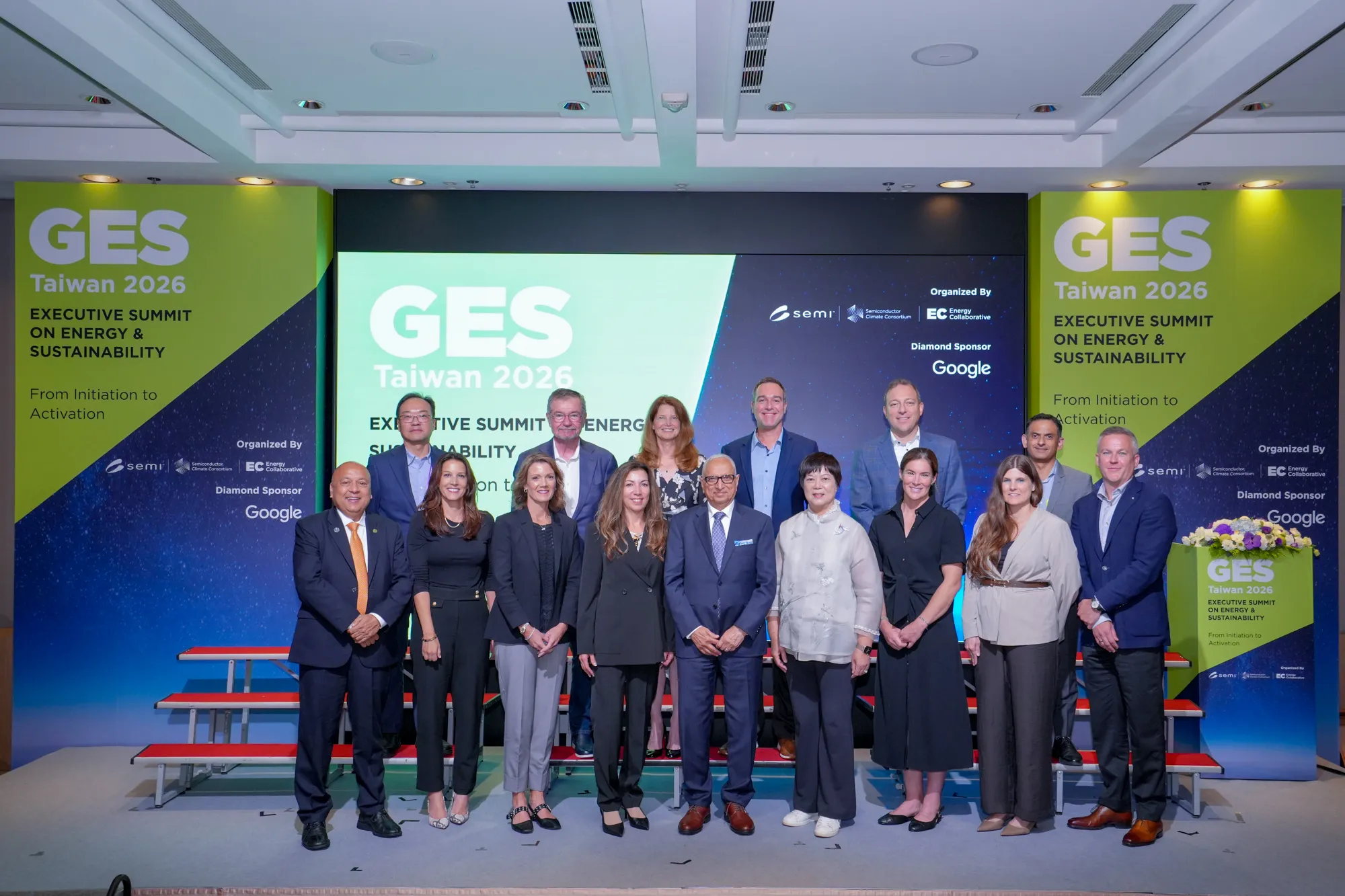
GES Executive Council Leaders attending GES Taiwan 2026
Front Row: Left to right: Dr. Saifi Usmani, SEMI; Ms. Angela Baker, Qualcomm; Ms. Elizabeth Elroy, Micron; Ms. Carolin Seward, Google; Mr. Ajit Manocha, SEMI; Ms. Lora Ho, TSMC; Ms. Susannah Calvin, Apple; Ms. Susan Duncan, Intel and Mr. Bruce Gall, Google.
Back row: Left to right: Mr. James Huang, GlobalWafers; Mr. Dan Hutcheson, TechInsights; Ms. Shawn Covell, Lam Research; Mr. Justin Murrill, AMD; Mr. Jens Liebermann, BASF and Mr. Sundeep Bajikar, Applied Materials.
The GES Executive Council (GESEC) session was sponsored by Google as Diamond Sponsor and co-hosted by Dr. Saifi Usmani and Mr. Bruce Gall, Strategic Partnerships Manager at Google. The session was inaugurated by Mr. Ajit Manocha, President and CEO of SEMI, and Ms. Carolin Seward, Vice President at Google, who opened and closed the morning session with a recognition and appreciation to the executives for the spirit of collaboration and the subsequent progress made on the four priority initiatives adopted at GES Tokyo 2025.
Carolin reminded the participants that “given the growth cycle ahead of us, it is imperative for us to be mindful of our environmental footprint while enabling access to clean energy to enable the growth cycle. We all need to work together to enable solutions for these challenges.”
Carolin and Ajit then invited Mr. Yein-Rui Hsieh, Deputy Minister, Ministry of Environment (MOENV) to deliver his opening remarks who shared Taiwan’s commitment to meeting Net Zero ambitions and highlighted that “As we pursue Net Zero by 2050, ensuring a stable power supply while accelerating industrial decarbonization as a shared challenge.”
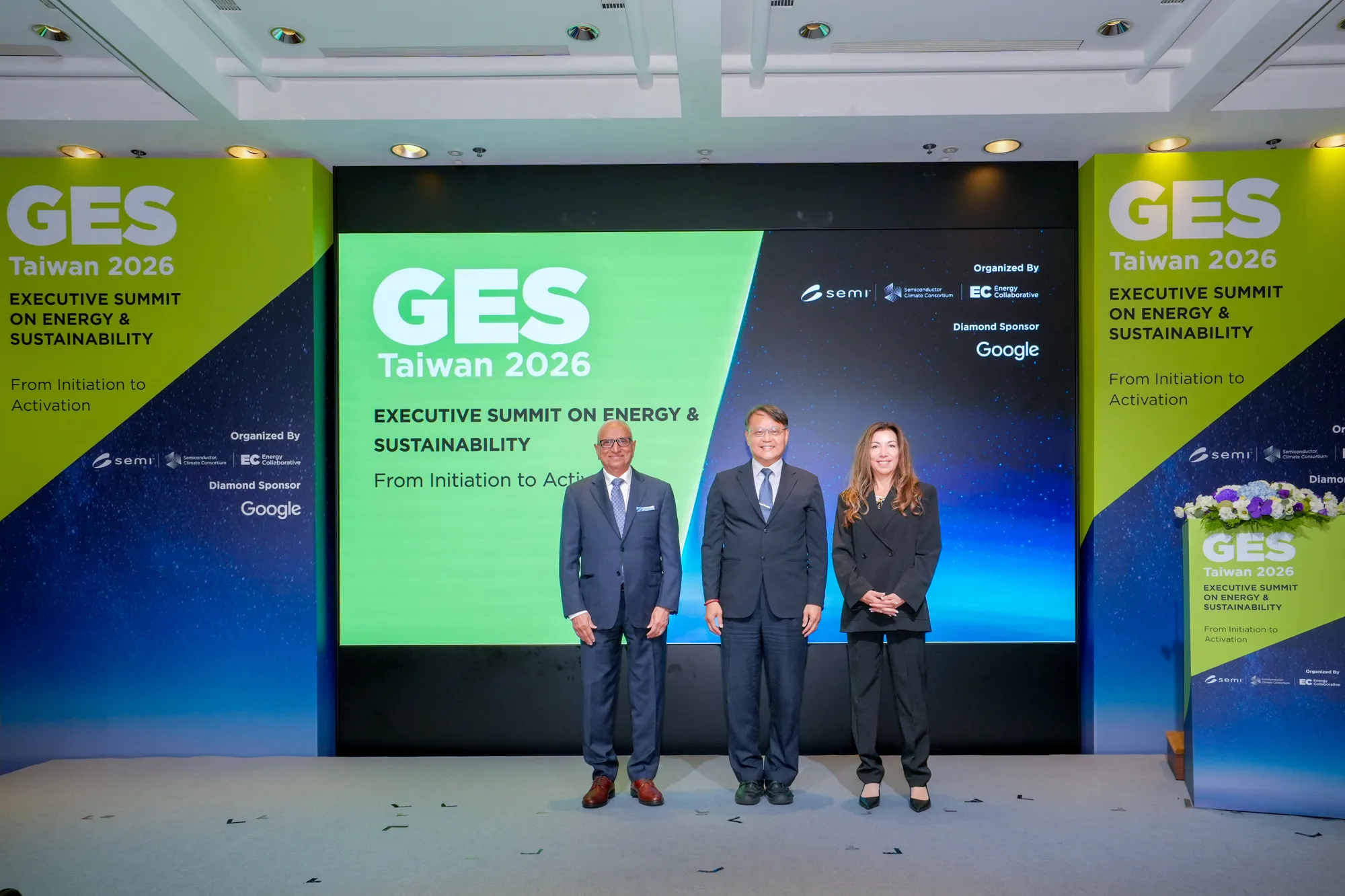
GES Executive Council Welcome by Leaders:
Left to right, Mr. Ajit Manocha, President and CEO of SEMI, Mr. Yein-Rui Hsieh, Deputy Minister, Taiwan Ministry of Environment (MOENV) and Ms. Carolin Seward, Vice President at Google.
In his welcome remarks delivered to the GESEC, Dr. Usmani traced the arc from Tokyo to the present: “That first summit convened more than 150 executives from roughly 100 companies across 15 countries, established four priority initiatives in Gas Substitution, Abatement, Fab Upstream Materials and Clean Electricity, and issued calls to action to move from Ambition to Initiation (inaugural summit in Tokyo in December 2025).” According to Usmani, “the GESEC was formed to create a mechanism to track progress on the priority initiatives adopted at GES Tokyo 2025 and to hold ourselves accountable to our collective commitments.” He then thanked GESEC members, initiative leads and GESEC co-vice-chair Mr. Bruce Gall for their passion and commitment to making significant progress on the four priority initiatives since Tokyo.
As the semiconductor and artificial intelligence sectors experience unprecedented expansion, the resulting surge in energy demand and carbon footprints has intensified the industry's environmental challenges. To address this crisis, executive participants across the global value chain are uniting through collaborative platforms like GES Taiwan 2026 and targeted initiatives to drive collective action on decarbonization. As listed above, the GES Executive Council is focused on four priority initiatives: expanding clean electricity access, substituting high-global-warming-potential gases, improving sub-fab abatement technologies, and decarbonizing upstream supply chains. At the GES Executive Council review, the Initiative Leads reported on progress across the four priority initiatives and highlighted the work completed since GES in Tokyo, with discussion focused not only on what has been achieved to date, but also on what will be required to accelerate implementation and deliver meaningful industry-wide outcomes.
Because the vast majority of the sector's emissions are tied to electricity consumption and supply chain networks, leaders are tackling critical barriers such as grid capacity, data-sharing constraints, and facility infrastructure limitations. Ultimately, the industry is shifting from high-level analysis to concrete implementation by developing standardized frameworks, regional policy engagement strategies, and targeted funding mechanisms to ensure long-term sustainable growth.
The Executive Council discussion emphasized that the rapid growth of the semiconductor industry requires a commensurate acceleration of our collective decarbonization progress through the four priority initiatives. This will require executive alignment, dedicated capital allocation, robust accountability mechanisms, and innovative employee engagement strategies modeled after successful corporate sustainability journeys.
In a post-GESEC survey among participating Executive Council and industry leaders, the respondents appreciated the progress made since GES Tokyo 2025 but highlighted the urgency to focus more on execution highlighting the need for additional resources to make progress on critical initiatives. It was recognized that funding SEMI Energy Collaborative is the loudest single ask to help unlock clean energy semiconductor value-chain in Asia Pacific. We believe the survey outcome provides an excellent summary of our efforts and expected actions.
The GES Executive Council session was conducted under Chatham House rules thus meeting files and summaries will only be issued to those participants who are currently members of the GES Executive Council. The GES organizers will revert to the participants with a plan for future GES events. If you would like to get further involved with GES Executive Council initiatives, please contact Peilun Sun at [email protected] and specify your interest so that we can connect you with the right initiatives and contacts.
Detailed Summary of GES Energy (Afternoon) Session
The GES Energy session, held in the afternoon, focused on Taiwan's energy transition, sponsored by Apple and TSMC as Platinum Sponsors and by AMD and ASE as Gold Sponsors and was co-hosted by Ms. Lora Ho, TSMC Consultant, former SVP, and long-standing ESG Committee Chair, Dr. Saifi Usmani, VP SEMI Sustainability, and Mr. Terry Tsao, Global Chief Marketing Officer of SEMI and President of SEMI Taiwan.
The GES Energy session was officially opened by Mr. Ajit Manocha, President and CEO of SEMI and Ms. Lora Ho, TSMC Consultant, former SVP, and long-standing ESG Committee Chair. They were then joined on stage by Dr. Tze-Luen Alan Lin, Deputy Executive Director of the Executive Yuan's Office of Energy and Carbon Reduction, who highlighted Taiwan’s commitment to meeting Net Zero 2050 in his remarks to welcome the delegates. The meeting was also graced by Dr. Chien-Hsin Lai, Vice Minister of the Ministry of Economic Affairs who delivered a speech on “Outlook for Taiwan's Energy Transition and Competitiveness”.
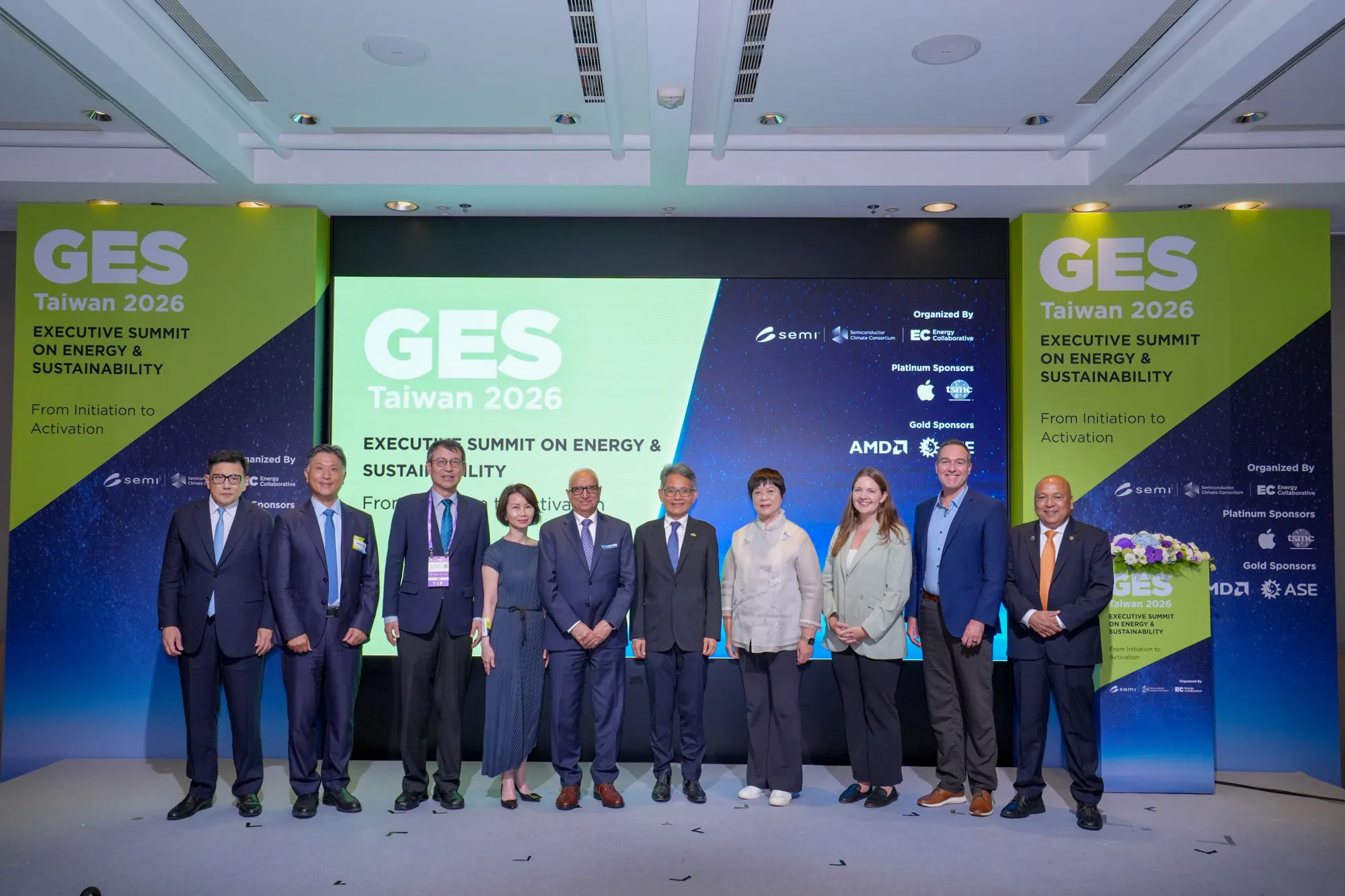
GES Energy Session Panelists and Speakers
Left to right: Mr. Terry Tsao, President of SEMI Taiwan, Mr. Daniel K.T. Kuo, Deputy Director at TSMC, Dr. Tze-Luen Alan Lin of the Office of Energy and Carbon Reduction, Executive Yuan, Jennifer Yuen of ASE Inc., Mr. Ajit Manocha of SEMI, Dr. Chien-Hsin Lai, Vice Minister of Ministry of Economic Affairs, Ms. Lora Ho of TSMC, Ms. Andrea Jorissen of Apple, Mr. Justin Murrill of AMD and Dr. Saifi Usmani, VP SEMI Sustainability.
The Growth Equation
In his opening remarks at the Energy session, Ajit stated that “for us to address the energy challenges for this industry, extensive engagement among people in this room is required.” Ninety-three new fabrication plants will come online through 2029, with seventy-five already in progress, and more than fifty additional fabrication plants will be required through 2035. Cloud infrastructure is expanding on a parallel curve, with 479 operational data center sites worldwide and seventy-seven more under construction. Mr. Manocha opened with those figures from SEMI's World Fab Forecast to establish what the industry is asking the grid to carry.
The arithmetic underneath them is unforgiving. Global electricity demand is projected to grow from roughly 28,200 terawatt hours in 2025 to 33,600 by 2030, an increase of 5,400 terawatt hours. On SEMI's analysis of IEA data, approximately 95 percent of the roughly 1,100 terawatt hours added each year through 2030 will need to come from new renewable generation if low-carbon share is to rise from 42 percent to 50 percent over that period.
Mr. Manocha then turned the argument around. This is not solely a burden we carry. Every new terawatt hour of renewable capacity runs on silicon, through power devices, inverters, storage and grid controls. Our industry is at once the party under pressure and the one supplying the means to relieve it.
Lora Ho highlighted “that we are chasing a moving target due to the quick expansion of AI demand.” She encouraged participants to continue the progress and innovation made since GES Tokyo 2025 and exhorted them never to give up in the face of challenges, noting that small gains combine into a big difference in achieving our climate and energy ambitions.
Taiwan Government's Commitment
Expressing sincere appreciation for organizing GES Taiwan 2026, Dr. Tze-Luen Alan Lin, Deputy Executive Director of the Executive Yuan's Office of Energy and Carbon Reduction reiterated the Taiwan government’s commitments to “meeting our legally binding 2050 Net Zero transition. We are gathered at this decisive turning point in Global Climate following COP30 where nations updated their 2035 Climate commitments, the global mandate is clear: Climate Ambition must translate into Deep Industrial transformation, Aggressive Clean Electrification and Supply Chain Transparency. Taiwan is fully stepped up to global code – Taiwan has committed to reducing net GHG emissions by 26% to 30% by 2030 and by 36% to 40% against 2005 baseline toward our legally binding 2050 Net Zero transition.”
Vice Minister Chien-Hsin Lai, Vice Minister of the Ministry of Economic Affairs, in his speech titled “Outlook for Taiwan's Energy Transition and Competitiveness” brought specific commitments that Taiwan intends to add generating capacity faster than its semiconductor load by adding approximately 15GW of energy supply by 2035 to exceed semiconductor demand and plans to spend heavily to do it. He also shared plans to accelerate RE deployment while adding diverse energy sources, in conjunction with investments in energy management and grid resilience.
Getting there means building capacity. Mr. Lai detailed NT$5.4 trillion in supply security investment across 2026 to 2035, adding some sixty-one gigawatts of capacity across natural gas, solar PV, offshore wind, geothermal and small hydro, with a further NT$564.5 billion for grid resilience and NT$91.7 billion for demand management. Taiwan ranked third worldwide in natural gas capacity additions in 2024 and again third in offshore wind additions in 2025, and its solar PV capacity has grown roughly thirteenfold since 2016.
Regulation is moving at a similar pace. Lai counted 14 amendments enacted between October 2023 and August 2026, among them behind-the-meter storage subsidies, revised renewable energy certificate rules, a mandatory renewable or storage requirement for large users, and a new obligation for data centers above 5 megawatts to file an energy use statement before building or expanding.
Taiwan is a Proving Ground for Speed to Power for Semiconductor Supply Chain:
Mr. Terry Tsao, President of SEMI Taiwan, described Taiwan as a proving ground for low-carbon solutions but reminded everyone that it is first and foremost the manufacturing base supporting global technology advancement. Precisely because Taiwan carries the production of the world's advanced chips and AI computing power, reliable power supply has become more critical than at any previous point. Tsao closed on the framing that defined the day. The energy transition, he said, must evolve from initiation to activation, with 2030 as the pivotal milestone for supply chain decarbonization. The hope for the summit was that a global perspective paired with Taiwan's execution capability would convert consensus into projects that are bankable and cross-sector.
Dr. Saifi Usmani encouraged the energy ecosystem to urgently tackle the fast-increasing clean energy demand as “chips will increasingly be built where the clean power is!” He reiterated the need for speed in delivering clean power by stating that “speed to clean power is speed to market for AI Infrastructure.”
Beyond Procurement:
Daniel K.T. Kuo, Deputy Director of TSMC's Facility Supply Chain Management Division, delivered the pivot of the afternoon. Net zero, he argued, is no longer a carbon question but an energy supply security one, and AI factories are scaling faster than the infrastructure meant to power them.
That framing raises the bar on what counts as a solution. Semiconductor manufacturing at nanometer scale does not simply require electricity. It requires firm power, available every hour of every day, with zero voltage drop and zero interruption.
The past decade of corporate energy strategy focused on procurement, and large-scale wind and solar power purchase agreements delivered real progress. The next phase is considerably harder. TSMC remains committed to RE100 by 2040 and net zero emissions by 2050, and Kuo was candid that honoring those commitments while AI-driven demand keeps climbing is the real work, not the pledge itself.
Efficiency as a Lever:
Supply is only one side of the equation, and the afternoon's final keynote worked the other.
Justin Murrill, Chief Sustainability Officer at AMD, opened from history. Ozone depletion and the phase-out of leaded gasoline each demanded coordination between upstream chemical producers and downstream manufacturers, and each turned a limit into a breakthrough. Constraint, in his framing, is the industry's most reliable design partner.
Today's limit is energy. Frontier model training compute has grown four to five times per year, far outpacing Moore's Law, while global electricity demand grows at roughly 3.5 percent annually through 2030. Making and operating AI more sustainably, Murrill argued, is becoming a market access question rather than a cost or reporting exercise, and he pointed to power and water disclosure requirements in Texas and limits on large data centers in northern Taiwan as evidence of the shift.
His argument for where leverage sits was specific. AI accelerators account for the majority of rack-level power in a typical AI data center, with cooling and power delivery losses accounting for much of the remainder. A watt saved in silicon is therefore saved again at the node, the rack, the data center and the grid. AMD's chiplet architecture illustrated the compounding effect: across four generations of accelerator, the compute die delivered thirteen times more peak half precision performance at 92 percent lower carbon intensity and 21 percent lower embodied emissions.
The Conversations in the Room
That cascade only works if every link in it pulls the same direction, which is why the afternoon closed in conversation rather than presentation. Two panels brought the day's arguments into contact with one another, and their composition reflected the summit's premise that no single party controls the outcome.
Panel A, moderated by Lora Ho of TSMC and conducted in Mandarin with simultaneous English translation, addressed opportunities for public-private partnership in Taiwan's energy transition. Regulator, utility, manufacturer and developer sat on one stage: Chih-Wei Wu, Director General of the Energy Administration at the Ministry of Economic Affairs; Wen-sheng Tseng, Chairman of Taiwan Power Company; Du Tsuen Uang, Chief Administrative Officer of ASE; and Jason Chou, General Manager of HD Renewable Energy. Across four questions the panel worked from where public-private partnership can create the greatest impact over the next three to five years, through how to break the coordination problem that slows delivery, to how risks, responsibilities and incentives should be distributed among government, utilities, industry and developers. It closed by asking what single flagship initiative Taiwan should launch before 2030.
Panel B turned to the buyer and investor perspective, examining key opportunities, challenges and calls to action across Taiwan's transition. Moderated by Yushen Liu, Co-head of APAC Commercial at BloombergNEF, it paired three of the world's largest corporate clean energy buyers with one of its largest infrastructure investors, bringing together Will Hudson, Director of Energy and Sustainability Policy for Asia-Pacific at Microsoft; Josh Seidenfeld, Cloud Sustainability Supplier Engagement and Clean Energy Lead at Google; Han Chen, Head of Clean Energy Policy for Asia at Apple; and Bob Shueh, Managing Director for Energy at Brookfield Corporation. Its five questions traced a delivery pathway end to end: expanding renewable supply to unlock the next wave of medium and large-scale projects, strengthening grid and infrastructure readiness across transmission, storage, substations and siting, improving utilization through surplus renewable energy and more flexible matching arrangements, broadening market access so a wider range of corporate users can procure, and building policy momentum toward 2030. The panel closed on a call to action: advance an integrated renewable energy delivery pathway that connects new supply, enabling infrastructure, efficient utilization and broader market access, translating corporate demand and policy momentum into investment that scales.
The Road to 2030
Manocha and Ho closed the summit together, returning to the theme Tsao and Usmani had opened on: Taiwan's semiconductor ecosystem, from front-end manufacturing and memory through advanced packaging and test, has accumulated practices it is prepared to share in order to lift the wider supply chain. But net zero across our industry requires cross-sector collaboration that no single company or government can deliver alone.
Commitments of that scale raise the question the summit was organized to answer. What converts them into delivery? Dr. Usmani reiterated that “it requires concerted and coordinated action by all ecosystem partners – among customers and suppliers alike.” He stated that SEMI will continue to bring the ecosystem together to tackle and address industry wide challenges and we request continued investment and engagements to continue progress through platforms such as the GES Executive Council, the Semiconductor Climate Consortium, the SEMI Energy Collaborative, and in Taiwan the Global Green Energy and Sustainability Alliance. As an example, Dr. Usmani highlighted that through the SEMI Energy Collaborative, SEMI has convened twenty-three government roundtables across five economies since 2024, five of them here in Taiwan with the Ministry of Economic Affairs, to advance the energy agenda for the semiconductor ecosystem. Korea's recent legislative progress illustrates both the opportunity and the caution. Ambition is necessary, and its long-term value depends on continued collaboration and partnership to unlock clean energy by investing in and enabling credible pathways to implementation.
Conclusion
GES Taiwan 2026 underscored that reliable clean energy is no longer just a reporting metric, but a core determinant of market competitiveness and the literal velocity of the global AI revolution. While the semiconductor industry has made measurable headway since the inaugural GES Tokyo summit in 2025, leaders agree that the coming years require an aggressive pivot from initiation to activation. By pairing Taiwan's manufacturing execution capability with a newly backed NT$5.4 trillion energy transition framework, the sector aims to accelerate Scope 1, 2, and 3 decarbonization and ensure that future clean power availability is not only abundant but affordable to meet the growing needs of the economy where more of the modern chips are built.
Next Steps
In terms of next steps, the Council will receive an offline status update on initiative progress before year end and will reconvene alongside the next summit. The date and location for the next GES have not been determined and will be communicated by the end of 2026.