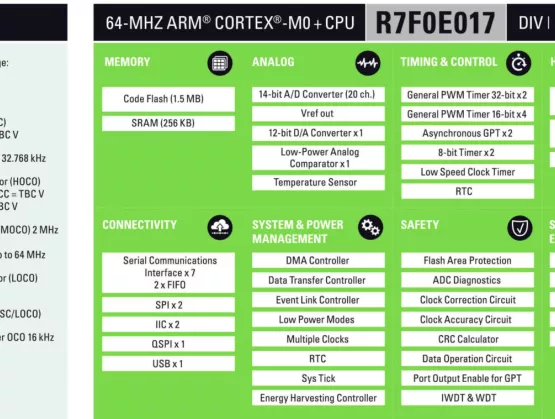
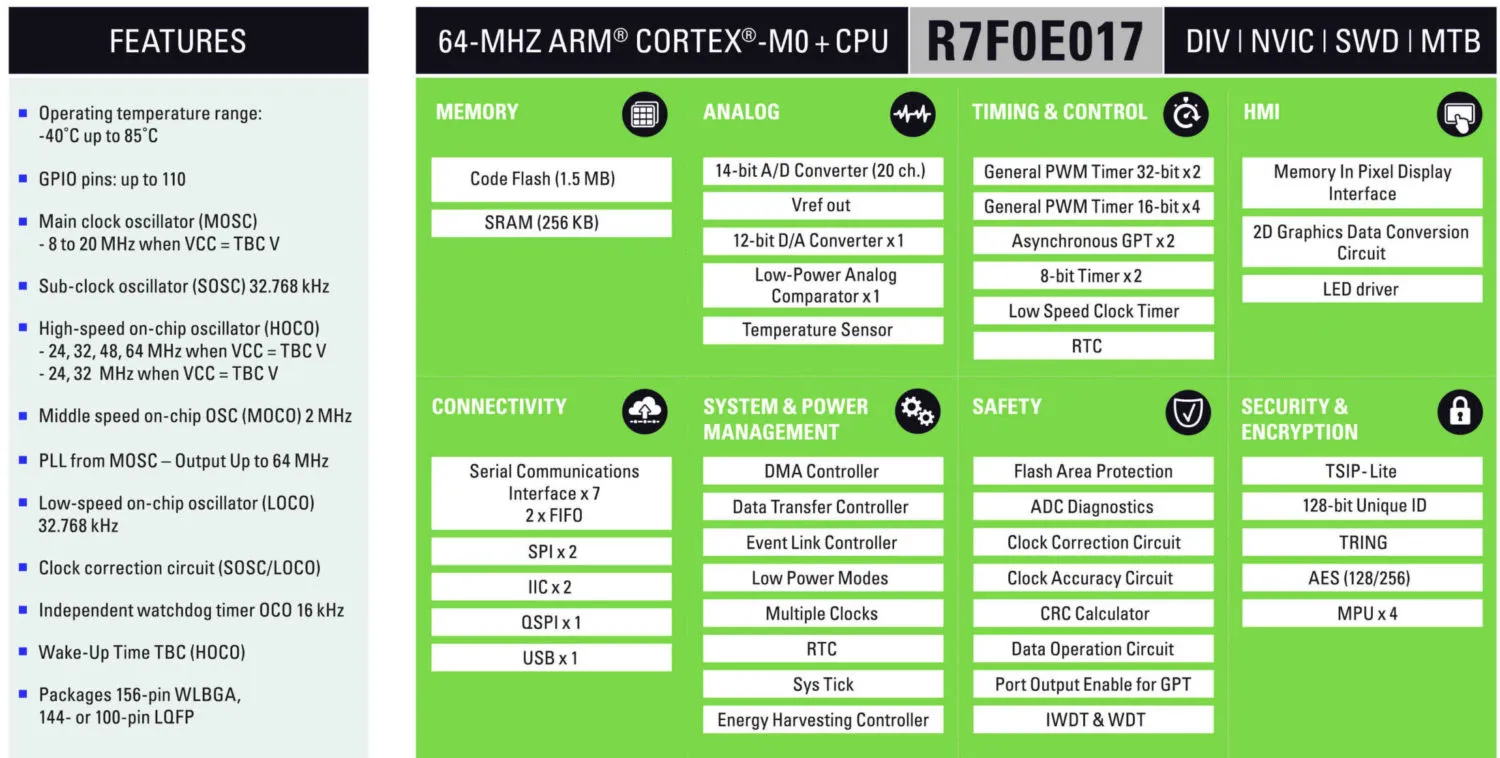
Renesas, one of the world’s very top MCU manufacturers, is heralding its new FD-SOI based R7F0E017 for energy harvesting applications. In an in-depth article in the May 2019 edition of EENews Embedded, Renesas Product Marketing Manager Graeme Clark detailed the new chip, which is sampling this year. It’s a fascinating read, with lots of explanations about how SOI enables the cutting-edge features (like an integrated energy harvesting controller) – you won’t want to miss it. BTW, here at ASN we’ve been covering the origins of this technology since 2005.They call it SOTB, for Silicon On Thin Box, but it is indeed their flavor of FD-SOI. The work started at Hitachi in cooperation with Renesas with a paper that debuted at IEDM 2004, then moved along through the series of mergers that resulted in the offering at what is Renesas Electronics today. Here
are some key quotes from the article:“The
new SOTB process can now offer active mode current of less than 20
µA/MHz and leakage currents down to 150 nA, while still allowing the
development of devices with reasonably high clock rates, large
embedded flash memories and SRAMs on chip. This combination of
integration and power consumption will make devices developed on this
process ideal for energy harvesting applications. The result of this
new process is that we can develop a new generation of
microcontroller products.”
“The
use of the Silicon on Thin Buried Oxide technology on this new device
has resulted in some unique low power characteristics. The first
device has the following features and future devices using this
process could offer even lower power consumption. Active current of 20 µA /MHz Standby Current of 200 nAADC operation 3 µA @ 32 kHz256 Kbyte SRAM with 1 nA / Kbyte standby current”
“The
R7F0E017 is able to run safely from a pure energy harvesting power
source due to the operation of the Energy Harvesting Controller. The
device can operate from a wide range of potential energy sources
including solar power, vibration, pressure and temperature
difference, and many others. The integrated energy harvesting
controller, supported by very few inexpensive external components,
completely manages the cyclic wake-up sequence of the
microcontroller, only using the extremely low energy harvesting
source current.”Click here to read the full article on the eenewseurope website.