The world's SOI wafer leader, Soitec is posting strong sales and issuing a steady stream of compelling announcements. This is clearly good news for everyone in the SOI ecosystem, as the outlook for the various families of SOI wafers is excellent.
Soitec CEO Paul Boudre told ASN, “I'm excited because of the fundamentals behind the growth. Reaching down the supply chain gives us the ability to help our customers with the next generation. We're not in a technology push, but in a technology pull. It's long-term growth we're seeing.”
[caption id="attachment_15532" align="alignleft" width="239"] Paul Boudre, CEO, Soitec[/caption]
Soitec has brought people from the device side into the company to better understand the solutions customers need, he said. They're talking to the carmakers, telcos and more, working one-on-one with them to understand the constraints and the problems they are trying to fix, in order to deliver a solution based on the Soitec product roadmap. Boudre is particularly excited about 5G. It's not just new handsets and systems: the entire infrastructure will require a massive upgrade, across which Soitec has a role to play supplying SOI wafers.
They also have other SOI and engineered substrates for specific markets like filters, displays, imaging and power. He adds that they're seeing nice growth in SOI wafers for photonics, driven by cloud computing, and for smart power in markets like automotive and white goods.
Here's a roundup of some recent developments. Chips made on RF-SOI wafers are in every mobile phone made on the planet these days, so lets look at what they're doing there first. We'll follow that with an update on the surge of activity on FD-SOI wafers.
Simgui, RF Power
It's no secret that the runaway success of RF-SOI for front-end modules (FEMs) in mobile phones has stretched wafer capacity mightily. To help address this, in February 2019 Soitec and China's SOI wafer leader Simgui announced an enhanced partnership and increased production capacity of 200mm SOI wafers in China, securing future growth. The two companies redefined their manufacturing and licensing relationship to better serve to better serve the growing global market for RF-SOI in mobile and Power-SOI in automotive and consumer electronics.
[caption id="attachment_15535" align="alignright" width="936"] (Image courtesy: Simgui)[/caption]
Since the two companies signed their original licensing and technology transfer agreement in May 2014, Simgui has mastered Soitec’s Smart Cut™ proprietary process to deliver world-class RF-SOI and Power-SOI products. Simgui’s strategic partnership with Soitec allows them to use the same tools and processes to deliver the same products meeting the same specifications.
Simgui has invested in their Shanghai fabrication line in order to double annual 200mm SOI wafer production capacity from 180,000 to 360,000. The fab is production ready, having been qualified by multiple key customers inside and outside China.
Simgui CEO Dr. Jeffrey Wang notes, “China has design, wafer manufacturing and good momentum in the IC industry. We are committed to our strategic partnership with Soitec to keep advancing SOI as China’s key differentiator.”
With China Mobile
China Mobile's interest in the SOI ecoystem is clear: they've presented at the SOI symposia in Shanghai for two years running now. In a February 2019 press release, Soitec announced that they've joined the China Mobile 5G Innovation Center – and they're the first materials supplier to do so. The China Mobile 5G Innovation Center is an international alliance chartered to develop 5G communication solutions for China, the world’s largest wireless communications market with 925M mobile subscribers. The Center aims to accelerate the development of 5G by establishing a cross-industry ecosystem, setting up open labs to create new products and applications, and fostering new business and market opportunities.
Soitec's RF-SOI wafers have been critical in the deployment of 4G communications, and the opportunity in 5G is even bigger. Plus the company's FD-SOI wafers enable the technology that brings unique RF performance, making it an ideal solution for many applications including mmWave communications such as 5G transceivers. They are also enabling full RF and ultra-low-power computing integration for IoT and edge computing.
For Samsung Foundry
In January 2019, Soitec announced that they have expanded their collaboration with Samsung Foundry on the FD-SOI wafer supply, securing the high-volume Samsung needs to meet industry's current and future demands in consumer, IoT and automotive applications. The agreement is built on the existing close relationship between the companies and guarantees wafer supply for Samsung’s FD-SOI platform starting with the 28FDS process.
“Samsung has been committed to delivering transformative industry leading technologies,” said Ryan Lee, Vice President of Foundry Marketing at Samsung Electronics. “FD-SOI is currently setting a new standard in many high-growth applications including IoT with ultra-low-power devices, automotive systems such as vision processors for ADAS and infotainment, and mobile connectivity from 5G smartphones to wearable electronics. Through this agreement with Soitec, our long-term strategic partner, we hope to lay the foundation for steady supply to meet high-volume demands of current and future customers.”
“This strategic agreement validates today’s high-volume manufacturing adoption of FD-SOI,” said Christophe Maleville, Soitec’s Executive Vice President, Digital Electronics Business Unit. “Soitec is ready to support Samsung’s current and long-term growth for ultra-low power, performance-on-demand FD-SOI solutions.”
Silicon Catalyst Partner
In February 2019 Soitec announced they'd become a strategic partner in Silicon Catalyst's start-up incubator. Silicon Catalyst is a Silicon Valley-based incubator providing silicon-focused start-ups access to a world-class network of advisors, design tools, silicon devices, networking, access to funding and marketing acumen needed to successfully launch their businesses.
[caption id="attachment_15534" align="alignright" width="300"] (Image courtesy: Soitec, Silicon Catalyst)[/caption]
Soitec will engage in this start-up ecosystem to gain insight into the newest technologies and applications across high-growth markets, and to guide nascent technologies to successful market penetration.
“As a Strategic Partner of Silicon Catalyst, Soitec has a unique opportunity to grow our visibility among early-stage semiconductor companies,” said Thomas Piliszczuk, Executive VP of Global Strategy for Soitec. “Engineered substrates give semiconductor related start-ups a competitive edge in developing new high-performance, energy-efficient solutions."
Pete Rodriguez, CEO of Silicon Catalyst said, “Soitec is creating technical advances that are enabling the next generation of products across many market segments. Their SOI technology is a key ingredient to meet the diverse challenges for breakthrough differentiated semiconductor products, combining ultra-low power with excellent analog/mixed-signal performance.”
Energy Harvesting with Renesas
And finally, jumping back a few months, at the end of 2018 Soitec announced that their SOI wafers are at the heart of a new Renesas SOTBTM energy harvesting chipset, opening a self-powered future for IoT devices. SOTB is how Renesas refers to its FD-SOI technology.
[caption id="attachment_15533" align="alignleft" width="300"] (Image courtesy: Renesas)[/caption]
(BTW, here at ASN we've been covering the work that Renesas has quietly done on this technology since 2005 (!). And we did a piece about an EETimes Japan article back in 2015 that revealed the launching of the 65nm work. )
Soitec supports the Renesas SOTB chipset with a special version of its FD-SOI wafer product line. The new Renesas SOTB-based chipset overcomes the energy constraints of IoT devices and reduces the power consumption to approximately one-tenth that of the existing products in the market today. That makes the chipset perfectly suited for extreme low-power, maintenance-free and energy harvesting applications including wearable devices, smart home applications, smart watches, portable appliances, infrastructure monitoring systems, industrial, business, agricultural, healthcare, as well as health and fitness apparel, shoes, drones and more.
Renesas has developed its energy harvesting chip using its unique SOTB 65nm process technology that achieves both low active current of 20 μA/MHz and deep standby current of 150 nA. As a result, Renesas’ SOTB chipsets offer enhanced control of the transistor electrostatics and reductions in both the standby and active currents to levels never before achieved. Additionally, Renesas has successfully delivered the dopant-less channel to suppress Vth variability for the ultra-low voltage operation, and the ultra-low power back bias control to reduce the standby current at the same time.
“To spur innovations in IoT and consumer applications, we have integrated our exclusive energy-harvesting SOTB technologies into our Energy Harvest Controller,” said Mr. Toru Moriya, Vice President of Renesas’ Home Business Division, Industrial Solutions Business Unit. “We are confident that our SOTB technology built on Soitec’s ultrathin substrates can deliver unmatched capabilities for developing maintenance-free IoT devices that never require power supply or replacement, giving rise to a new IoT global market based on endpoint intelligence.”
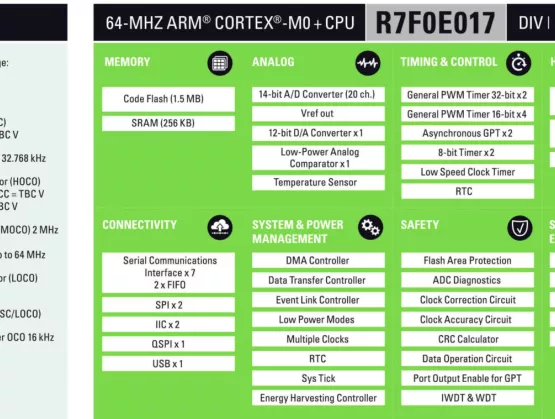
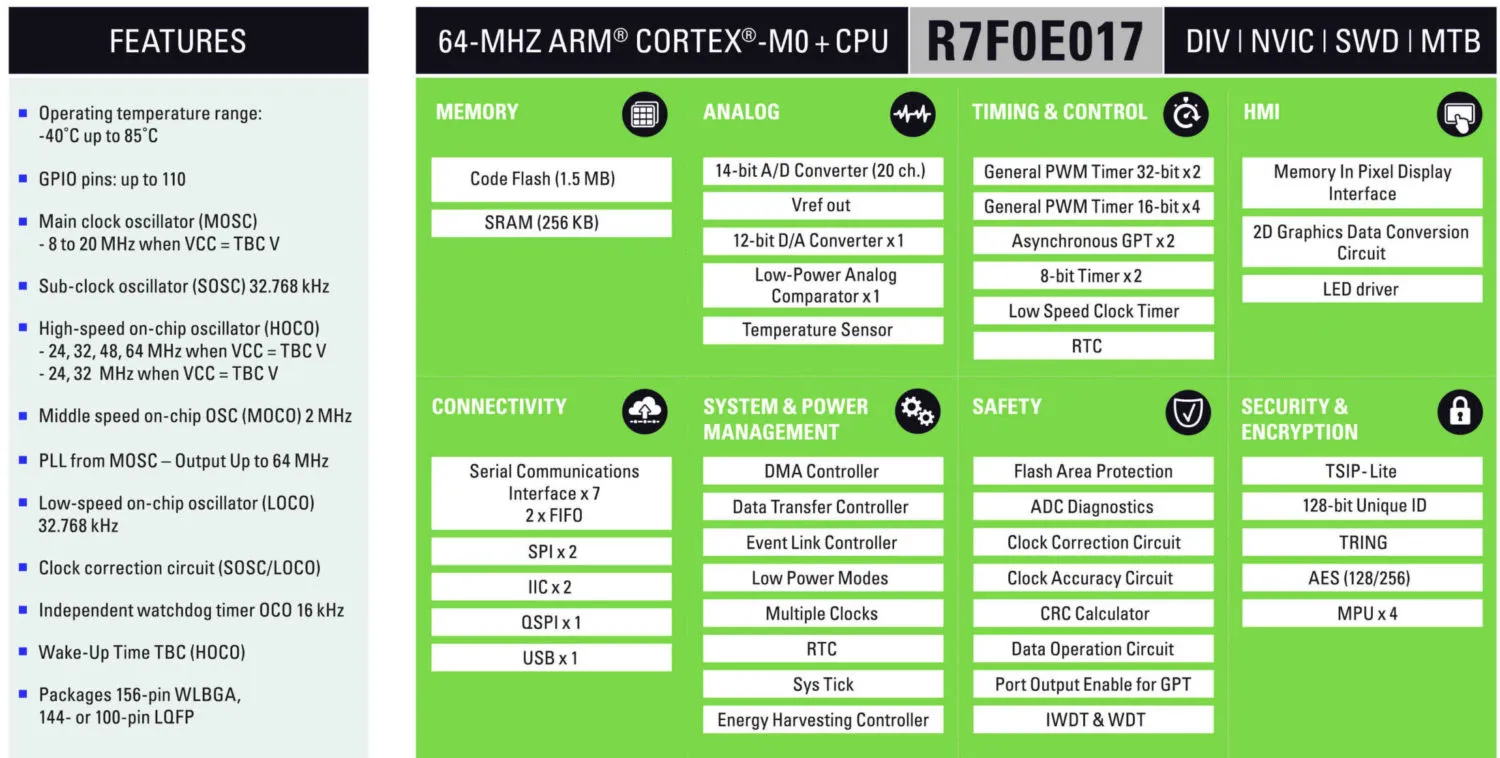
[caption id="attachment_15714" align="alignleft" width="300"] (click to enlarge) Block diagram of the Renesas R7F0E Embedded Controller, their first device based on their SOTB (aka FD-SOI) technology. Target applications are battery-free connected IoT sensing devices with endpoint intelligence. (Image courtesy Renesas)[/caption]
The new R7F0E Embedded Controller is the first device based on Renesas’ SOTB technology. Developers can now design applications that need no battery or recharging. The R7F0E features: an Arm® Cortex® -M0+; operating frequency up to 32 MHz, and up to 64 MHz in boost mode (that's body bias in action!); memory of up to 1.5 MB flash, 256 KB SRAM; and active current consumption while operating at 3.0V of just 20 µA/MHz, and in deep standby of 150 nA with real-time clock source and reset manager. As of this writing, Renesas indicates it's engaging select customers through July 2019, with mass production in 4Q19. Read more about the RE Family SOTB™ Process-Based Energy Harvesting Embedded Controllers on the Renesas website.