downloadGroupGroupnoun_press release_995423_000000 copyGroupnoun_Feed_96767_000000Group 19noun_pictures_1817522_000000Member company iconResource item iconStore item iconGroup 19Group 19noun_Photo_2085192_000000 Copynoun_presentation_2096081_000000Group 19Group Copy 7noun_webinar_692730_000000Path
Skip to main content
Default Banner Image

self-driving vehicles

It’s official.The first autonomous vehicle has been verified for operation on the open road in Asia with no traffic restrictions. And this is no corner case, flash-in-the-pan technology. The white 4-door minivan’s modular software can be integrated into all manner of vehicles including cars, trucks and buses. More promising still, the minivan – proven roadworthy after more than 1,300 miles of testing – will lead not only to an upgrade of Taiwan’s automobile electronics industry but to groundbreaking smart transportation service models.Imagine, for example, hopping a driverless shuttle to the hottest attractions in Hsinchu City, Taiwan such as Big City, Hsinchu Cheng Huang Temple, 19 Hectares Grassland, 17KM Coastline Scenic Area and Siangshan Wetland. The autonomous ride could become another transportation option sooner than you think.“We have every intent to make available self-driving sightseeing shuttle services soon,” said Chih-Chien Lin, mayor of Hsinchu City. “The services will be our first step to substantially improving the traffic flow, highlighting the unlimited applications associated with autonomous vehicles.”Bearing the license plate number Taiwan No.0001 – the first issued for an autonomous vehicle in Taiwan – the minivan is an early but important advance in the region’s autonomous-driving technologies under a new initiative led by the Industrial Technology Research Institute (ITRI), which developed the test vehicle’s software, and the Hsinchu City government. SEMI president and CEO Ajit Manocha joined Hsinchu City mayor Chih-Chien Lin and ITRI vice president Pei-Zen Chang to promote the initiative at SEMICON Taiwan 2019 in the run-up to its launch during an October 22nd press conference in Hsinchu City. Taiwan luminaries attending the press conference were (L-R in photo below) Terry Tsao, SEMI Chief Marketing Officer and SEMI Taiwan President; Jwu-Sheng Hu, Vice President and General Director, ITRI Mechanical and Mechatronics Systems Research Laboratories; Der-Sheng Lin, Deputy Director General, MOEA Department of Industrial Technology; Chih-Chien Lin, Mayor of Hsinchu City; Pei-Zen Chang, Vice President, ITRI. ITRI and Hsinchu City government officials kick off the next phase of Taiwan’s smart transportation initiative in an October press conference near Nanliao Fishing Harbor, Hsinchu City. “This milestone in self-driving technology is a shining example of public-private partnerships in action to advance smart mobility and dovetails with SEMI's work building communities consisting of the automotive and microelectronics industries, government, and academia for collaborative innovation,” said Terry Tsao, SEMI chief marketing officer and SEMI Taiwan President. “We are thrilled to have joined ITRI and the Taiwan government in promoting the extraordinary power of technology to make automobiles and cities smarter.”Emmy Yi is a marketing specialist at SEMI Taiwan.
Read More
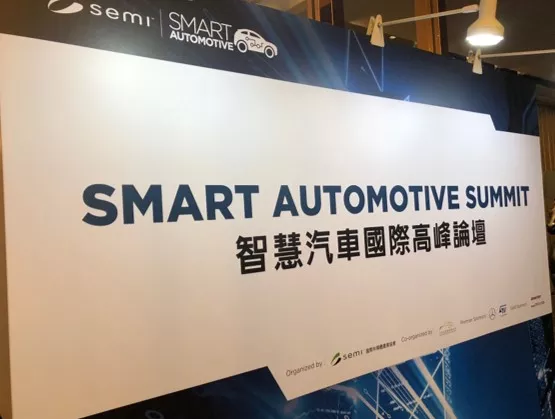
Are you ready for a shared economy where your transportation needs are no longer met by an automaker, but rather a “mobility service provider”? While smart transportation news has mostly focused on the likes of electrification (Tesla) and autonomy (Waymo), the real changes in transportation may be more fundamental than self-driving electric cars. According to presenters at this week’s Smart Automotive Summit at SEMICON Taiwan, new technologies won’t just make cars smarter: they will transform the way we see and use transportation in myriad ways.Constance Chen, public relations general manager for forum sponsor Mercedes Benz, opened with a brief overview of parent Daimler’s evolving approach to transportation, dubbed CASE, which stands for Connected, Autonomous, Shared and Services, and Electric.“The fundamental value of vehicles is changing,” Chen said, and car ownership is one of the biggest changes. Ride-sharing services like Uber and Lyft, and shared car services like ZipCar and DriveNow, are already addressing the transportation needs of a growing urban population that eschews car ownership. Traffic congestion, parking challenges, and a desire to improve air quality are key drivers (no pun intended) moving people away from car ownership to embrace shared transportation solutions.Indeed, societal considerations are as challenging as some technological hurdles facing autonomous vehicle development. Robert Brown, Taiwan operations manager for Magma Electronics, listed his top five challenges for autonomous transportation: Perception (vision, sensors) Assessment (ability of systems to analyze data) Control (need for faster-than-human response) Communication (vehicle-to-vehicle, vehicle-to-everything) Expectations—specifically people’s expectations of the value autonomous transportation should deliver As people change the way they view transportation and begin to understand what is possible when they can relinquish control of their vehicle, they’re transportation needs and expectations are likely to change. The challenges are, of course, also an opportunity to deliver a wide range of services, including information, entertainment, and retail, which opens the door for traditional carmakers to position themselves more as service providers like Mercedes Benz.For those who have grown up with traditional car ownership and the perceived freedom that owning allows one to go anywhere at anytime, the idea of giving up their car—one that they drive themselves—might seem beyond the pale. But as ride-sharing services are already showing, a growing portion of our population seems more than ready to embrace a shared and autonomous future.The SEMICON Taiwan Smart Automotive Summit is part of SEMI’s Smart Transportation initiative focusing on automotive electronics, a top priority for SEMI and its 2,000+ members. SEMI’s industry standards, technology communities, roadmap efforts, EH S/regulatory activities and other global platforms and communities bring together the automotive and semiconductor supply chains to collaborate, increase cross-industry efficiencies and shorten the time to better business results.Michael Droeger is director of marketing at SEMI.
Read More
Emboldened by advances in self-driving and Internet of Vehicles (IoV) technologies, Taiwan’s microelectronics sector is investing heavily in manufacturing processes and equipment as engines of innovation and growth for autonomous driving, the world’s next market goldmine. But breaking into the self-driving vehicle industry can be a steep uphill climb. Semiconductor players hungry to secure their piece of the potentially massive market must know how to navigate the automotive industry’s unique ecosystem of suppliers, not to mention its lofty standards for safety and reliability.To explore opportunities and challenges in the automotive semiconductor market, SEMI recently organized Mobility Tech Talk – a gathering of experts from Strategy Analysis, Yole Développement, Renesas, X-FAB and IHS Markit who examined the evolution of sensors for autonomous cars, advanced driver-assisted system (ADAS) applications, and new energy vehicles (NEVs) in China. Nearly 200 participants exchanged in-depth, forward-looking insights and perspectives as the event helped forge stronger relations among various market segments. Here are four key takeaways from the conference. Lidar: The Hottest Sensing Technology for Smart AutomotiveLidar, mmWave radar, cameras and inertial measurement units (IMUs) are critical sensing devices for autonomous cars. With sensor and high-speed computing technologies maturing at their current pace, some 350,000 self-driving vehicles are expected to hit the road by 2027. But before a single autonomous vehicle takes to the roadways, self-driving technology must become expert at monitoring a vehicle’s environment.That’s where Lidar, the hottest of all sensing technologies and the key to the holy grail of safe self-driving, comes into the picture. Lidar’s versatility supports multiple essential functions such as mapping, object detection and object movement. The problem is that mass production is still impossible due to the technology's high costs. What’s more, technical issues must still be sorted out with solid-state lidar, mechanical lidar and MEMS. Both startups and traditional tier-1 semiconductor manufacturers are aggressively investing in related research and development in hopes of fulfilling lidar's promise and seizing the market opportunity. Smart Automotive Sets New Quality and Safety StandardsAs cars become smarter, so too must silicon. Chips must support vastly more data generated by in-vehicle connectivity, ADAS, electrification, autonomous driving and an array of other functions that rely on advanced automotive electronics components. With demand for smarter silicon surging, Taiwan semiconductor companies are turning to the automotive chip industry for expertise and serving as OEMs for major automakers.Quality and safety for automotive applications is paramount. In-vehicle semiconductors must meet strict requirements for vehicle control, robustness, liability, cost and quality management to meet the automotive specifications necessary to securing certifications. Smart silicon must also pass all AEC-Q liability standards promoted by North America automakers and score “zero defect” for the ISO/TS 16949 Automotive Quality Management System.China’s New Energy Vehicles To Fuel Semiconductor GrowthTo promote NEVs and reduce fuel consumption of cars with internal combustion engines (ICEs), late last year the Chinese government introduced the Measures for the Parallel Administration of the Average Fuel Consumption and New Energy Vehicle Credits of Passenger Vehicle Enterprises. With China the world’s largest market for NEVs, the policy is forcing automakers in Japan, the U.S. and Europe to accelerate moves towards NEVs that, in turn, will fuel growth in the semiconductor and automotive battery industries. NEVs in China are expected to number 2 million by 2020 before more than doubling to 4.9 million by 2025. Today, most cars still run on ICEs as environmentally friendly motor drives are still under development. In unit shipments, motor drives are expected to surpass ICEs by 2025.Cross-field Collaboration is KeyThe rise of smarter, fully autonomous vehicles – a disruptive Car 2.0 – is unlikely to happen overnight. Rapid growth of the global automotive semiconductor market will continue, with safety and powertrain applications driving the strongest chip demand. Meanwhile, automakers are focusing more on innovations from startups and non-traditional suppliers, and some have even started to develop their own IP and solutions. These paradigm industry shifts are diversifying the automotive supply chain into a cross-domain collaborative network of suppliers, pushing the closed, one-way automotive supply chain into lesser relevance. In the near future, rivals and partners may become indistinguishable as traditional turf wars begin to wane. As ADAS and autonomous cars evolve, and the era of electric cars nears, automotive semiconductors are emerging as the engine of growth for the global semiconductor industry. The automotive semiconductor market is expected to grow at a CAGR of 5.8 percent, reaching US$48.78 billion by 2022.For its part, the SEMI Smart Automotive special interest group connects professionals from the microelectronics and automotive industries. The group promotes the semiconductor industry's development of automotive technologies and cross-domain collaboration to help drive autonomous vehicle innovation.
Read More