downloadGroupGroupnoun_press release_995423_000000 copyGroupnoun_Feed_96767_000000Group 19noun_pictures_1817522_000000Member company iconResource item iconStore item iconGroup 19Group 19noun_Photo_2085192_000000 Copynoun_presentation_2096081_000000Group 19Group Copy 7noun_webinar_692730_000000Path
Skip to main content
Default Banner Image

virtual trade show

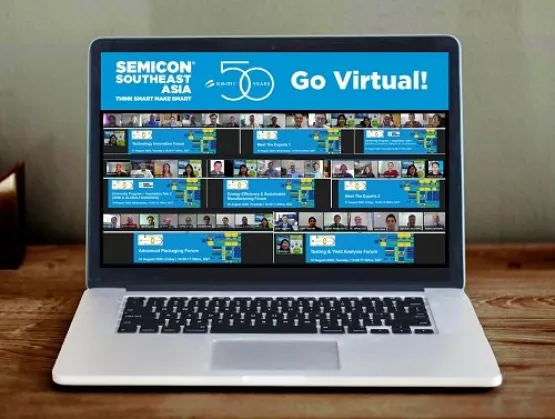
Never before had we expected that SEMICON SEA 2020 would go virtual.The COVID-19 crisis abruptly halted our ability to hold our premier Southeast Asia electronics manufacturing exposition as we typically do – in the physical realm. The pandemic tested our adaptability, challenged our willingness to experiment and, perhaps above all, accelerated not only our own but the world’s digital transformation. We had to change our way of doing business and learn to connect virtually like we had never had before. SEMI continues to believe that virtual interaction is no replacement for face-to-face engagement. But, like the rest of the world, we fast-tracked our digital education and staged the virtual event 20 July to 21 August 2020 to gather supply chain players and help fulfill the tremendous potential of our great industry. For all the suffering the COVID-19 has caused, the pandemic has underscored an important truth – that we need innovation through collaboration now more than ever to help solve the world’s greatest problems. We thank all our event sponsors as we turned what started as a grand experiment into a successful event that drew nearly 3,000 attendees to our webinars, business matching sessions and other online offerings designed to help them uncover new business opportunities. Following are other highlights. Southeast Asia Pavilion at Virtual SEMICON West 2020 In our first collaboration with SEMICON West, our Southeast Asia Pavilion at the event welcomed virtual visitors from around the globe to help them form new connections and grow their businesses. Business Matching Sessions Technical buyers from more than 15 multinational companies along with 141 pre-qualified suppliers attended more than 50 meetings across four online business matching sessions.Technical WebinarsCompany representatives from regions including Malaysia, Singapore, Vietnam, Taiwan, the United States, the UK, Israel, China and Japan shared their expertise and industry insights at SEMICON Southeast Asia 2020 webinars. In addition, experts from leading semiconductor companies such as Micron Semiconductor Asia Operations, ViTrox Corporation Berhad and A*STAR took part in our technical exchange by sharing the latest trends in the rapidly evolving semiconductor industry. Talent Development: Inspirational University Program Talks With building the talent pipeline critical to sustaining growth of Southeast Asia semiconductor manufacturing dynamics, talent champions from Lam Research and GLOBALFOUNDRIES highlighted career opportunities and pathways for young engineers while generating recruiting leads. More than 750 students from Malaysia and Singapore engaged panelists with questions during the sessions. The SEMICON Southeast Asia team extends its tremendous thanks to sponsors and attendees for their support. As we all navigate the pandemic and hope in the near future to awaken to a brighter day, we will continue to connect virtually and, whenever possible, in person as the semiconductor industry evolves and flourishes. The SEMICON SEA 2020 team In the meantime, we will all continue to pull together to support our resilient industry as it outperforms most other manufacturing sectors. Semiconductor capital equipment shipments were up 23% globally in the second quarter of 2020 versus the same period in 2019 and semiconductor chip growth remains in positive territory. Our team has already started planning for SEMICON SEA 2021, scheduled to take place at the Setia Spice Convention Centre in Penang, 18-20 May 2021.We look forward to seeing you again soon as we continue to strengthen the microelectronics ecosystem!Bee Bee Ng is president of SEMI Southeast Asia.
Read More
To attract and cultivate new talent across the microelectronics industry, virtual SEMICON West 2020 offered wide-ranging career insights for engineering students seeking that vital first job and young employees embarking on their careers. They learned about overcoming challenges at work and gained a competitive edge by connecting with industry leaders for insider knowledge. These are just some examples of how the SEMI Foundation and the SEMI Workforce Development and Diversity, Equity and Inclusion (DEI) initiatives serve as a springboard to careers in the industry and help close its talent gap.Following are experiences of aspiring engineers at SEMICON West and career lessons presented to help them shape the future of our semiconductor industry.Jump-Starting Careers at SEMICON West 2020More than 600 students from over 50 colleges and universities across the Unites States joined SEMICON West 2020 to jump-start their careers in the semiconductor industry. With free access to SEMI’s first virtual expo, they connected with recruiters and companies in the exhibit hall, and sponged up insights from speakers about digital internships, job opportunities, and key trends shaping the digital future.“It was almost overwhelming,” said Jason Wong, 20, a junior at San Jose State University working toward an advanced degree in mechanical engineering. “It was kind of like an engineering student’s dream for contacts and knowledge all on one platform.”Wong visited about 15 booths in the online exhibit hall to speak with company representatives about his field of interest – microelectromechanical systems (MEMS).“MEMS is a pretty niche area, so it was really surprising how many companies were there in this category alone,” Wong said.Through the expo’s chat tool, Wong made some solid contacts and has followed up with several engineers via email, LinkedIn and Zoom meetings, cultivating what he believes will be “some long-lasting and valuable connections.”“I’m not really looking for a job at the moment, but I hope to get an internship at some point,” Wong said. “With the current (COVID-19) outbreak, a lot of events with opportunities to interact are no longer available, so this was an enlightening and useful experience for me I plan to attend again.”On the other side of the country in Virginia, Devayani Pawar, 23, found it easy to network at SEMICON West. She especially appreciated the free pass for students and practical sessions in the Smart Workforce Pavilion tailored to help early-career job seekers find opportunities, build contacts, and polish resumes.She was drawn to the Smart Manufacturing Pavilion because of her skills and interests in toolmaking and wafers.“I understand manufacturing and it’s a hot field right now,” said Pawar, who recently earned her master’s degree in data science from George Mason University. “It’s interesting to me how such tiny components can do so much powerful work.”“A lot of people my age aren’t very aware of the microchip industry – they’re mostly focused on information technology and companies like Google, Amazon, or Facebook,” Pawar said.After landing an internship at Micron Technology analyzing wafers and working in clean rooms, she was wowed by the potential of nanotechnology. Pawar learned about the strong demand for data scientists in semiconductor manufacturing. After making connections at SEMICON West and absorbing information, she now has a better handle on career opportunities.“The recruiters and other contacts I made have been so responsive, and now I have a better understanding of use cases and what companies are seeking,” she said.A Day in the Life of an EngineerRight after college in 2017, Erika Gabrielle Hansen joined Applied Materials as an engineer. She told management she wanted to travel, learn about the “big picture” behind the company’s products, and work with customers.In her presentation A Day in the Life of an Engineer at the SEMICON West Smart Workforce Pavilion, she recalled a whirlwind of unforeseen opportunities, soul-searching challenges, and the rewards of personal, professional, and community growth. She also candidly shared lessons learned about pride, collaboration, and resilience.Her journey began when she had the opportunity to share her aspirations for her at career at Applied and landed a dual role as a process engineer and customer account technologist.In her job as a process engineer, Hansen puts her materials engineering degree from Cal Poly, San Luis Obispo to good use analyzing data, solving technical problems, developing new processes to meet customer requirements, and working with cutting-edge technologies. At one moment she might be in a clean-room laboratory wearing a bunny suit doing hands-on work with tools. In another, she could be videoconferencing with hardware, software, and systems engineers worldwide, or preparing a report for upper management.“I was very nervous at first as a process engineer,” Hansen said. “I was the only person in my group who didn’t have a Ph.D. and tried to compensate for that by doing things on my own and not asking for help.”After making a few mistakes, she began to turn to her team for their expertise and sharing the results of her work – both good and bad – with them.“Having humility to ask for help and not let pride get in the way was a huge learning point for me,” she said.As a customer account technologist, she has made a dozen trips to customer sites in four countries to implement new processes or resolve technical issues. By seeing tools in action, she now has what she calls a “whole picture” perspective on their effectiveness, while enjoying the camaraderie of colleagues and sampling local cuisines, sites, and scenes around the world.At one point, she was assigned to lead an international team to resolve an issue with a major customer – her greatest challenge yet and her first time in such a role. She struggled to overcome language barriers and eventually told her boss she might not be the best person to lead the project. He promised to provide more support, and her team went on to resolve the customer’s problem.“I picked myself up, reached out to people with international experience, and changed my communication style,” Hansen said. “I learned it’s okay to be uncomfortable, to flex my leadership style, and be resilient, which is a learned skill.”Building a Better Network: Crucial ConnectionsAndrew Carnegie, one of history’s richest industrialists and most generous philanthropists, said 85 percent of a person’s success is based on “interpersonal relationships” and “abilities to be a human being.” Professional skills account for just 15 percent of success.While advancing to her current role as Chief Marketing Officer for FormFactor, Amy Leong found this advice critical to her career trajectory. Just like the challenge of raising a strong family, building a successful career “takes a village… you can’t do it alone,” she said in her Smart Workforce Pavilion presentation Building a Better Network: Crucial Connections.Outperforming expectations might be essential early in one’s career to get promotions, raises, and the attention, but that mindset goes only so far.“As seniority levels increase, people already know you’re a phenomenal performer and expect nothing less,” Leong said. “So, the higher you go the more vital it is to spend almost a disproportionate amount of effort on building relationships.”Building your network isn’t about the quantity of one’s business cards or LinkedIn connections; it’s about building quality relationships with mutual benefits over the long run.“We need to be smart about return on investment when building our professional network,” she said. “You help me, and I help you. It’s win-win horse trading.”And the most important factor in career success? For Leong, a strong family foundation has mattered most.“Family comes first,” said Leong, who has twin teenagers. “Take care of the ones you love. Check in with your family whenever you can. Family relationships are bound by blood. Thanks to my retired parents and a helpful husband, we tough it through.”She reemphasized the importance of mutually beneficial relationships, noting “A rising tide will lift all boats.”Fostering Talent for the Industry’s FutureDeveloping young talent and future leaders in microelectronics stands as a persistent and growing need – and a critical challenge to realizing expected growth. Emerging technologies such as artificial intelligence, quantum computing, and augmented/virtual reality are expected to impact a huge range of markets, leading to projections that the semiconductor industry will double in size in the next 10 to 15 years.The opportunities for growth and technologies that promise to improve the quality of human life worldwide are breathtaking. The industry’s talent pool will need to scale accordingly, magnifying the importance of expanding industry-wide programs such as the Workforce Development and DEI initiatives that the SEMI Foundation are building. Learn more about how you and your company can get involved with these initiatives on the SEMI Foundation website.Shari Liss is executive director of the SEMI Foundation. She oversees SEMI Workforce Development programs from K-12 through re-skilling for veterans.
Read More
Internships provide a wealth of benefits for students and corporate managers as they work side-by-side in a real-world environment. Students gain practical, hands-on experience and employers get an infusion of fresh energy, diverse ideas and eager talent.The full value of an on-site internship – the ultimate job interview – flowers when it leads to full-time employment.That was before “everything went crazy,” said Tina Revels, university relations manager at KLA, during her Smart Workforce Pavilion presentation The New Reality: Digital Internships at the virtual SEMICON West 2020. Today, amid COVID-19 restrictions, everyone must adjust to a new reality – a virtual reality. Part of this substantial shift has led to internships going digital.“Internships are more important than ever as we shift to a virtual reality,” Revels said, explaining how today’s job seekers and companies alike can make sure digital internships sustain the same mutual benefits as traditional ones.At companies turning to digital internships, managers need to do more upfront planning to re-create real-world experiences that make interns “feel engaged and connected with one another,” Revels said. For prospective interns, digital internships require greater independence, self-management discipline, and responsibility than traditional internships – all critical skills that can lead to permanent employment.Watch Revels’ full presentation below to learn how to get the most out of digital internships. Register for virtual SEMICON West 2020 to access the additional Smart Workforce and Diversity, Equity and Inclusion sessions, which covered dynamic topics such as job searches during uncertain times, creating a culture of inclusivity, supplier diversity, and hiring military veterans. The content is available until September 20, 2020.Learn more about the SEMI Foundation and how its Workforce Development and Diversity, Equity and Inclusion initiatives are helping build the electronics manufacturing and design supply chain’s talent pipeline.Bryson Gauff is program manager for SEMI High Tech U.
Read More
Data recently collected by SEMI points to only a moderate slowdown in the industry’s pursuit of talent, illustrating the growing and significant need for attracting workers at all levels of the organization. With COVID-19’s devastating impact on many sectors of the economy, the time is ripe to sharpen the industry’s focus on attracting and training a new wave of workers to meet the growing talent needs across our industry.To help illuminate the state of microelectronics industry hiring during the pandemic, following are three takeaways from recent workforce development data. Key Takeaway 1 – Emsi Hiring Data and Analytics ReviewIn a May 5 SEMI webinar on the Future of Work, presenter Andrew Crapuchettes, CEO at Emsi, a labor data analytics firm based in Moscow, Idaho, revealed that the U.S. semiconductor equipment and device manufacturing sectors posted 199,326 total jobs (32,022 unique positions) from March through June 2020 with an advertised median annual salary of $68,500 – the highest posting intensity for all other occupations and companies in the U.S. Crapuchettes noted that “although the job postings number was actually down from the previous quarter, some of the large companies have shown flat or growing postings during this period. At Emsi, we are evangelists for more accurately establishing the requirements for the job to more closely match the skills actually being sought.”He pointed to a gap between the skills employers list in job postings and those employees itemize in their resumes. Today’s use of algorithmic resume analysis, however, may reveal false gaps in hiring. Emsi is working with several Fortune 500 companies in the electronics sector to help them analyze their job postings. The goal: to better understand if they have identified the right skills for their business and the recipe for attracting top talent. Emsi supports programs such as the SEMI Works workforce development initiative that are out to more closely align job seekers and curriculum development with the skills needed for microelectronics design, development and manufacturing.During COVID-19, Crapuchettes sees companies across all industries doubling down on employee training. For many organizations, a business slowdown is an opportunity to identify and work to fill employee skill gaps and prepare companies to emerge stronger once the pandemic has passed. Key Takeaway 2 – SEMI COVID Impact SurveyIn March, April and June, SEMI surveyed members to evaluate the impact of COVID-19 and help inform SEMI’s response. Among the questions in the June survey was “How has COVID-19 impacted your hiring plans?” Of the more than 300 respondents, just 13% reported a hiring freeze and 55% said their hiring plans remain unchanged.Figure 2: Data from SEMI COVID-19 Impact Survey All SEMI regions show a similar pattern. Japan, Korea and China reported little to no slowdown in hiring as shown in Figure 2. Differences across regions were notable with more cautious approaches to hiring adopted by North America, Europe and Taiwan, with some companies slowing hiring for certain positions.Key Takeaway 3 – SEMI Survey of Workforce Development Advisory CouncilSEMI relies on members for industry insights we use to build, evolve and prioritize our programs. A June survey of SEMI America’s Workforce Development and Diversity Inclusion Advisory Council showed that, while some member companies have delayed hiring until the pandemic’s impact of the industry is clearer, most respondents see this period as an opportunity to attract talent to the electronics industry and maintain hiring programs to meet the growing demand for talent the digital revolution is fueling. The survey data, as shown in Figure 3, is consistent with Emsi’s results and a larger SEMI member survey. Our June survey also illustrated the strong desire by the Council for SEMI to support diverse communities and lead efforts to connect talent from these groups with career opportunities in electronics. All survey respondents urged SEMI to place the highest priority on promoting Diversity Inclusion in the workforce, with 57% ranking university outreach as a high priority. Visit the Workforce Development Pavilion at Virtual SEMICON West 2020 for More InformationThe microelectronics industry is making a huge impact in the COVID-19 era – from developing the tools to run algorithms for companies working on a vaccine, to keeping the internet humming for home workers and online ordering for homebound seniors. But these services will only continue to evolve at a rapid clip with the right talent. SEMI programs remain laser-focused on pursuing and developing that talent.Thank you to all members who responded to the surveys and Emsi for contributing to understanding of the workforce need in the current climate. We invite all members to connect with SEMI Workforce Development activities. We need your help to align skills to curriculum (SEMI Certs), presenting at our workforce development events and donating to the SEMI Foundation, which provides financial support for much of our work.Learn more about how you can help the industry grow its talent pipeline at the SMART WorkForce Pavilion at the virtual SEMICON West – July 21-23! Checking out the pavilion is free, but there’s a modest fee for the content. Register now for a discounted all-in pass to enjoy blister- and COVID-free access to the first virtual SEMICON West ever. Shari Liss is Executive Director of the SEMI Foundation. She oversees the development and success of all programs from K-12 through re-skilling for veterans.

Read More