

Conformity Assessment and Certification
By Tim Turley, Sr. Manager, Standards Business Development, SEMI
Conformity Assessment (CA) and certification programs are topics not often covered in these articles but play a role in the implementation and adoption of standards, in general. This article provides a short review of the Conformity Assessment process along with the framework for beginning a Certification program for products or services.
Conformity Assessment defines a process for demonstrating that product or service meets the requirements specified in a Standard or other specification such as a procurement document. CA encompasses testing and validation that leads to a level of assurance that a product or service meets intended specifications, for which a Certification can be issued for that product or service.
Conformity Assessment began with ISO 9000 being used as the basis for procurement contracts issued by buyers for products and services. It established basic requirements for a supplier to assure product quality depending on the complexity of the product, market sector, and business risk to the buyer. The aim was to improve quality controls and inspection results of specific contract requirements that lead to cost savings by reducing the administrative burden of maintaining multiple sets of quality manuals and procedures.
The umbrella of ISO 9000 defining quality management principles evolved into several subordinate Standards defining the Conformity Assessment process. ISO 9001 defines the requirements that organizations wishing to meet the standard must fulfill. ISO 9002 defines quality assurance in production and installation; ISO 9003 defines quality assurance for final inspection and test; and ISO 9004 provides guidance on achieving sustained organizational success.
The parties involved in Conformity Assessment leading to a product Certification are the Sponsor granting the Certification (such as SEMI), the OEM Supplier of equipment, the equipment Buyer, an independent Test agency, and an Accreditation agency that certifies the Test agency. The Sponsor agency would initiate and coordinate the Certification process based on an existing, mature Standard. In parallel, an Accreditation agency would select and accredit an independent Test agency that would provide testing services for the certification. The Test agency would write the test plan representing the functional components of the Standard to be tested and perform the conformance tests. Once the product passed the required test elements, the Sponsor agency, would be the issuer and guardian of the Certification.
ISO (the International Organization for Standardization) and IEC (the International Electrotechnical Commission) sponsor the Committee on conformity assessment (CASCO) responsible for setting up internal Conformity Assessment Boards to manage assessment activities and oversight of programs. To support this, the ISO/IEC 17000 Standards series was created as well as several ISO/IEC Guides, contained in the so-called CASCO Toolbox (image below), which provides a full set of tools for setting up a reliable conformity assessment program.
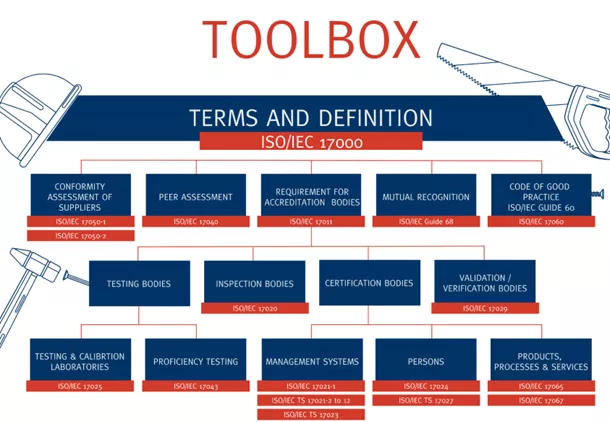
Of particular interest for SEMI to initiate a Certification Program would be the following Standards in the CASCO Toolbox:
- ISO/IEC 17011: Requirements for accreditation bodies accrediting conformity assessment bodies
- ISO/IEC 17025: General requirements for the competence of testing and calibration laboratories
- ISO/IEC 17065: Requirements for bodies certifying products, processes, and services
ISO/IEC 17011 provides the requirements to certify the accreditation body that performs product testing, such as Bureau Veritas or CETECOM. ISO/IEC 17025 provides the general requirements for the competence, impartiality, and consistent operation of testing laboratories. ISO/IEC 17065 provides requirements to ensure certification schemes are designed in a competent, consistent, and impartial manner.
In a follow-up article, I will take a deeper dive into how a Certification program could be started using the CASCO Toolbox as a guideline.
Standards Watch
SEMI
www.semi.org
December 9, 2022