
The Power of Collaboration: SEMI Technology Communities and the SEMI Standards Program
By James Amano, Senior Director, International Standards & EHS, SEMI
The number of SEMI Technology Communities has increased in recent years, reflecting the growing interests of SEMI members and reaffirming the value of SEMI as the collaborative platform for the industry to gather to address common challenges, discuss solutions, and accelerate business and technical results. These new Technology Communities are increasingly utilizing the Standards Program to transform their ideas into global, industry consensus manufacturing standards.
The most recent example of successful collaboration between a SEMI Technology Community and the Standards Program is SEMI MS12, Specification for Silicon Substrates Used in Fabrication of MEMS Devices, which was recently approved by the MEMS/NEMS Standards Committee and scheduled to be published in early 2020.
The initial idea for this document was generated out of the MEMS and Sensors Industry Group (MSIG) before transitioning into the Standards Program. While substrates used in the production of MEMS devices share many physical and electrical properties with those used in IC manufacturing, some significant differences exist. In order to achieve the mechanical features of various MEMS devices, particular substrate configurations may be required which differ significantly from substrates used in traditional semiconductor device fabrication. SEMI MS12 includes information on physical properties such as dimensions and surface properties as well as basic electrical properties of customized silicon substrates (150 mm and 200 mm nominal diameter) to be used for MEMS device fabrication, and will allow the stocking of standard material, lowering the time to purchase, time to market and overall cost.

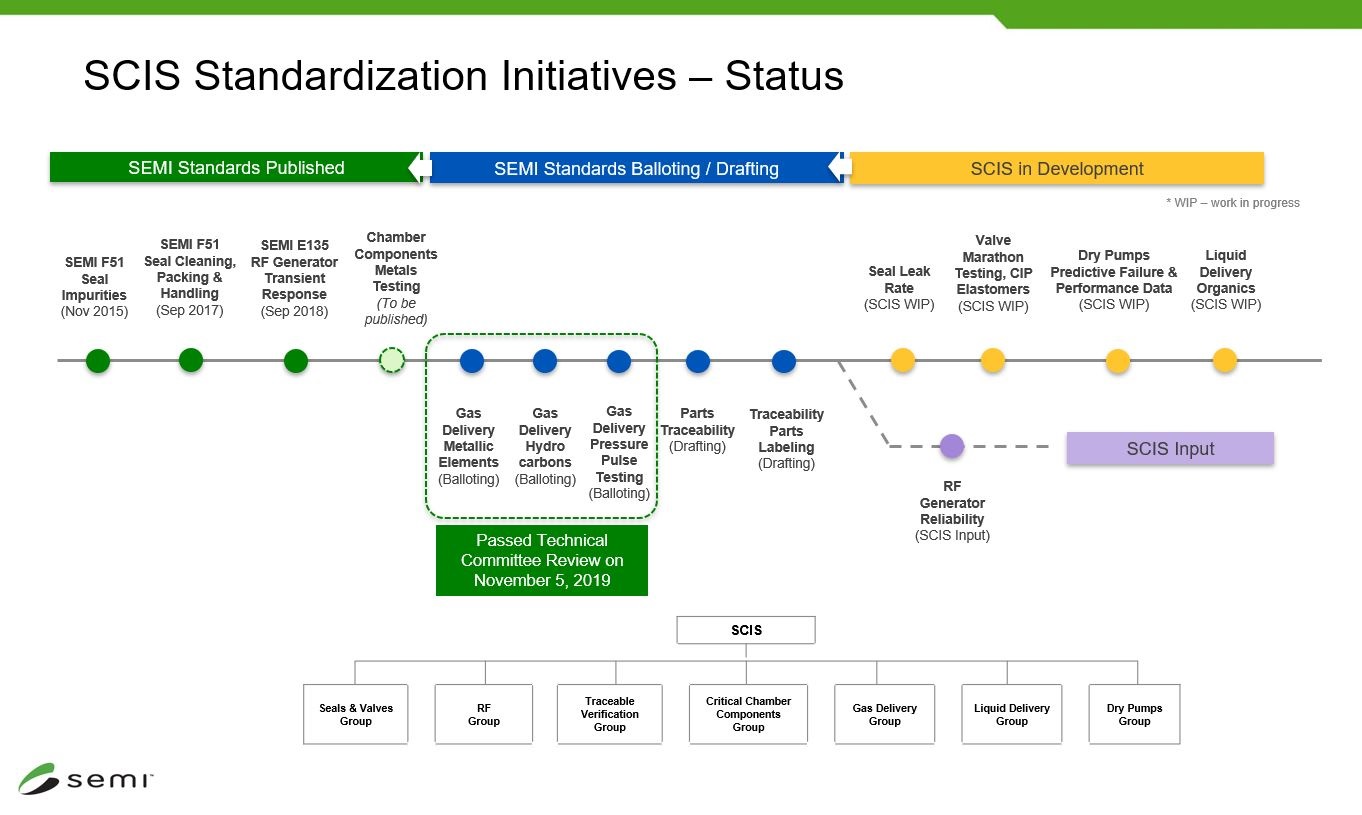
The MSIG – Standards Program collaboration follows the model established by the Semiconductor Components, Instruments and Subsystems (SCIS) Technology Community, which has seen the successful development and publication of three Standards, four undergoing procedural review, and two more in development.
Other Standards efforts inspired by SEMI Technology Communities are also underway, including proposals from the Collaborative Alliance for Semiconductor Test (CAST) for Rich Interactive Database (RITdb), Tester Event Messaging for Semiconductors (TEMS), and Chip ID & Traceability.
Efforts such as these are all critical to the industry’s sustained success – get involved! SEMI Standards meetings are held throughout the year in all major manufacturing regions. For more information, contact your local Standards staff, and visit the SEMI Standards Web site.
Standards Watch
SEMI
www.semi.org
December 5, 2019