downloadGroupGroupnoun_press release_995423_000000 copyGroupnoun_Feed_96767_000000Group 19noun_pictures_1817522_000000Member company iconResource item iconStore item iconGroup 19Group 19noun_Photo_2085192_000000 Copynoun_presentation_2096081_000000Group 19Group Copy 7noun_webinar_692730_000000Path
Skip to main content
Default Banner Image

robotics

SEMI has submitted comments to the U.S. Department of Commerce’s Bureau of Industry and Security (BIS) in response to its Section 232 National Security Investigation of Imports of Robotics and Industrial Machinery.The submission highlights the vital role robotics and precision machinery play in semiconductor fabrication, packaging, and inspection and emphasizes the need for a balanced, risk-based approach to any future trade actions that strengthen U.S. national security while preserving access to robotics and industrial machinery essential to expanding the domestic semiconductor industry. SEMI RecommendationsSEMI outlined five key recommendations to the Administration.Encourage Investment and Maintain Existing Competitiveness. SEMI recommends excluding essential robotics and industrial machinery where domestic sourcing is not yet viable. If trade actions are taken following the investigation, SEMI recommends providing tariff reductions or waivers for companies investing in U.S. manufacturing capacity. SEMI emphasized protecting small and medium suppliers that keep the ecosystem running.Avoid Stacking Tariffs. Coordinate Section 232 actions across potentially overlapping actions and ongoing investigations, such as on imports of steel and aluminum, semiconductors, critical minerals, and polysilicon. This will help prevent duplicative or compounding tariffs that could raise costs and slow U.S. capacity building.Implement Adjustment Periods and Sunset Provisions. SEMI recommends any trade actions should phase in gradually to allow for domestic adaptation and include regular review mechanisms to recalibrate as the market evolves.Pair Trade Actions With R D, Workforce, and U.S.-Allied Collaboration. Strengthen domestic capacity through targeted federal research and development (R D) programs, workforce training, and deeper partnerships with trusted U.S. allies to build resilient technology ecosystems.Develop a National Robotics Strategy. Given robotics’ foundational role across semiconductor and advanced manufacturing sectors, SEMI recommends that the Administration develop a National Robotics Strategy. The strategy should align federal programs including those at NIST, NSF, and Department of Energy to accelerate robotics innovation, update technical standards, and drive U.S. leadership in automation and manufacturing competitiveness.The Global ContextWorldwide installations of industrial robots surpassed 540,000 units in 2023, with the market projected to exceed $73 billion in 2025.Robotics and industrial machinery are integral to semiconductor production ensuring cleanroom integrity, precision, and throughput. Broad or overlapping tariffs could raise costs and undermine U.S. competitiveness at a time when historic investments in domestic semiconductor manufacturing are taking hold.Next StepsSEMI looks forward to working with the Department of Commerce and other federal partners to ensure that Section 232 policies enhance both U.S. national security and the industry’s global competitiveness.Read SEMI’s full submission on Regulations.gov by searching Section 232 Investigation of Imports of Robotics and Industrial Machinery (XRIN 0694-XC138).Visit SEMI Global Advocacy to learn more about public policy efforts and developments as well as how your company or organization can get involved.Marc Coldiron is Director, Global Public Policy Advocacy at SEMI.
Read More
Tracking and quickly diagnosing COVID-19 infections, working from home and telemedicine recently came into sharp focus as technology executives and other subject matter experts from microelectronics heavyweights recently gathered for the first-ever virtual SEMI CTO Forum to explore how the microelectronics industry and their own companies can leverage future technology trends to drive growth. Themed Intelligent Medtech and Wearable Technologies, the forum drew CTOs from ARM, Babblelabs, Brewer Science, Dell, Dow/Dupont, E-Ink, Hewlett Packard Enterprise, Intel, Lam Research, KLA, Microchip, ON Semiconductor, Qualcomm, Tokyo Electron, Ulvac, Veeco and Xilinx. The event is designed as a strategic driver of pre-competitive innovation. Following are key takeaways from the forum. Microfluidics Promises to Speed COVID-19 Diagnosis More than 240 companies worldwide are developing microfluidics solutions to improve diagnosis and treatment of COVID-19 and other conditions, said forum speaker Dr. Kurt Petersen, a member of Band of Angels, Silicon Valley's oldest angel investment group, with an illustrious background1 in technology. And their innovations are bearing fruit. Cepheid, a company founded by Dr. Petersen, has developed a disposable microfluidic cartridge, Xpert Xpress SARS-CoV-2, used by doctors to swab the inside of a patient’s mouth. Highlighting the vital role of MEMS in medical electronics, the tiny powerful devices are behind a test that can detect COVID-19 infection in under 40 minutes. Dr. Petersen also cited a few examples of implantables and injectables under development, including: In vivo chemical sensing: Profusa developed a continuous glucose monitoring sensor via an optical patch. Glaucoma pressure monitors: Injectsense built a silicon chip the size of a grain of rice that is embedded in the eye to measure eye pressure. Retinal implants: Second Sight implanted a 60-electrode array chip that projects images onto the retina to improve vision. Microelectronics Takes Aim at Battling COVID-19 The event’s CTO roundtable, a platform for discussing societal and technology issues, revealed microelectronics technology will likely give rise to solutions for combatting pandemics and new business opportunities both in the short and long run. Areas of the greatest interest included: Tracking and Security: Infection tracking accuracy is key to limiting the spread of viruses yet comes with inherent privacy and security challenges. The consensus view of the executives was that developing trusted hardware capabilities is critical for adoption of accurate infection-tracking technologies. Remote Operation: Executives expect working from home or the use of telehealth to continue building momentum long after pandemic. To give staying power to the remote communications at the heart of these trends, microelectronics ecosystems will need to boost compute performance, both at the edge and in the cloud, while increasing bandwidth to enable applications such as augmented reality/virtual reality (AR/VR), artificial intelligence (AI), machine learning and advanced data analytics. Edge intelligence: The challenge of remote communications spans both people and the Internet of Things (IoT). Questions persist about how hundreds of billions of sensors will connect to the cloud and how much power they will consume. The need to push computing to where data is generated – at the edge – is rising and the necessary underlying technologies will only come by combining various forms of distributed computing and analytics. The microelectronics industry’s ability to seize these opportunities will only be possible with huge strides in innovation, raising concerns among the CTOs about the financial viability of cutting-edge devices because of increasing device complexity and R D costs. Technology partnerships and collaborations – an area where SEMI is contributing and will continue to expand its efforts as it works with the CTO community – will be critical to containing R D costs. SEMI will help the executives identify and mobilize the resources key to future innovation. Improving Home, Work Productivity and Experiences Key to AR Adoption Smart wearables also offer great promise. In just over a decade, AR and VR have grown from science fiction to practical uses such as AR applications for smart contact lenses, said Dr. Mike Wiemer, Co-Founder and CTO of Mojo Vision2. Dr. Wiemer said that while many AR applications remain under development, the technology will only see widespread adoption once it starts to improve productivity and efficiency at home and work and the quality of other experiences. The smart augmented reality contact lens developed by Mojo Vision is a step in that direction. The product’s built-in display gives users timely information about everything they see while remaining invisible by packing 70,000 pixels into a space smaller than a half a millimeter across, making it the smallest and densest dynamic display ever made. The contact lens is powered by an ARM-based processor, with later versions adding an image sensor, eye-tracking sensors and a communications chip. SEMI thanks EMD Performance Materials and Telit for sponsoring the CTO Forum. For more information on the CTO Forum and SEMI’s Smart Data-AI initiative, please sign up on our webpage. 1 Dr. Kurt Petersen is a member of the National Academy of Engineering, an IEEE Medal of Honor winner, and a Life Fellow of the IEEE for his contributions to the commercialization of MEMS technology. 2 Dr. Wiemer also co-founded Solar Junction, where he led technical teams to two world records in solar cell efficiency (43.5% and 44%). He also has patents and papers in Semiconductor Devices Applications, Silicon Photonics, Materials Integration, Lasers, Solar Cells, Solar Systems, and Analog Circuits. Tom Salmon is Vice President of Collaborative Technology Platforms at SEMI. Pushkar P. Apte, Ph.D., is Strategic Technology Advisor for the Smart Data AI Initiative at SEMI.
Read More
During the COVID-19 pandemic, the SEMI Global Advocacy team has been working tirelessly to ensure the microelectronics manufacturing and design supply chain is classified as an “essential business” in the United States and for similar designations in several other countries so that SEMI member companies can maintain operations. Their efforts have included direct lobbying and letters to the governors of 16 states in the U.S., 23 European countries and several European Union officials across the continent, as well as government officials in Japan, Mexico and Malaysia. The bedrock of these efforts, and the reason they have been highly effective, is that our industry enables both modern digital infrastructure and technology critical in the fight against the virus.SEMI takes immense pride in highlighting the role of our industry in providing the building blocks for innovations that improve social and economic prosperity the world over. It is never more apparent that necessity is the mother of invention than during a crisis, and the pandemic has created a diverse range of demands for technological advancements to address the myriad of challenges it presents. Our SEMI Tech Spotlight blog series highlights some of the many ways that our industry and member companies are enabling technology employed on the front lines of this fight – and that we strongly believe will ultimately help to win it. Our first piece in this series focuses on platforms enabled by big data and artificial intelligence.Fighting the Pandemic with Big Data-AI Enabled PlatformsThe COVID-19 pandemic is testing humanity in unprecedented ways, but it is also uniting us to fight this crisis with the best weapons we have. Big data and Artificial Intelligence (AI) technologies – built with microelectronic chips and systems that generate, transmit, store and analyze data – are making a profound contribution to our arsenal for this protracted war. Big data-AI technologies are enabling platforms such as data analytics, robotics, augmented/virtual reality (AR/VR), 3D printing, and others that are already being applied to address many facets of this crisis.Big Data and Analytics Inform Policy In the fight against COVID-19, data analytics platforms are being used first and foremost to slow the rapid spread and to inform policy decisions. This requires analysis of massive amounts of data about public health and travel, often using AI algorithms. The state of California, for example, is partnering with companies such as BlueDot, Esri and Facebook to build a software platform that uses smartphones and location intelligence to track people’s movement and predict hospital needs. Taiwan owes its considerable success in limiting the spread of the virus to the extensive use of big data analytics for identifying and tracking carriers. Google and Apple are driving a joint effort that connects Bluetooth with their popular iOS and Android platforms to trace contacts of infected people. India has developed Aarogya Setu, a mobile app based on Bluetooth and location-mapping platforms, designed to alert citizens if they have crossed paths with another app user who has tested positive for the virus. This app was launched in 11 languages, and despite being entirely voluntary, it was downloaded by 50 million people in 13 days, making it the world’s fastest-ever to reach that number. Such contact-tracing apps, now being rolled out in at least 26 countries, carry inherent privacy and security challenges due to the sensitive data they access. While mitigation strategies like strict data anonymity and opt-in protocols are being implemented, these will need to be refined over time.Robotics Protect Frontline SoldiersToday’s robust robotics platforms are enabled by huge amounts of data from sensors and guidance from predictive AI algorithms. These robots can learn on the job, adapt to the environment, and work safely with humans. In this pandemic, they are perfect for minimizing human interaction with infectious environments. Companies around the world such as Boston Dynamics, Akara Robotics, UBTECH Robotics and CloudMinds have already deployed robots on the front lines of this war to assess patient health, disinfect hospital surfaces, and help health workers with Personal Protective Equipment (PPE).Robot drones are also delivering blood and other lab samples. For example, WakeMed hospitals in North Carolina launched the first drone delivery program approved by the U.S. Federal Aviation Administration with Matternet drones operated by UPS; while Terra Drone from Japan executed similar tasks in the hard-hit Wuhan province of China.3D Printing Speeds ManufacturingBig data-AI technologies enable 3D printing platforms by providing accurate 3D models for optimized designs and defect-free manufacturing. Low-cost, fast-cycle-time 3D printing has helped to alleviate at least some of the medical equipment shortages. For example, the U.S. Food and Drug Administration (FDA) has approved the first 3D-printed “Stopgap Face Mask” for liquid barrier protection from the SARS-CoV-2 coronavirus for healthcare workers. The U.S. Veterans Health Administration has developed this in collaboration with America Makes using an open-source database – the 3D Print Exchange from the National Institutes of Health. In another example, Formlabs worked with Northwell Health, New York’s largest healthcare provider, and University of South Florida (USF) Health to develop and test a nasal swab prototype over just one weekend, and it is now producing up to 150,000 test swabs daily. Prisma Health in South Carolina received emergency FDA authorization for VESper, a 3D printed device that allows a single ventilator to support two patients, and possibly up to four.Telehealth Becomes a “New Normal”Telehealth is not a new concept but is much enhanced by today’s microelectronics platforms that can collect and transmit rich datasets with very low latency. Further, rapid data analysis is increasingly supported by AI systems. The requirement for social distancing makes telehealth a perfect solution for many healthcare consultations. U.S. government data indicates that the daily average of telehealth claims from private insurance for upper respiratory infections increased nearly 12 times over the previous month from March 14 to April 1. Similarly, Teladoc Health coordinated 100,000 patient “televisits” in the week of March 8 – a 50 percent spike over the previous week, taking pressure off the healthcare system. The next generation of telehealth is likely to use AR/VR platforms, which use even richer datasets and AI to improve the accuracy and predictive capability of their underlying models. Consequently, these platforms can provide more realistic experiences and improved outcomes. At least 11 states in the U.S. are already working with AR/VR companies such as XRHealth and AppliedVR for primary care and many medical specialties. Accelerating the Search for a Vaccine or TreatmentThe way out of this pandemic depends on swiftly finding a vaccine and a treatment, ideally by fast-tracking the traditionally slow drug development process. Big data-AI technologies are at the forefront of such efforts globally, often using the most powerful supercomputers available. For example, researchers at the University of California, San Diego (UCSD) are using the Frontera supercomputer to build a complete model of the SARS-CoV-2 coronavirus envelope – a formidable task, requiring analysis of data from 200 million atoms and interactions between them. Researchers at Argonne National Laboratory are combining AI with physics-based models to search for a molecule that might disrupt the activity of the virus, a precursor to finding a treatment. Also, several companies around the globe such as BenevolentAI (UK), Gero (Singapore), Innoplexus (Germany-India), and Insilico Medicine (US-Hong Kong) are using AI platforms to accelerate the search for a solution. ConclusionUltimately, the success of technology is not measured by the number of bits and bytes or by the speed of algorithms. It is measured by every janitor who did not have to clean a hazardous surface because a robot did, by every doctor and nurse protected by a 3D-printed mask, and by every person whose life may be saved by the accelerated discovery of a vaccine or treatment. Big data-AI technologies, and the platforms they enable, are just coming of age – they give us hope that as they evolve in the future, we can use them to build a more resilient society and economy.Note/Disclaimer: The examples cited above are purely for illustration – they are neither comprehensive, nor intended to endorse any particular product or solution.The SEMI Smart Data AI initiative helps members realize full value in the intelligent future enabled by Big Data and Artificial Intelligence – including the large revenue upside, and the transformational potential for operational and supply-chain efficiency. For more information on the initiative, contact Pushkar Apte at [email protected] Manocha is President and CEO of SEMI. Pushkar P. Apte, Ph.D., is the Strategic Technology Advisor for the Smart Data AI Initiative at SEMI.
Read More
Japan’s Prime Minister Shinzo Abe declared a state of emergency for Tokyo, Osaka and five other prefectures[1] on April 7 in response to a startling increase of COVID-19 infections in the region’s cities in an uneasy moment for its domestic semiconductor industry. The declaration, effective through May 6, authorized the six prefectural governors to strengthen curbs on the spread of the virus and included guidance for citizens to stay home and restrictions on operations of non-essential businesses.With Japan supplying some 40 percent of the world’s chip production equipment and materials, the declaration stirred fears among semiconductor manufacturers that their uninterrupted operations – critical to sustaining the global industry – might be at risk. Japan Government Designates Semiconductor Industry as EssentialIn April 7 and 11 revisions to its Basic Policies for Novel Coronavirus Disease Control, the Japanese government allayed those concerns by designating semiconductor manufacturers essential businesses – a stark acknowledgment of the chipmakers’ vital role in combatting the novel coronavirus. The policy stated:“Among medical and manufacturing industries, we request the continuation of the following business operators in consideration of infection prevention: operators who are difficult to stop production line due to the characteristics of the equipment (such as blast furnaces and semiconductor factories); and operators who produce essentials (including important items in supply chains) for protection of the people who need medical care and support, as well as for maintenance of social infrastructure. We also request the continuation of the business operators who sustain medical care, the lives of the people, and maintenance of the national economy.”[2]SEMI Japan Reaches Out to Prefectures to Urge Essential Business Designation Equipment and materials shortages can halt production of an entire fab line and ripple through intricately connected global supply chains to stifle the production of end devices including the electronics critical to COVID-19 treatments. Electronic devices also play a central role in containing the virus’s spread by enabling artificial intelligence (AI), data analytics, digital communications, telemedicine, robotics, remote health monitoring, telecommuting, online shopping and other digital services.The essential business designation was explicit recognition that Japan’s semiconductor supply chain is integral to the global chip production ecosystem and worthy of the same protections the government has implemented for semiconductor companies. With SEMI members operating in Japan’s 47 prefectures, I sent letters to all prefectural governors three days after the second policy revision, urging them to apply the same designation, and the SEMI Japan team is following up to secure their support.SEMI Japan Encourages Government to Exempt Members from Travel Restrictions The Japan Foreign Ministry on March 31 raised to level 3 its travel advisory for 49 regions including the U.S., China, Taiwan and South Korea, encouraging Japanese citizens to avoid travel regardless of purpose to blunt the international spread of the coronavirus. SEMI Japan is working with the Semiconductor Equipment Association of Japan to urge the government to exempt semiconductor supply chain companies from the level 3 travel restrictions if they implement measures to prevent domestic infections and contagion in the visited regions. The exemptions would allow supply chain companies to install and service equipment at fabs – one key to maintaining smooth, uninterrupted operations.SEMI Supports Members with COVID-19 ResourcesSEMI international headquarters and regional offices are here to help you, our members. For more information on our webinars, surveys, best practices and other information designed to help you meet the challenges of the pandemic, please visit the SEMI Coronavirus Updates Resources page.[1] The six prefectures are Tokyo, Kanagawa, Chiba, Saitama, Osaka, Hyogo and Fukuoka.[2] Provisional translation by Ministry of Health, Labour and Welfare. Full document is available at https://www.mhlw.go.jp/content/10900000/000620733.pdf.Jim Hamajima is president of SEMI Japan.
Read More
SEMI has urged government representatives around the U.S. and world to designate the semiconductor industry as an essential business so operations at companies across the chip supply chain can continue without interruption as the spread of COVID-19 continues. SEMI President and CEO Ajit Manocha assured the U.S. and global officials that SEMI members – the device makers and suppliers of chemicals, materials, components, design tools and equipment at the heart of chip manufacturing – “are employing all measures necessary to maintain the health and safety of their employees and local communities” to help contain the virus. Manocha last week sent letters to the governors of 16 states and the chairs of the National Governors Association, U.S. Conference of Mayors, National League of Cities, and National Association of Counties requesting consideration of the semiconductor industry as an essential business if shelter-in-place or similar orders are issued to curb the spread of COVID-19. More than half of U.S. states have imposed shelter-in-place or stay-at-home orders in the past month. The designation would allow SEMI members to maintain continuous operations to ensure that manufacturing of components for critical infrastructure equipment, the defense industrial base, and other vital technological products and services is not jeopardized. Semiconductors are the foundation of modern electronics and information technology and are critical in helping health workers effectively treat COVID-19 symptoms, Manocha told the officials. The devices also play a central role in containing its spread by enabling artificial intelligence (AI), data analytics, digital communications, telemedicine, robotics, remote health monitoring, telecommuting, online shopping and other digital services.Manocha urged state and local officials to follow guidelines issued on March 19 by the Department of Homeland Security (DHS) Cybersecurity Infrastructure Security Agency (CISA) identifying “manufacturers and supply chain vendors that provide hardware and software, and information technology equipment (to include microelectronics and semiconductors) for critical infrastructure as ‘essential critical infrastructure workers.’” Most states issuing shelter-in-place or stay-at-home orders have followed the DHS guidelines and/or separately designated the semiconductor industry an essential business. Likewise, other nations have recognized the power of technology in effectively containing COVID-19 and similarly designated the semiconductor industry an essential business.On March 27, SEMI, the Semiconductor Industry Associations in China, Europe, Japan, Korea, Singapore, Taiwan and the U.S., as well as several other trade associations in Asia issued a statement “calling on all governments to specify semiconductor industry operations as ‘essential infrastructure’ and/or ‘essential business’ to allow continuity in operations.” The global semiconductor supply chain forms a highly intricate network consisting of research, design and manufacturing operations. Operating restrictions in one region can compromise production in others, leading to inefficiencies and breakdowns that cascade across the supply chain.With semiconductors underpinning vital sectors of the global economy, the chip associations called on all global governments at all levels – central, states, provinces and localities – to help protect the uninterrupted operations of domestic semiconductor companies and their suppliers by applying the essential infrastructure or essential business designation.Joe Pasetti is Vice President of Global Public Policy and Advocacy at SEMI.
Read More
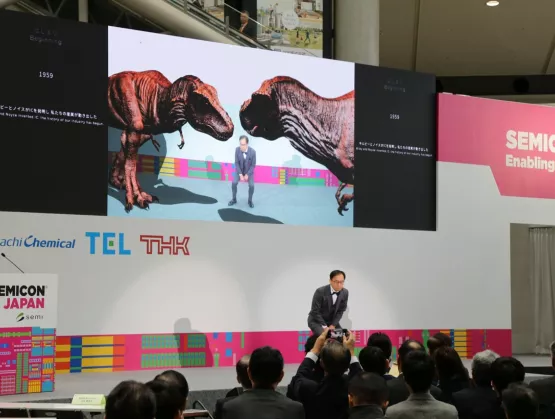
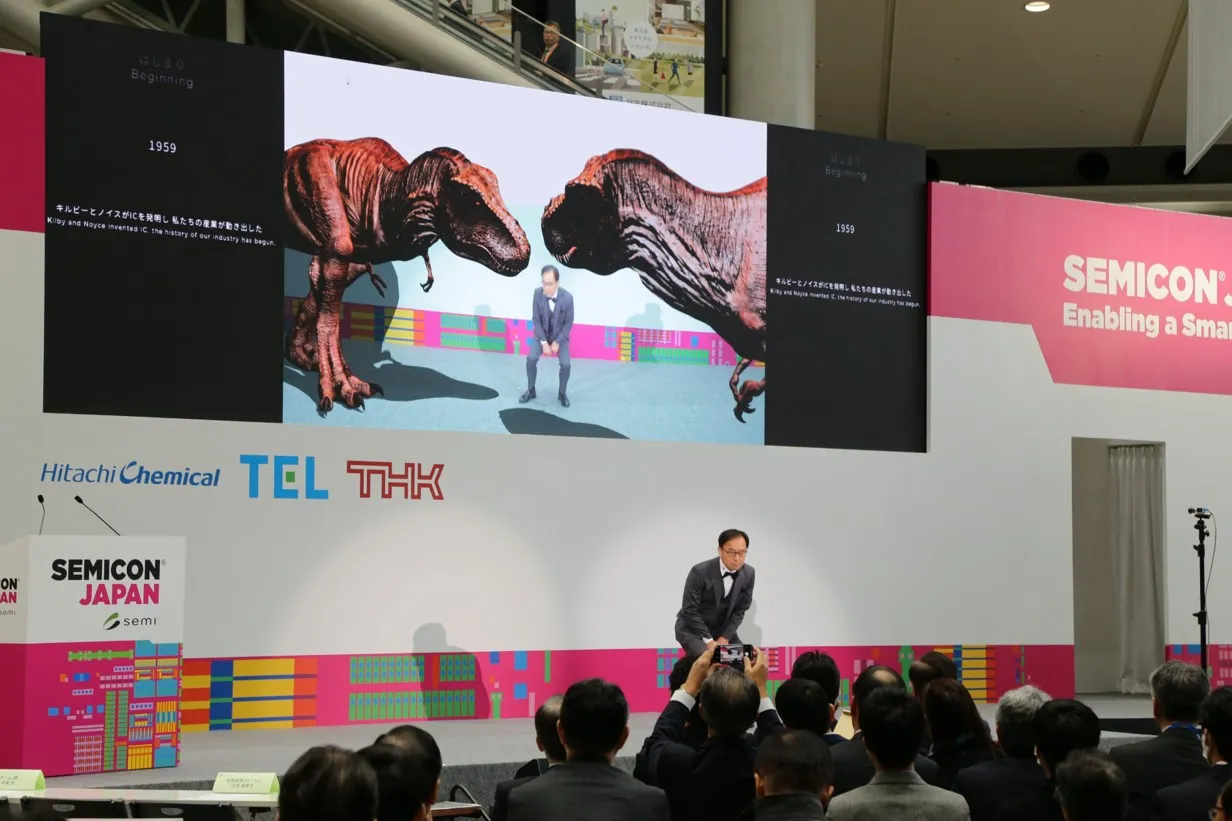
Augmented reality (AR) tyrannosauruses towered on-screen as I interacted with the creatures in a mix of prehistoric and cutting edge. Or, rather, my AR double was doing the playacting. Minutes later, virtual doppelgangers of a small lineup of chip industry executives cut the ceremonial ribbon. Seemingly sweeping away the winter chill, the opening of SEMICON Japan 2019 dazzled with smart technology and the promise of lives, cities and workplaces transformed, with uber-intelligent applications in full display at Tokyo Big Sight. But what resources does the industry need to harness to drive the next era of innovation? The semiconductor industry’s unwavering passion and young talent are key, said Hiroshi Imano, Chairperson of the SEMICON Japan Initiatives Committee, in his opening keynote. And hardly any region of the world is in a better position to help realize that future than Japan, Imano said. The region supplies one third of the equipment and more than half of all materials to the global semiconductor manufacturing industry.Talent was also top of mind for SEMICON Japan 2019 keynote speaker Makiko Eda, Japan's Chief Representative Officer at the World Economic Forum (WEF). Serving as a platform for public-private partnerships, the organization's mandate is to tackle global issues such as climate change and geopolitical strife in making world more resilient to risk and, by extension, more sustainable.Spanning ecology, economy, technology, society, geopolitics and industry, that mission includes reskilling and upskilling a billion people over the next decade, a high priority for WEF, which hosts a conference every January in Davos, Switzerland. The theme of this month's conference – Stakeholders for a Cohesive and Sustainable World – reflects the vital importance of building the international partnerships and global consensus necessary to achieving WEF's goals.One key to that sustainability will be technology and Arm, a global chip design company, will play a key role, with the company’s chips touching over 70 percent of the world’s population, Arm president Yuzuru Utsumi said in his keynote. Today, Arm is driving toward an ambitious goal: Ship 100 billion chips from 2017 to 2021 – the same number produced over the previous quarter century – by powering advances in mobile computing, server and networking infrastructures, and automotive applications.Arm’s innovation ecosystem of more than 1,000 partners will deliver these chips as they continue to work together to develop differentiated technology. Arm plans to increase investments not only in its primary processor business to accelerate market share gains but in the company’s new IoT business to create new revenue streams. The goal: Deliver long-term sustainable growth, Utsumi said. SEMICON Japan 2019 showcases SMART manufacturing and transportation Billed as a showcase of smart technologies, SEMICON Japan 2019 delivered with an array of eye-grabbing exhibitions in the popular SMART Applications Zone. In the SMART Transportation area, the automatic operation pavilion featured a car equipped with open-source software for autonomous driving. The exhibitor, Tier IV, aims to help lead the early commercialization of self-driving vehicles through the adoption of its software, Autoware, which makes it easier to develop self-driving vehicle prototypes using low-power platforms.Sony Semiconductor Solutions demonstrated a vision sensing processor designed to guide autonomous drones. Using two cameras, the processor measured the changing distance between visitors moving about the exhibit and stationary objects in real time, indicating proximity in hues of red (nearby) and blue (at a distance). Many visitors were wowed, describing the multichromatic display as futuristic.Others rode a simple wooden swing hanging by two ropes, but from dizzying heights thanks to Solidray’s Duo-Sight, a virtual reality (VR) system that projects 3D images stretching from wall to floor for immersive experiences. One visitor thrilled at how riding the swing, suspended only a few feet from the floor, felt like soaring on a flying trapeze. Target applications for the technology include virtual rides at amusement parks and presenting interior design options to homeowners.In the SMART Manufacturing area, one highlight was the demonstration by the National Institute of Advanced Industrial Science and Technology (AIST) of a remote-controlled Minimal Fab System designed for low-volume, high-mix chip production with little staffing. Designed to increase production efficiency, the system allows a circuit designer to manufacture a semiconductor by singlehandedly operating equipment up and down the production line. Controlling nearly 50 pieces of equipment, the Minimal Fab System on display manufactured chips that were verified for functional operation and exhibited afterwards.On the SMART Applications stage, exhibitors DENSO and Toyota Motor Corporation announced a new joint venture to conduct research and advanced development of the next-generation in-vehicle semiconductors critical to electric and autonomous vehicle innovation. The venture, operating as MIRISE Technologies, will combine Toyota’s mobility expertise with DENSO’s in-vehicle component prowess. The goal is to build a rapid, competitive development system by 2030, said Yoshifumi Kato, executive director of the DENSO Research and Development Center, and president and representative director of the venture. On track to begin work this year, MIRISE will span three fields of technology development: power electronics, sensing and SoC (System-on-a-Chip). The name MIRISE combines word the Japanese word "mirai" (future) with "rise."Business Continuity PlanningNatural disasters and other emergencies are an ongoing threat to uninterrupted business operations across the semiconductor manufacturing supply chain and particularly in earthquake-prone Japan. To better prepare for business disruptions and restore normal operations as soon as possible after disaster strikes, more companies are teaming on Business Continuity Planning (BCP).THK's Seismic Isolation Experience Car demonstrated one technology designed to help – a seismic isolation device. The car shakes like an earthquake to give people inside a taste of how a building heaves and sways during a quake with and without the device deployed. Visitors were struck by how much the isolator dampens tremors to prevent or minimize damage. In the BCP seminar, representatives from Sony Semiconductor Manufacturing, THK, DISCO and Team Engineering Consulting shared lessons learned from actual disasters and discussed the critical importance of daily disaster drills. Yukihide Keigo, Executive Engineer in charge of Products and Development at Sony Semiconductor Manufacturing, recounted how the company’s Kumamoto Prefecture plant struggled for 96 days to restore full operations after the facility sustained heavy damage in the 2016 earthquake. Keigo said the plant lacked the structural reinforcements necessary to withstand the impact and fell prey to poor planning and accountability. The Kumamoto plant has since implemented measures – structural and procedural improvements – that more accurately account for seismic risks to ensure full recovery within 56 days. The plant’s new procedures include emergency drills for staff including night-shift workers.Innovation abounds at six SuperTHEATER forumsSEMICON Japan 2019 was held in the West and South Halls of Tokyo Big Sight as organizers of the Tokyo Olympics occupied the East Hall, the exhibition's usual home at the venue, to prepare for the 2020 games. For the first time, the main stage, SuperTHEATER, was set up in the cavernous arena near the main entrance. The SuperTHEATER featured six forums over three days. Semiconductor Executive Forum – View by Top Two in the Era of Digitalization with thought leaders from IHS Markit and Sony Semiconductor Solutions SMART Connectivity Forum – Infinite World Brought by 5G Innovation with experts from Softbank and Nokia Solutions Networks SMART Transportation Forum I – Front-line of Automated Driving featuring speakers from Intel and DENSO SMART Transportation Forum II – Revolution of Sky Transportation, supported by the U.S. Commercial Service in Japan, with presenters from Ministry of Economy, Trade and Industry (METI), Subaru and Bell Helicopter Manufacturing Innovation Summit – Issues and Innovation: What will Drive Growth to 2030 featuring thought leaders from VLSI Research, Applied Materials, KLA, Nikon and Tokyo Electron Mirai Vision Forum – Future Relation of Technology and Body 2.0 with speakers from Leave a Nest, Ory Lab and Autonomous Control Systems Laboratory The Mirai Vision Forum highlighted advanced technologies that could lead to societal improvements. One presenter, Kentaro Yoshifuji, CEO at Ory Lab, recalled how, as a child, he once stayed home from school while recovering from an illness. His imagination in full flight, the youngster imagined having a clone that could attend school and be with his classmates. The experience eventually inspired him to develop OriHime, a robot that gives socially isolated people a way to communicate with friends or colleagues remotely. Originally developed for physically impaired people, OriHime today is used to help the able-bodied. The robot is situated with the companion and the user operates OriHime remotely. A camera and monitor in OriHime’s face provide the visual and audio connection and the user controls the device with a smartphone or tablet or, for those who are paralyzed, through eye movement. One potential application: With OriHime stationed at a business office, working mothers could use OriHime to telecommute to better balance their careers with their parenting responsibilities at home. The robot would be a mother’s go-between, enabling her to communicate directly with colleagues.The next generation of innovators also took the stage as five teams presented innovative business ideas in friendly competition. The top prize in The TECH CAMP Hackathon went to the group that hatched an ingenious plan to develop a jacket that trains users to move their bodies in preprogrammed ways. For example, legendary Japanese professional baseball player Shigeo Nagashima could wear the gear while batting to program the device, then give the jacket to someone who’s never swung a baseball bat. The jacket would help the user replicate Nagashima’s swing. Now comes the real work of any innovator – executing on the vision.And then came two soccer-playing artificial intelligence (AI) robots that squared off and ... Scored! The demonstration by the Toyota National College of Technology started as a research project by Toyota National College students in 2002. The young innovators designed and developed all the robotic hardware and software from scratch. Looking ahead to SEMICON Japan 2020!SEMICON Japan 2019 not only gathered leading Japanese semiconductor materials and manufacturing equipment providers to demonstrate their latest innovations. The premiere regional event also provided insights on key trends critical to the entire electronics manufacturing supply chain. This year’s event drew more than 51,000 visitors and 695 exhibitors from 15 regions filling more than 1,700 booths.SEMICON Japan 2020 returns to East Hall at Tokyo Big Sight in December 2020. I look forward to seeing you there!Jim Hamajima is president of SEMI Japan.
Read More
Five young dancers bathed in a striking rainbow of colors with their silhouettes cast in the background dazzled SEMICON Japan 2018 attendees at the opening ceremony in mid-December. Gone were the standard opening keynotes and ribbon cutting, replaced by live performance and media art set against a dramatic black backdrop. There was no mistaking the wide-eyed looks of wonder in the audience.In its sheer vibrance, the opening ceremony thrilled with an excitement that seemed to embody the extraordinary growth expectations for the global semiconductor supply chain over the next five years, with the industry poised to double sales from $2 trillion to a staggering $4 trillion – a phenomena SEMI president and CEO Ajit Manocha has called The Rebirth of the Semiconductor Industry. Driving this unprecedented growth will be SMART applications that are transforming industries and applications worldwide, powered by artificial intelligence (AI) and Internet of Things (IoT) technologies.The dramatic scene at SEMICON Japan 2018 was staged by Rhizomatiks, a media arts company that produced the Rio Olympic Games closing ceremony and is famous for its pop music spectacles. The company’s CTO, Motoi Ishibashi, the event’s first keynote speaker, described his team’s development of drones and vehicles guided by motion and precision-control technologies. It was some of these SMART vehicles that maneuvered the opening ceremony performers from the dance company Elevenplay onstage. Only Rhizomatiks, Ishibashi said, has this capability. In its mission to enrich people’s lives through new media arts, Rhizomatiks uses the latest virtual and mixed-reality technologies to orchestrate not only dance performances but music videos, commercials, fashion shows and festivals.Toru Nishikawa, the second keynote speaker and CEO at Preferred Networks, a leading Japan-based developer of deep learning software programs, surprised the SEMICON Japan audience with his discussion of his company’s work to develop a specialized chip for deep learning processing, joining technology giants Apple, Google, Alibaba and Microsoft in chip design. As more IT and software companies develop specialized, differentiated chips, the devices are quickly becoming the heartbeat of SMART technologies. The company’s approach has taken hold. Only four years old, Preferred Networks is enjoying rapid growth by working with global powerhouses including Toyota, NTT, Panasonic, Fanuc, NVIDIA, Intel and Microsoft. Ishibashi’s and Nishikawa’s fresh visions and the media arts extravaganza reflected the success of SEMICON Japan, held again at Tokyo Big Sight: The event’s 1,881 booths – filled by 727 exhibitors from 14 regions – was the highest count in six years. With Japan home to companies that supply about 40 percent of semiconductor equipment and materials worldwide, top suppliers historically have occupied the largest spaces on the SEMICON Japan show floor.According to IDC, personal computers and smartphones, long the largest revenue sources for the semiconductor industry, will remain top revenue drivers in the coming years. But revenue from new SMART technologies for applications such as automotive and factory automation is growing, a trend expected to continue with a 2018-2022 CAGR of 9.5 percent for automotive and 5.2 percent for manufacturing, compared to 1.1 percent for PCs and 2.9 percent for smartphones.SEMICON Japan’s new SMART Applications zone highlighted these and other new market opportunities for semiconductor growth with product and technology exhibits from companies including Bosch, IBM, Microsoft, NEC, Preferred Networks, Sony, SAS, Siemens, Tesla and Toyota. But the zone wasn’t all work and no play. The ROBOT SQUARE and SPORTS x IOT robot exhibits took visitors back to their school days, with robot anime – from Astro Boy to Gundam and Evangelion – that they could ride and control! As the World Gets Smarter, So Must SEMICON and the IndustryWe all agree the world is getting smarter at a fast pace. New cars are easier to drive – some models are almost fully autonomous on highways and streets. Your SMART speaker has gone well beyond an audio playback device and is more like a home AI platform. Almost all storefronts are equipped with video cameras. Your workplace, whether an office or a factory, is driven by automation. The reliance of these environments and devices on semiconductors is driving exponential chip and changing the world. Businesses need to adapt and so do SEMICON events. We’re doing just that as SEMICON Japan 2018 demonstrated – from an opening ceremony enabled by technology innovation to new faces of the industry to the SMART Application zone. As the SEMICON Japan presidents’ reception concluded the first day of the show, a robot from the ROBOT SQUARE suddenly appeared in the reception hall in front of about 250 executives from the global industry. Everyone at the reception was impressed and stepped forward to the stage, reflecting the overall excitement about SEMICON Japan, which for many years showcased only chip manufacturing equipment and materials. This year, to keep pace with the changing world, it was much more than that.SEMICON Japan 2019 will again take place in December at Tokyo Big Sight. However, organizers of the Tokyo Olympics will be using the East Exhibit Hall usually occupied by SEMICON Japan to prepare for the games. As a result, SEMICON Japan will be held in the West and South Halls instead. Look for more changes to the event. I hope to see you next year!Jim Hamajima is president of SEMI Japan.

Read More