

A New Topology for MEMS
ABSTRACT
In the semiconductor industry, innovation is tied to the newest technology node. In MEMS, it’s about advancing topology to create a robust, repeatable process. But the last time we saw a new topology for MEMS was over a decade ago, with the industry-changing Nasiri process. To keep up with surging demand for an enormous range of MEMS sensors in high-volume markets, we need a new topology for MEMS. We can achieve that by rewriting the script for MEMS—which simplifies fabrication to improve capacitance, to increase ruggedness, to improve yield, to speed design-to-manufacture, and to reduce cost.
We now have a proof point for our new topology. We’re leveraging it by building a 15mm diameter MEMS step-scanning mirror for long-range LiDARs. Its performance is on par with optical subsystems that are up to 100x more costly, and it’s robust enough to handle vibration, shock, and temperature change. We’ll discuss the foundational innovation behind our topology for MEMS during this presentation.
BIOGRAPHY
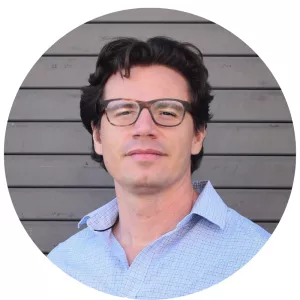
An award-winning entrepreneur, Eric is co-founder and CEO of Omnitron Sensors. He is a recognized leader in Silicon Valley in the field of advanced sensor systems for complex systems such robotics and autonomous platforms.
Eric has pursued his passion for sensor design throughout his two-decade career. He’s held senior leadership positions at groundbreaking companies developing autonomous systems, including Tesla—for which he led a team of 300 on the firmware for Model 3—and X, for which he helped develop Google project Wing, an autonomous delivery drone service. Eric also led the sensor integration effort for a fleet of robotaxis at Argo AI, a self-driving company funded by Ford and Volkswagen. Earlier in his career, Eric built sensors for drones at U.S. Navy Research Labs. In addition, he drove product development efforts for a sensor company that was later acquired by Google for $85 million.
Eric holds a BS in Electrical Engineering from California State Polytechnic University and has pursued advance studies in Electrical and Electronics Engineering at University of Southern California.