

Advancing MEMS-Integrated AI: Research Breakthroughs and Commercialization Efforts
In this talk, Dr. Alsaleem will share his research advancements in the novel area of integrating AI and computing directly within MEMS devices—a major shift from the conventional approach of separating AI from MEMS. In this approach, an array of MEMS will be engineered to perform sensing and computing at the same single physical layer. As a case study, it has been shown to perform acceleration sensing and human activity classification tasks simultaneously with near-zero latency and extremely low power consumption—on the order of 10^-17 kWh per operation. This approach builds on the fact that the sensing element of a MEMS accelerometer requires very little power, and its mechanical response, coupled with other sensing elements, is complex and can be tuned to naturally perform machine learning algorithms from their own measurements. Thus, rather than producing row measurement signals that need to be amplified, conditioned, and converted from analog to digital to be read and processed by a microprocessor, the response of the multiple coupled sensing elements will collectively encode high-level information. Finally, in this talk Dr. Alsaleem will also discuss his efforts to commercialize this innovative technology and explore its potential market opportunities.
BIOGRAPHY
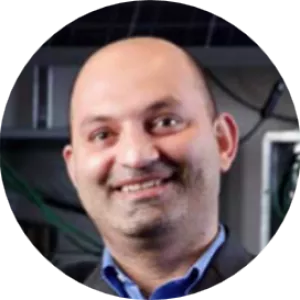 Dr. Alsaleem is an associate professor at the College of Engineering at the University of Nebraska at Lincoln (UNL). He has over six years of industry experience related to IoT devices. He received over 7.5 million in funding from federal funding agencies such as NSF, DOE, and IARPA to support his research work related to MEMS analog computers.