Smart Sustainability Model Focus Areas
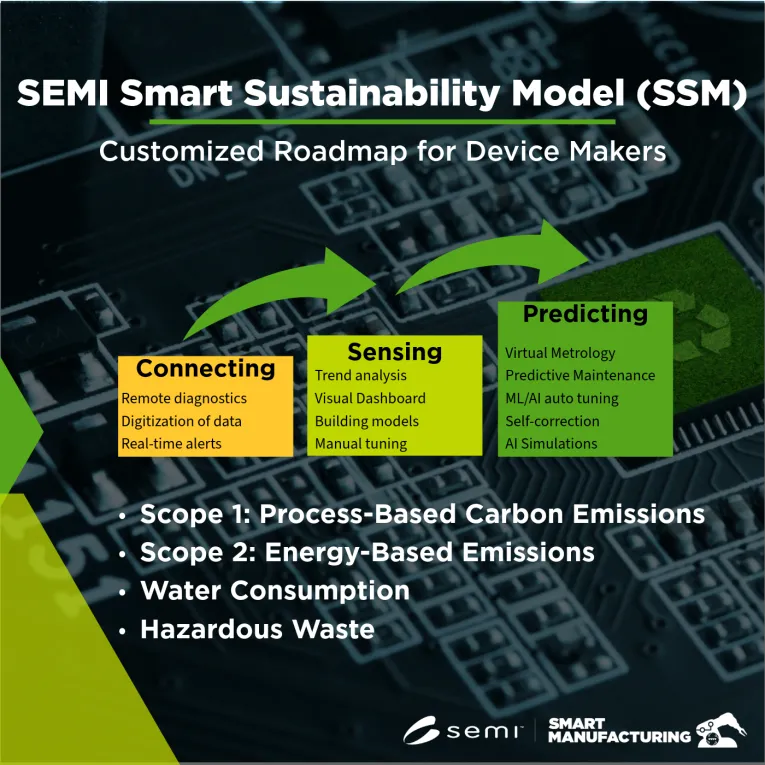
Download a comprehensive customizable model for accelerating the reduction of Scope 1 process-based carbon emissions, Scope 2 energy-based emissions, water use and hazardous waste. ROI benefits identified include cost-savings on process materials, utilities, regulatory, hazardous waste disposal, and labor plus potential higher yield and shorter cycle time after implementation.
Overview
The SEMI Smart Manufacturing Initiative has formed a task force of supply chain industry professionals entitled, “Accelerating Sustainability with Smart Manufacturing,” to formulate a roadmap of best practices for pre-existing, brownfield device-making wafer and packaging fabs leveraging Industry 4.0/5.0 methodologies for minimizing carbon emissions, water intake and chemical, particulate and gas waste via reduction, reuse and recycling methods at the cleanroom, subfab, facilities levels in addition to new, greenfield fab design. A summary of prioritized use cases assessed following a standard ranking system for expected impact to baseline level reductions will be shown as a guide to highlight critical areas for decision-makers to determine the most efficient use of capital investment and highlight ROI benefits, amid energy and supply chain security geopolitical tensions globally. Advanced techniques with respect to connectivity, sensing and predictive analytics such as machine learning and AI will be covered to show the value in facilitating companies to meet their sustainability goals, while improving fab productivity and resource efficiency.
Download Latest Whitepapers
Please download these free foundational white papers to understand the motivation, logic, scope, and quantified sustainability metric improvements that can be achieved using the SSM.
Accelerating Sustainability Part I
Accelerating Sustainability Part II
Resources
SSM was developed by the SEMI Smart Manufacturing Accelerating Sustainability with Smart Manufacturing Task Force
Participating member company representatives denoted in white paper acknowledgement section. For more information on this initiative read the latest blogpost here and review highlights from our session at SEMICON West 2024 here
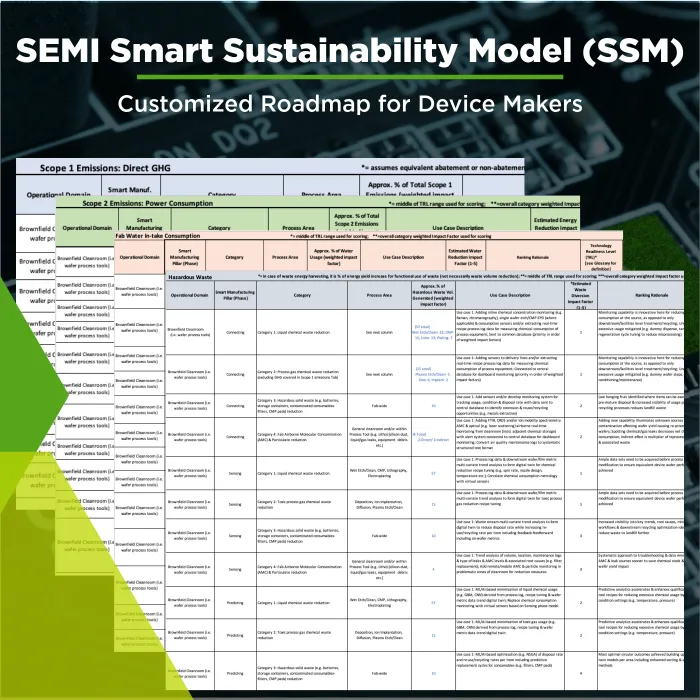
The SSM Excel file has 6 unique tabs:
- Instructions
- GHG-Scope 1 Emissions
- GHG-Scope 2 Emissions (Power Usage)
- Water Consumption
- Hazardous Waste
- Glossary
SSM Excel platform base case numerics for all use cases, are based on an overall 300mm fab industry average determined from published literature and task force input, which include weighted impact factors that can be tailored to represent a specific SSM user fab.
SEMI members can access task force SEMI Connect Portal as an added benefit for context and background details.
Customizable model for device-maker fabs
- Applied in scalable fashion to front & back-end & wafers-level packaging fabs
- Identify opportunities and gaps following consistent logical approach
- Prioritize efficient investment of capital based on expected impact
- Accelerate meeting of corporate sustainability goals, ESG targets
Internal benchmarking tool
- Compare Model metrics between fabs sites internally and/or for developing Smart Golden fab for global roll-out
- Best practices from brownfield fabs can be applied to greenfield sites
- Self-assessment for sustainability improvements as use case implementation increases over time
Scouting new greenfield plant locations (based on environmental resource limitations & local regulatory policy)
- Determine potential of energy/water/waste/emissions reductions when applying use cases to meet sustainability targets
- Comprehensive approach for widening geographic locations for build-outs where constraints may lie (e.g. desert regions)
Fab ecosystem alignment
- Can be referenced up & down semiconductor supply chain, manufacturing areas, or other related industries
- Supply chain plays big part in developing or refining technologies based on TRL status to provide fabs with off-the-shelf solutions
- Suppliers can be aligned to key device maker use case priorities for better alignment & stronger collaboration working in lock-step off same Roadmap & develop economies-of-scale
Direct Benefits
- Cost-savings on utilities, regulatory/permits, process materials, hazardous waste disposal and transportation; labor after implementation
- Accelerate time-to-market for product development done in sustainable manner up-front to avoid re-engineering later
- Potential yield & cycle time increases to boost output amid chip shortages (reduce opportunity cost of not meeting demand)
- Maximize profitability per wafer based on #1-3 above
Indirect benefits
- Time-savings leveraging legwork of task force supply chain professionals over 3-year period with well-defined comprehensive strategic roadmap well-documented with industry best practices & innovation
- Numerical roadmap that goes beyond simply listing out solutions but assesses them for projected impact that can be tailored easily to specific fab operation
- Companies can leverage pre-existing AI infrastructure build-out being developed for other ML/AI optimization initiatives
- Ability to claim title of not only “Smart Factory” but “Autonomous Smart, Sustainable Factory” when fully implemented
SEMI Member Pricing - $500
Non-Member Pricing - $750