

The Inner Ear, Eyes, and Skin of Humanoid Robots: How Advanced Sensors Enable Human-Like Performance
ABSTRACT
Humanoid robots are rapidly transitioning from research laboratories into factories, hospitals, warehouses, homes, and public spaces. Yet achieving truly human-like performance remains one of the most challenging goals in robotics. While advances in artificial intelligence have significantly improved perception and decision-making, the quality of those decisions is fundamentally limited by the robot's ability to sense and understand its environment. Just as humans rely on a sophisticated network of sensory organs, next-generation humanoid robots require highly integrated sensing systems that function as their "eyes," "inner ears," and "skin."
This presentation explores the critical role of advanced sensors in enabling robots to perceive, navigate, balance, manipulate objects, and interact safely with people. We examine how breakthroughs in MEMS inertial sensors provide the equivalent of the human vestibular system, allowing robots to maintain stability and orientation during dynamic motion.
Beyond individual sensing modalities, the presentation addresses the fusion of sensor data with artificial intelligence models to create robust perception systems capable of operating in real-world environments. Novel architectures for sensor fusion, edge intelligence, and real-time decision-making are reshaping the capabilities of humanoid platforms and accelerating their deployment across numerous industries. Ultimately, the future of humanoid robotics will be determined not only by smarter algorithms, but by the sensors that provide robots with the ability to see, feel, balance, and understand the world around them.
BIOGRAPHY
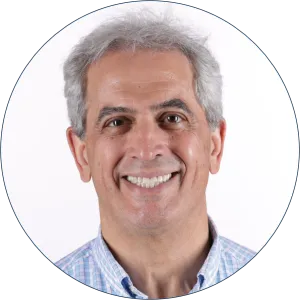
Dr. Sabah is the Head of the MEMS Technology Group (Aerospace, Defense and Communication) at Analog Devices. He joined the company in 2015 following Analog Devices’ acquisition of the Cambridge-based MEMS startup SAND9, where he had been a member of the leadership team since 2013. Prior to SAND9, Dr. Sabah spent more than 15 years at Dover Corporation (Vectron International) in Germany and the United States, holding senior technical and commercial roles including R&D Director, Product Marketing Manager, RF Filter Designer, and Principal Scientist. His work has spanned advanced MEMS and RF technologies from concept through commercialization. Dr. Sabah is the author and coauthor of numerous technical publications and is an inventor and co-inventor on multiple patents. He holds a PhD and an MSc (Diploma) in Electrical Engineering from the Technical University of Berlin, Germany, earned in 1999 and 1995 respectively, and is fluent in four languages.