

August 5, 2026 - August 6, 2026
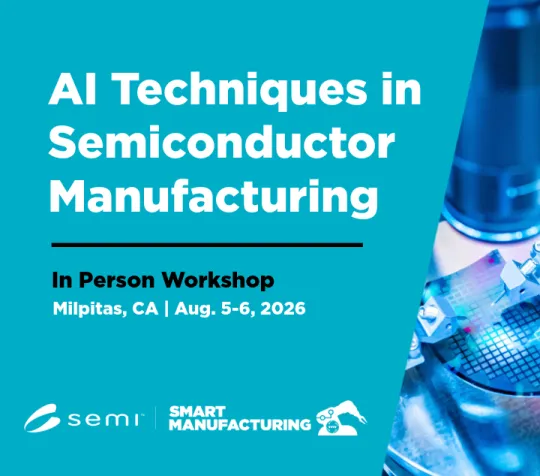
The SEMI Smart Manufacturing Initiative is hosting a two-day workshop titled "AI Techniques in Semiconductor Manufacturing" at SEMI HQ in Milpitas, CA, on August 5–6, 2026. This event is part of a continuing series focused on integrating advanced AI into the semiconductor landscape. The workshop is designed to help participants understand: The real-world deployment, impact, and lessons learned from AI techniques. Strategies for building observable and scalable multi-agent workflows. The industry transition from restrictive data silos toward autonomous discovery. Methods for achieving tangible business results and automation through diverse AI applications.
Time
8:00 am - 5:00 pm PDT
Location
SEMI HQ
673 S Milpitas Blvd.
Milpitas, CA 95035
United States
Agenda
Morning, Day 1: August 5th, 2026
Emergent AI/ML Tools for Semiconductor Manufacturing Technology Optimization
Semiconductor manufacturing faces a broad set of complex challenges addressed through Yield Management Systems (YMS), Fault Detection and Classification (FDC), Run-to-Run (R2R) control, Design of Experiments (DOE), and Statistical Process Control (SPC). Existing machine learning approaches are predominantly scoped to individual process steps or short loops, leaving full-traveler analysis — essential for informed tool decisions such as hold, parameter adjustment, and recipe modification — largely unaddressed. Bespoke, step-specific models do not generalize across process nodes or design variants, and manually configuring analytical workflows for each new use case is time-intensive and error-prone as technology nodes diversify. General-purpose coding agents built on large language models (LLMs) partially close this gap by automating workflow generation, but they lack the semiconductor-specific domain knowledge required for robust, production-grade solutions: open-source ML packages carry no fab context, and proprietary data curation and signal-processing conventions are rarely captured in public training corpora.
This session shows how a fab-aware agentic approach closes that gap, focusing on three use cases: YMS, FDC, and Process DOE. It opens with a technical primer built on a common pipeline — preprocessing and feature reduction, uncertainty-aware imputation, regime-aware modeling (physics and virtual-metrology priors when data is scarce, data-driven as it grows), and interpretable attribution rather than black-box scores — instantiated differently across the three, with emphasis throughout on when a result can be trusted. YMS downselects high-dimensional metrology, imputes sparse measurements, and trains a tuned regressor ensemble (GPR, gradient-boosted trees, neural nets), with feature attribution (SHAP) mapped to process step and tool. FDC aligns traces, then layers univariate control limits (SPC) with multivariate anomaly detection (PCA, Hotelling T², MEWMA), per-sensor attribution, and alarm-budgeted limits that transfer across chambers. Process DOE designs experiments, fits uncertainty-aware surrogates (Gaussian processes), reduces dimensionality (PCA), and selects runs sequentially (single- and multi-objective Bayesian optimization). Attendees then see these techniques operationalized live by a domain-specific agentic platform and work directly with the agents on curated datasets.
By the end, attendees will understand how problem formulation, data characteristics, and method selection shape outcomes, and what distinguishes a domain-aware agentic workflow from a general-purpose coding agent. The session is interactive by design — participant choices steer the live analysis, and attendee input shapes how these capabilities evolve.
Real-Time Equipment Health Monitoring Using Gaussian Process Regression on Sensor Signals
Will present a real-time health monitoring method for semiconductor equipment using multi-sensor time-series signals. From a small set of baseline runs (typically 5–20), Gaussian Process Regression is used to learn expected sensor behavior and associated confidence bands over repeatable operating segments. At runtime, deviations from these bands are aggregated into health scores per sensor and segment to identify abnormal behavior early. The system automatically reports anomalies and raises warnings to support proactive maintenance and reduce unplanned downtime and quality risk. To address the O(N^3) training cost of standard GPR, we use a split-training approach that achieves linear scaling, keeping computation practical for production use.
Break
Predict Before Failure: A Predictive Maintenance Blueprint with NV-Tesseract and NeMoClaw
Semiconductor fabs generate high-volume, multivariate sensor telemetry from process tools, ambient monitoring systems, sub-fab equipment, etc. Scheduling maintenance operations depends on more than just reacting to alarms/alerts: teams need to forecast how equipment will behave and detect abnormal trajectories/baseline shifts before failures occur.
This session introduces an open Predictive Maintenance Blueprint that embeds NV-Tesseract as the core time series AI component. The pipeline performs multivariate forecasting on equipment sensor data, then runs diffusion-based anomaly detection on the forecasted window to flag emerging degradation patterns.
The blueprint is packaged as a reusable, deployable workflow with Hugging Face weight retrieval, configurable sensor channels, and structured outputs for downstream automation.
We extend this blueprint with NVIDIA NeMoClaw, treating predictive maintenance as an always-on agent workflow: an autonomous agent ingests sensor streams, invokes the NV-Tesseract pipeline, interprets anomaly scores, and produces operator-ready summaries and recommended actions under OpenShell runtime guardrails.
Together, this shows how foundational time series models and agent orchestration can be coupled to build a production-style Predictive Maintenance stack for semiconductor operations.
What the Audience Will Learn:
Predictive maintenance is shifting from threshold-based SCADA alarms to forecast-then-detect workflows that catch drift earlier on multivariate equipment signatures.
Foundational time series models (like NV-Tesseract) are increasingly deployed as components inside larger agent systems, not as standalone notebooks.
Semiconductor and industrial teams are adopting blueprint + agent patterns (similar to NeMoClaw deployments in EDA, simulation, and factory ops) to move from prototype to governed, repeatable workflows.
Practical lessons: multivariate sensor alignment matters; model weights and configs should be versioned and auto-retrieved; anomaly outputs must be explainable enough for maintenance engineers to trust and act on.
Architecture takeaways:
When to use multivariate forecasting vs. single-signal monitoring.
Why diffusion-based anomaly detection fits correlated, high-dimensional fab sensor data better than univariate reconstruction approaches.
How NeMoClaw can orchestrate the pipeline: data ingest → inference → thresholding → alert routing → human-in-the-loop review.
Lunch
Practical Agentic AI at Scale for Manufacturing: Lessons Learned from Large-Scale Deployments
Agentic AI is nearing mainstream adoption, yet many organizations still lack a clear strategy for deployments at scale. In order to bring LLM capabilities to manufacturing, companies need to go beyond what mainstream AI suppliers can deliver; they need AI deployments to be governed, reliable, repeatable, and scalable enough to earn trust and deliver measurable results. Most importantly, it must be grounded in and continuously integrate the knowledge of subject matter experts who understand the complexity of real systems and processes.
In this session, we will share lessons learned from deploying large-scale agentic AI solutions in the semiconductor industry. We will explore how SME expertise and operational context can be embedded into Agentic AI systems to create trusted, high-value results. Specifically, we will show how an auto-Triage/RCA a Facilities Anomaly event workflow can be set up such that, as the event triggers, an AI agents completes a first pass investigation that is ready for consumption by the end user shortly after an event triggers with an optional integration with CMMS systems to ease the creation of a work order to drive faster time to resolution and greater consistency in event disposition. We will also demonstrate how engineers can build custom apps and AI agents on demand, without requiring an AI specialist or extensive coding skills, while maintaining the structure and scalability needed for enterprise adoption. Attendees will leave with practical insights for enabling better, faster decisions across engineering, technician, and operator workflows.
Afternoon, Day 1: August 5th, 2026
Human-Machine Collaboration for Improving Semiconductor Process Development
One of the bottlenecks to building semiconductor chips is the increasing cost required to develop chemical plasma processes that form the transistors and memory storage cells1,2. These processes are still developed manually using highly trained engineers searching for a combination of tool parameters that produces an acceptable result on the silicon wafer3. The challenge for computer algorithms is the availability of limited experimental data owing to the high cost of acquisition, making it difficult to form a predictive model with accuracy to the atomic scale. Here we study Bayesian optimization algorithms to investigate how artificial intelligence (AI) might decrease the cost of developing complex semiconductor chip processes. In particular, we create a controlled virtual process game to systematically benchmark the performance of humans and computers for the design of a semiconductor fabrication process. We find that human engineers excel in the early stages of development, whereas the algorithms are far more cost-efficient near the tight tolerances of the target. Furthermore, we show that a strategy using both human designers with high expertise and algorithms in a human first–computer last strategy can reduce the cost-to-target by half compared with only human designers. Finally, we highlight cultural challenges in partnering humans with computers that need to be addressed when introducing artificial intelligence in developing semiconductor processes.
What the Audience will Learn:
How Bayesian optimization can help enhance speed-to-solution for semiconductor manufacturing.
Break
From Prediction to Action: Causal AI for Real-Time Root-Cause Analysis in Semiconductor Manufacturing
Semiconductor fabs generate massive volumes of data across tools, sensors, inspection systems, and process logs—yet most AI deployments remain predictive, identifying anomalies without explaining their root cause. This results in prolonged root cause analysis (RCA), costly downtime, and repeated trial-and-error fixes.
In this talk, we present a practical approach to moving from prediction to action using causal AI. By unifying multi-modal data like images, time-series signals, and process metadata into a single intelligence layer, we enable systems that reason about cause-and-effect relationships rather than correlations.
We will discuss how such systems can be trained efficiently using weak supervision and deployed at the edge to meet latency, privacy, and reliability requirements. We also highlight how continuous monitoring and model refinement in production ensure sustained performance in dynamic manufacturing environments.
Drawing from real-world deployments, we show how this approach reduces RCA time from hours to minutes, improves diagnostic accuracy, and enables prescriptive actions for faster yield recovery and improved operational efficiency.
What the Audience will Learn:
1. Why predictive AI falls short for RCA and how causal AI bridges the gap
2. How to build an “intelligence layer” on top of MES and traceability systems
3. Practical methods for leveraging limited labeled data
4. How to integrate multi-modal data (inspection images + sensor logs + process flows)
5. How to build AI agents that improve with more data
How this AI technique is being used in industry today (real deployments, lessons learned, impact): In semiconductor manufacturing environments, causal AI systems are being deployed alongside existing inspection and MES infrastructure to accelerate and improve root cause analysis.
In one deployment, defect patterns observed across multiple inspection stages were correlated with tool-level and process metadata. Instead of manual investigation across dozens of steps, the system identified a specific tool-stage interaction responsible for recurring defects. This reduced RCA time from 20–40 hours to under 10 minutes while improving diagnostic consistency.
Demo: Yes
Hands-on Session:
Yes, Applying weak supervision to label defect data with minimal manual effort
Interpreting causal relationships across process steps
Monitoring and updating models in a production-like setting
Reception
Morning, Day 2: August 6th, 2026
Get More from Your Sign-off Flow: Agentic AI That Makes Power & Signal Integrity Engineers Radically More Productive
Agentic AI is moving from research demos to production EDA flows, and the leverage is very clear in power and signal integrity sign-off, where engineers routinely write 1000+-API Python scripts, search for root causes through ~100 GB log files, and stitch results across half a dozen vendor tools. This talk presents our experiences with building, shipping, and supporting a multi-agent system for a production sign-off tool used on modern VLSI and 3DIC designs — covering what it took to move from a single LLM "wrapper" to a hardened agentic system that customers can actually trust with their IP.
We will walk through the full stack: a multi-agent architecture (code-generation, log-debug, RCA/diagnostics) built on a Deep-Agent framework; an Agent Skills pattern that makes diagnostic workflows modular, composable, and customer-extensible; MCP used in both directions (the Copilot consumes vector-DB and API knowledge as MCP, and the tool itself is exposed as an MCP server so other EDA agents and customer orchestrators can drive it); and a governance layer covering tiered action approval, API-hallucination guards, prompt sanitization, audit trails, and on-premise / air-gapped local-LLM deployment. We will close on the next frontier: cross-vendor agent-to-agent flows, for example, place-and-route → parasitic extraction → power integrity → timing — orchestrated through MCP, with humans setting policy at well-defined checkpoints rather than copy-pasting between tools.
The session is built for practitioners. A curated set of short demo videos recorded from real Agentic AI sessions on representative designs showing the agent generate scripts and run a multi-step RCA end-to-end, with explanations on what is happening under the hood at each step.
What the Audience Will Learn:
1. Reference architecture for a production EDA Copilot: Multi-agent decomposition (code-gen, log-debug, RCA), RAG over manuals/API catalogs, and tool execution inside the host EDA product.
2. The Agent Skills pattern for RCA / diagnostics: Composable Agent Skills (IR-drop RCA, anomaly detection, comparative run analysis) the orchestrator plans over and that customers can extend without touching the core.
3. MCP as a two-way integration framework: Consuming knowledge and tool capabilities as MCP and exposing the EDA tool itself as an MCP server so customer or partner agents can drive it.
4. Governance and guardrails for production: Tiered action approval, API-validation against the catalog to block hallucinations, prompt sanitization for IP, audit trails, and runaway controls.
5. A practical LLM strategy: Cloud frontier models, qualified open-weight local LLMs for air-gapped customers, and distillation + RL fine-tuning strategies with LLM-as-judge and production feedback.
6. The feedback flywheel: What to instrument to drive weekly prompt fixes, monthly workflow updates, and quarterly model improvements.
7. Cross-vendor agentic flows: Sequential chaining, parallel fan-out, and iterative loops across EDA tools over MCP.
How This AI Technique Is Being Used in Industry Today
The Copilot is a shipped, per-user binary that launches alongside a production sign-off tool, attaches to the user's interactive session, and runs entirely on customer infrastructure (cloud LLM or fully on-premise).
Demo Session: Curated Videos (20 min)
Rather than a live hands-on segment, the demo is a curated set of short, pre-recorded clips captured from real Copilot sessions on representative designs. This keeps the demonstration crisp and reproducible, and the speaker narrates each clip — calling out which agent, skill, or MCP call is firing and why.
Break
From Data Silos to Autonomous Discovery: Agentic AI in Semiconductors
Semiconductor manufacturing is increasingly challenged not by the availability of data, but by the difficulty of integrating and reasoning across fragmented, heterogeneous information sources spanning process data, metrology, and engineering knowledge. This session introduces a practical, system-level perspective on building agentic AI capabilities for semiconductor applications, beginning with foundational considerations in data definition, representation, and consistency across structured and unstructured domains.
The discussion focuses on how these foundations enable a transition from isolated analytics toward more integrated, decision-oriented systems. Architectural patterns are explored for combining data-driven models, simulation, and domain knowledge into cohesive workflows, with emphasis on reliable orchestration, traceability of reasoning, and appropriate human oversight—elements that are critical for deploying AI in high-stakes manufacturing environments.
The session concludes with an overview of how emerging approaches are extending these ideas toward more adaptive and semi-autonomous optimization systems. Attendees will gain a structured view of the end-to-end stack—from data preparation to decision support—and practical insights into considerations for adopting agentic AI methodologies in semiconductor manufacturing settings.
Building a Trustworthy Semiconductor Knowledge Base for Agentic Insight Generation
Semiconductor organizations face doubling advanced-node design costs, compressing design cycles, and scarce engineering talent while their most valuable asset, engineering knowledge, sits fragmented across schematics, waveforms, 8D reports, JIRA tickets, fab SOPs, and decades of tribal expertise. Generic search and AI tools routinely fail on this dense, technical content.
Drawing on real-world deployments at Broadcom, SanDisk, Altera, and Texas Instruments, Vectara will explore the solution architecture and real-world deployment of their domain-specialized Knowledge Hub and Agentic AI Platform designed specifically for the semiconductor lifecycle.
We'll walk through the multi-stage ingestion pipeline that preserves formulas, nested tables, and schematics natively; Vectara unified retrieval fabric that replaces fragmented, separately licensed point tools; and the agent layer that runs multi-hop, semantically deep queries across technical logs and historical failures - letting engineers surface root-cause indicators in plain language, no SQL required.
Crucially, the session will focus on what production-grade accuracy demands: grounded, citation-backed answers over complex IP for generating net-new insights, and streamline cross-team knowledge reuse that engineering teams, and agents can trust.
Lunch
Afternoon, Day 2: August 6th, 2026
Making Sense of Equipment Time‑Series Data: From Signals to Insight
Modern semiconductor equipment generates vast amounts of time-series and inspection data, but much of it remains under-utilized. This session presents a practical, end-to-end workflow—from data preparation and AI modeling (including anomaly, defect, and drift detection) to validation and deployment—using familiar manufacturing data. It also highlights how synthetic data and generative AI can accelerate model development while maintaining robust validation and engineering control.
What the Audience will Learn:
Attendees will learn how to turn equipment data into actionable insights using an end-to-end AI workflow—from data preparation to deployment. They will also see how multiple AI approaches, synthetic data, and generative AI can accelerate development while maintaining rigorous engineering validation.
Demo / Hands-on Session: Yes
Break
Achieving Business Results from Air-gapped Agentic AI Automation in Semiconductor Manufacturing - Lessons from the Field
Agentic AI has crossed a capability line where it can now effectively automate non-trivial portions of work that previously was only done by factory engineers - process engineers, yield engineers, test engineers, maintenance engineers. At Cohu, we have been working closely every week with our customers to roll out agentic capabilities that are leading to significant automation, yield, and capacity improvements. Along the way, we have needed to overcome significant constraints - such as prohibitions on providing sensitive process data to cloud AI providers - and had to manage the more complicated issue of integrating agentic AI into legacy systems and processes. In this talk I can share some of ways that our customers are benefiting from agentic AI and talk about some of the learnings gained through these various deployments.
What the Audience will Learn:
Key learnings for the audience a) real use cases of agentic AI in global semiconductor manufacturing companies; b) practical recommendations for how to prepare for and be successful with the deployment of agentic AI in semiconductor manufacturing.
Demo:
FDC model creation, and fault analytics
Yield analytics
Tester Operations Management
Test Engineering - lot disposition analytics
Maintenance optimization and predictive maintenance
Line support optimization
Sponsors
Event Sponsors
Sponsorship Opportunities
Enhance your brand with our exclusive sponsorship packages. For details, contact:
Karim Somani
Email: [email protected]
Suggested Hotels:
Embassy Suites by Hilton Milpitas Silicon Valley
901 East Calaveras Boulevard
Milpitas, CA 95035
(408) 942-0400
Courtyard by Marriott Milpitas Silicon Valley
1480 Falcon Dr.
Milpitas, CA 95035
(408) 719-1966