

Turning Variability into Insight: A Holistic Approach to Optical Inspection
ABSTRACT
Semiconductor technology inflections are driving unprecedented complexity in manufacturing, where challenges associated with variability and stochastic effects require novel inspection methods. To maintain yield and accelerate learning, inspection must evolve beyond single-modality detection toward integrated, predictive solutions. This paper outlines an approach built on three complementary vectors of innovation. First, advances in algorithms and software enhance the ability to separate true defects from background variation, improving sensitivity while reducing nuisance signals. Second, portfolio-level integration of complementary inspection and metrology capabilities enabling a more holistic view of process health, supporting faster root-cause analysis and excursion control. Third, agnostic multi-data-stream strategies combine diverse sources—inspection, metrology, and process telemetry—into unified models that transform random signals into predictable, actionable insights. This fusion enables dynamic sampling, prioritization of high-risk patterns, and closed-loop feedback to upstream processes. Together, these innovations reposition optical inspection from a standalone detector to a system-level enabler of predictive process control, ensuring scalability and resilience as technology complexity accelerates.
BIOGRAPHY
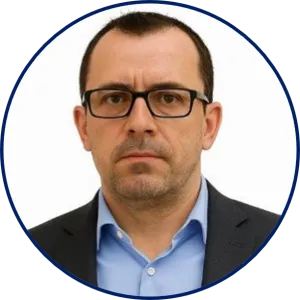
Scott Hoover is Director of Yield Solutions at KLA, bringing over 30 years of experience in the semiconductor industry. His career spans leadership roles in process engineering, process integration, and yield enhancement at ON Semiconductor, Intel, and Samsung. At KLA, where he has served for the past 11 years, Scott works closely with leading-edge integrated circuit manufacturers to apply KLA’s advanced products, solutions, and technical expertise to solve complex and elusive yield challenges. His efforts have been instrumental in accelerating yield ramps and elevating yield entitlement across advanced technology nodes.
Scott holds degrees in Chemical Engineering and Mathematics from the Colorado School of Mines. He is well published and a named inventor, reflecting his commitment to innovation and knowledge sharing in semiconductor manufacturing.