
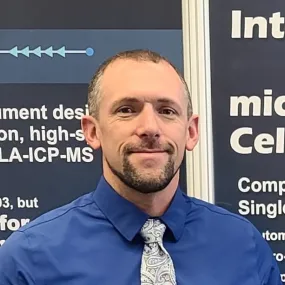
Senior Scientist Elemental Scientific
C. Derrick Quarles Jr. is a Sr. Scientist working for Elemental Scientific, Inc. since 2016, in the areas of automation, elemental speciation (LC-ICP-MS), single particle- and single cell-ICP-MS, LA-ICP-MS, LA-MS, LIBS, and LC-QTOF-MS. He received his PhD in Analytical Chemistry from Clemson University in 2011 under the supervision of Prof. R. Kenneth Marcus and did a fellowship at the Centers for Disease Control & Prevention (CDC). Prior work includes time as a guest researcher at Lawrence Berkeley National Laboratory and Pacific Northwest National Laboratory working in the field of atomic spectroscopy. Dr Quarles has over 60 scientific peer-reviewed publications and was named one of the “2014 young analytical scientists” by the Journal of Analytical Atomic Spectrometry and received the “2018 Young Alumni Award” from the College of Science and Mathematics at Augusta University. In 2019, he became the Atomic Section chair for the annual SciX meeting and still holds this role. In 2020, Dr Quarles became the Atomic Section chair of the Society of Applied Spectroscopy; in 2024 created the subsociety “International Atomic Spectrometry Association (IASA)” and is the acting President of the association. In 2026, IASA had the distinct honor to carry on the operation of the United States Winter Conference on Plasma Spectrochemistry from Prof. Ramon Barnes. Dr. Quarles has served as an associate editor for Applied Spectroscopy Practica since 2022 and has been on the advisory board for the Journal of Analytical Atomic Spectrometry since 2023.
Abstract
Exploring the capabilities of LA-ICPMS and LIBS for surface, spatial, and depth detection of nanoparticles and contaminants in Si and SiC wafers
Vapor phase decomposition-inductively coupled plasma mass spectrometry (VPD-ICPMS) provides ultra-low-level detection of metal surface contaminants on Si wafers. While VPD-ICPMS is excellent for the detection of surface contaminants on Si wafers, it does not provide spatial information on the micron-scale and does not provide depth analysis information. The use of laser ablation-inductively coupled plasma mass spectrometry (LA-ICPMS) provides elemental spatial information on the surface of the wafers down to the single µm scale and can provide elemental depth information on the 10’s of nm scale. Laser-induced breakdown spectroscopy (LIBS) is a complementary technique to LA-ICPMS which provides the additional ability to detect H, N, O, and F simultaneously. Furthermore, LA-ICPMS enables detection of discrete contamination particles and nanoparticles on wafer surfaces, providing elemental composition and spatial localization that can aid in root-cause analysis of defect-related yield excursions.
Here we highlight the application of LA-ICPMS and LIBS for the characterization of both surface and subsurface contamination in Si and SiC wafers, providing spatial and depth-resolved information unavailable through conventional VPD-ICPMS measurements. This technique can be used to analyze localized areas of known defects or can be used to scan the entire wafer (≤300 mm). Results will demonstrate 2D elemental images (Na, Al, S, Cu, Ni, Ba, etc.) on Si and SiC wafers using two different laser sampling methods: 100 µm x 100 µm (large laser spot) high-sensitivity, lower resolution method and 5 µm x 5 µm (small laser spot) high-resolution method. The results show that LA-ICPMS and LIBS provide a complementary analytical workflow to VPD-ICPMS, enabling contamination localization, elemental imaging, and depth characterization of defects that cannot be resolved through conventional surface extraction methods.