
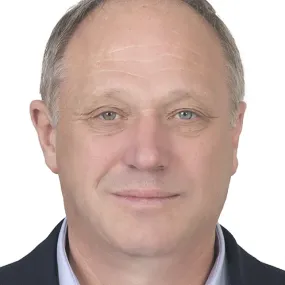
President Elemental Scientific
After earning a Ph.D. in Analytical Chemistry from Iowa State University in 1991, Dan Wiederin commercialized his doctoral research on direct injection nebulization ICPMS. He later served as Worldwide Marketing Manager for inorganic mass spectrometry products at Thermo Finnigan. In 1998, he founded Elemental Scientific to develop advanced instruments for elemental determinations in semiconductor process chemicals, environmental samples, and for geological and oceanographic research.
Wiederin is the inventor on more than 200 U.S. and foreign patents, primarily focused on ppt- and ppq-level online detection of contaminants in semiconductor process chemicals and VPD-ICPMS analysis of metal contaminants on semiconductor wafers.
Addressing IRDS Yield Enhancement Challenges in Liquid Chemical Metrology
Abstract
The International Roadmap for Devices and Semiconductors (IRDS) has identified 17 near-term yield enhancement challenges, four of which pertain specifically to metrology for liquid chemicals:
| Challenge | Description |
|---|---|
| #3 – Critical Organics in UPW | Lack of online metrology for organic speciation |
| #4 – Metals in H₂O₂ | Insufficient capability to characterize critical metals for key process steps |
| #7 – Particles in Liquid Chemicals | Need for reliable detection of particles <10 nm |
| #13 – Critical Metals in UPW for CMOS Image Sensors | Inadequate metrology for concentrations below 200 parts per quadrillion (ppq) |
We have developed methodologies and instrumentation that directly address these challenges:
- Challenge #3: Using Electrospray Ionization Time-of-Flight Mass Spectrometry (ESI-TOFMS), we can detect trace organics in UPW and other liquid chemicals at parts-per-trillion (ppt) levels. The high resolution of TOFMS enables detailed speciation. Our instrumentation supports both online and laboratory-based measurements.
- Challenges #4 & #13: We have implemented an inline concentration technique that allows detection of metallic impurities at ppq levels in H₂O₂ and other chemicals. For UPW, our system can measure sub-ppq concentrations. This capability is available for both online and lab environments.
- Challenge #7: Our methodology enables the detection of nanoparticles as small as 5 nm in liquid chemicals. The instrumentation is designed for both continuous monitoring and laboratory analysis.
We will present data demonstrating that these solutions effectively overcome the four IRDS-defined metrology challenges, contributing to enhanced yield in semiconductor manufacturing.