

Introduction to Lab Tours and Berkeley Sensor & Actuator Center
ABSTRACT
This presentation will provide a brief overview of the vision and guiding concepts that drive research at the Berkeley Sensor & Actuator Center (BSAC), touch upon some of its compelling research projects, then provide Lab Tour logistics and send participants on their way to the labs.
BIOGRAPHY
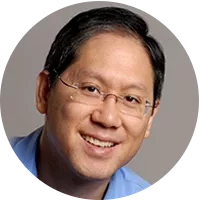 Clark T.-C. Nguyen is the Co-Director of the Berkeley Sensor & Actuator Center, as well as Chair of Electrical Engineering in the Electrical Engineering & Computer Sciences Department at the University of California at Berkeley. His research interests focus on micro electromechanical systems (MEMS) and include integrated micromechanical signal processors and sensors, merged circuit/micromechanical technologies, RF communication architectures, and integrated circuit design and technology. In 2001, Nguyen founded Discera, Inc, the first company to commercialize timing products based upon MEMS technology, at the time breaking ground for a brand new MEMS-based timing industry with an initial focus on the very vibrating micromechanical resonators pioneered by his research. From 2002-05, he served as a Program Manager in DARPA's Microsystem Technology Office, where he generated/funded a diverse portfolio of ten MEMS-centric programs. He is an IEEE Fellow and served as President of the IEEE Ultrasonics, Ferroelectrics and Frequency Control Society from 2016-17. He is a recipient of the 2017 IEEE EDS Robert Bosch Micro and Nano Electro Mechanical Systems Award, as well as numerous teaching awards that include the University of Michigan’s Henry Russel Award and the UC Berkeley Electrical Engineering Award for Outstanding Teaching.