

The Race to A Trillion: Scaling Technology, Capacity, And Culture in The AI Era
ABSTRACT
Artificial intelligence is transforming the way we lead our lives and, in the process, it is driving unprecedented demand for computational power. Meeting this moment requires moving beyond traditional scaling to a new class of advanced semiconductor solutions. Front-end transistor scaling must be matched with innovations in materials, novel device architectures, and next-generation equipment, while advanced packaging—chiplets, 3D integration, and high‑bandwidth interconnects—becomes a critical system-level enabler. Silicon photonics and co-packaged optics will be essential to overcome electrical interconnect limits and deliver energy-efficient data movement for AI workloads.
This technological shift is unfolding in a highly capital-intensive environment that demands massive investment in fabs, assembly, test, data centers, power, and cooling solutions alongside cost-effective, high-throughput process and equipment innovations. Geopolitical uncertainty heightens the need for a geographically diversified, resilient supply chain, supported by policy and industry collaboration. Businesses and entities with access to advanced semiconductor solutions, power, and unhindered supply capabilities will dominate this AI transformation cycle. Success also depends on attracting, developing, and retaining skilled talent and building a work culture that keep teams engaged and energized. By advancing technology, scaling capacity, strengthening supply chains, and changing our way of working, together we can unlock the next frontier of AI and realize the trillion‑transistor, trillion‑dollar semiconductor future.
BIOGRAPHY
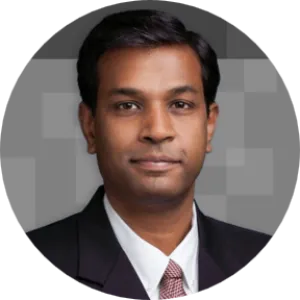
Naga Chandrasekaran is executive vice president, chief technology and operations officer, and general manager of the Intel Foundry organization at Intel Corporation. He is responsible for Intel Foundry’s technology development, worldwide manufacturing, customer service and ecosystem operations, including research, development, and deployment of next-generation silicon logic, packaging and test technologies, as well as front-end and back-end manufacturing, foundry services, strategic planning, corporate quality and reliability and supply chain.
The Intel Foundry business brings together all the critical components that fabless customers need to design and manufacture chips for the new era of AI-driven computing.
Previously, Chandrasekaran was general manager of Foundry Technology and Manufacturing, overseeing Intel Foundry’s technology development and global manufacturing operations. Prior to joining Intel, Chandrasekaran served in senior leadership roles at Micron, most recently as senior vice president of Technology Development. He led Micron’s global technology development and engineering efforts related to the scaling of current memory technologies, advanced packaging technology and emerging technology solutions. Before that, he served as Micron’s senior vice president of Process R&D and Operations.
Chandrasekaran earned a bachelor’s degree in mechanical engineering from the University of Madras; a master’s degree and a doctorate in mechanical engineering from Oklahoma State University; a master’s degree in information and data science from the University of California, Berkeley; and dual executive MBAs from the University of California, Los Angeles, and the National University of Singapore.