

Digital Twin in Nanofabrication Cleanroom
Abstract
Manufacturing advanced semiconductor devices and integrated microsystems with high yield remains a formidable challenge due to complex geometries, material variability, and process drift. These challenges are further compounded by increasing demands for heterointegration and multi-technology integration. Addressing these limitations necessitates the development of novel methodologies that transcend current manufacturing constraints, enabling breakthroughs in semiconductor technology.
We propose a Digital Twin framework designed to transform process development by integrating validated physical models (TCAD/EDA) with Artificial Intelligence (AI). This hybrid approach delivers quantitative insights that enable actionable process optimizations while ensuring scalability to High-Performance Computing (HPC) environments. Additionally, the framework adheres to stringent security protocols, incorporating federated learning for secure data sharing and encrypted data processing methods to protect proprietary information. However, the realization of this framework requires an interoperable ecosystem, encompassing contributions from designers, material suppliers, equipment manufacturers, and fab operators. Given the complexity and traceability requirements of semiconductor manufacturing data, a new set of standards must be established to facilitate wafer record exchange. To demonstrate the efficacy of our methodology, we present successfully trained Deep Neural Network (DNN) models capable of accurately predicting process outcomes in DUV nanolithography, ICP plasma etching, and applications extending to printed electronics and flexible hybrid electronics (FHE) manufacturing. These advancements pave the way for enhanced precision, improved process efficiency, and strengthened resilience in the national semiconductor supply chain.
Biography
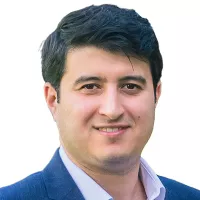
Benyamin Davaji is an assistant professor in the Electrical and Computer Engineering Department at Northeastern University. His main research interests include integrated microsystems, emphasizing sensing and computation using mechanical waves, acoustic/ultrasound transducers, bio-interfaces, microcalorimetry, and implementing data-guided methods for nanofabrication process development and semiconductor manufacturing. He received his Ph.D. degree in Electrical and Computer Engineering from Marquette University in 2016 and held a post-doctoral associate position in Electrical and Computer Engineering at Cornell University.