
SEMI FlexTech organizes this series of Flexible Electronics Master Classes on topics proving most challenging to the design, manufacture and use of flexible and printed electronics. The series enables product designers, integrators, and others new to the field to evaluate technologies and components and make the best choices for their product - getting to better business results, faster.
The courses were offered to a live audience April - December, 2021, and are now available on-demand.
FEMC005: Flexible Batteries
This Master Class covers the basics of battery terminology, chemistry and structures relevant to flexible electronics. The unique challenges related to the practical use and manufacturing of flexible batteries is discussed, as well as a summary of the current state of the art and emerging flexible battery technologies. The presentation is 90 minutes with 30 minutes of Q&A and discussion from the participants who attended the live recording on April 20, 2021.The course coverage includes:
 Flexible power
- Flexible batteries
- Printed batteries
- Thin batteries
- Flexible batteries and sustainability
- Flexible battery chemistry
- Non-toxic flexible batteries
- Materials for flexible batteries
- Solid electrolytes for flexible batteries
- Batteries for on-body electronics
- Flexible battery testing
- Flexible battery safety
- Flexible battery specifications
- Flexible battery power density
- Flexible battery energy density
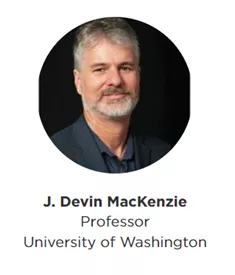
About the Instructor: J. Devin MacKenzie is the Washington Research Foundation Professor of Clean Energy and an Associate Professor of Materials Science and Engineering and Mechanical Engineering at UW. Dr. MacKenzie is also the director of the Washington Clean Energy Testbeds, an open access laboratory with world-class printed electronics, flexible electronics and energy device fabrication and testing capabilities.
Dr. MacKenzie has 20 years of experience co-founding or leading startups in novel fabrication including as a co-founder and CEO of Imprint Energy commercializing printed flexible batteries, as CTO of Add-Vision, a printed flexible OLED display company that was acquired in 2011, and as a VP at Kovio, an MIT spin out, leading printed Si RF device integration. Devin also co-founded the world’s first printed electronics company, Plastic Logic Ltd. in the United Kingdom. Previously Dr. MacKenzie was a researcher at AT&T Bell Laboratories.
FEMC007 – Flexible Hybrid Electronics 2.0 Based on Fan-Out Wafer Level Packaging
Learn why and how new packaging paradigms like chiplets and dielets are impacting the world of flexible hybrid electronics (FHE) from one of the industry's foremost experts, Dr. Subramanian Iyer of UCLA. The course explores how these packages are packing such a punch and enabling advanced performance in a much smaller and flexible footprint.
Overview: In the last few years, electronics packaging has rightfully emerged from the shadows of CMOS scaling to make a significant impact in high performance and mobile appliance computing. 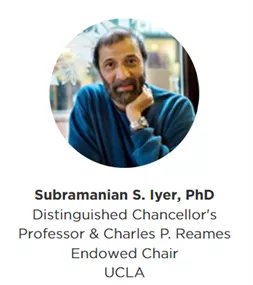
The area of Flexible Hybrid Electronics (FHE) has also developed and is making a significant impact in the area of medical and wellness electronics. The first generation of these devices have, for most part, adapted Printed Circuit Board (PCB) technology by using thinner PCBs and assembling either thinned or thin packaged “older” generation of chips on to these platforms, typically with coarse printed wiring to connect a small number of such chips.
This approach, while immensely useful to get the field going, needs to adapt and borrow from the both silicon and advanced packaging technology trends, so that we can advance this trend to the next level. The key paradigm challenges ahead are: scaling FHE in general – this includes the adoption of dielet (chiplet) technology in more advanced CMOS nodes including edge-AI, higher performance interconnects, flexible high-density energy storage, wireless communication and advanced ergonomics and all of these at lower cost and higher reliability.
This talk addresses the challenges and outline a possible technology roadmap to achieve these goals in the next few years.
About Professor Iyer: Subramanian S. Iyer (Subu) is Distinguished Professor at the University of California at Los Angeles. He is Director of the Center for Heterogeneous Integration and Performance Scaling (CHIPS). Prior to that he was an IBM Fellow. His key technical contributions have been the development of the world’s first SiGe base HBT, Salicide, electrical fuses, embedded DRAM and 45nm technology node used to make the first generation of truly low power portable devices as well as the first commercial interposer and 3D integrated products. He has been exploring new packaging paradigms and device innovations that they may enable wafer-scale architectures, in-memory analog compute and medical engineering applications. Read More About Dr. Subramanian Iyer
FEMC008 Printing, Curing & Characterizing Printed Electronics
This FHE Master Class covers all the basics of using printable conductors for additive manufacture of circuits on polymer substrates. Attendees will learn about the different types classes of conductive inks available, and how to characterize their performance and cost. Students will also procure an overview of traditional and digital printing methods, drying/curing/sintering methods, and design and assembly differences compared to traditional ‘printed’ circuit boards.
Course Outline:
 Historical perspective & summary of conductive ink classes & filler types
- Strengths & weaknesses of printed conductor and filler types
- Understanding the performance criteria of conductive inks
- Resistance measurement, sheet resistance vs volume resistivity, unit conversion, measuring film thickness and surface roughness
- Understanding the microstructure of low temperature printable conductors
- Percolation conductors: silver filled Polymer Thick Film (PTF) inks and isotropic ECAs
- Sinterable conductors: nanoparticle, metalorganic/particle hybrids, and copper inks
- Semi-sinterable conductors
- Test methods for mechanical and environmental reliability
- Overview of how printing methods work
- Methods with a master: Screen, flexo, gravure, gravure offset
- 'Digital' or direct write methods for 2D & 3D: jet based, microdispense,
- Conventional, non-equilibrium photonic, chemical, and mechanical methods for curing
- Understand the resolution and sheet resistance limits to AM of circuits
- Calculating the tradeoffs to selecting the appropriate conductor for achieving a specific sheet resistance
- Transparent printable conductors and films
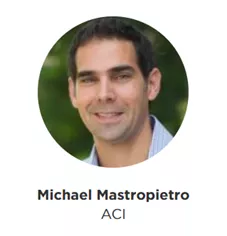
About Mike Mastropietro: Mike Mastropietro has spent his entire 20+ year career working with printable electronically functional materials and additive manufacturing methods for FHE devices including: formulation, conventional printing, direct write printing, equilibrium and non-equilibrium curing methods, and application development. Prior to joining ACI, he spent two years at NextFlex managing their printing/direct write programs, and overseeing material selection and integration into devices.
At 27, he cofounded a nanoparticle ink company, PChem Associates, whose unique low temperature sintering ink technology was acquired a decade later by NovaCentrix. He started his career at Parelec Inc., pioneers of hybrid particle-metalorganic decomposition (MOD) based inks.
FEMC009 Fabrication of FHE for Medical and Industrial Applications
This course, the 9th in the FlexTech Master Class Series, takes a deep dive into best known methods for optimizing flexible electronics into medical devices and industrial products. Our expert speaker cover the most important considerations when designing flexible and printable parts and circuits into systems or subsystems and the many approaches to consider.
This course is appropriate for those new to electronics design, as well as those familiar but looking for a refresher on the latest materials and techniques.
Course Outline
 Flexible hybrid electronics: definition, design, and fabrication
- Challenges to interface hard and soft electronic components
- Introduction to the IEEE Heterogeneous Integration Roadmap (HIR)
- Overview of inks and encapsulants
- Printing methods: dispense, inkjet, screen printing, multi-axis aerosol jet printing
- Electromechanical evaluation of printed interconnects
- Additive manufacturing of resistors and capacitors
- Highly stretchable conductors
- Interconnecting in the z direction - printed vias
- Printed RF devices and antennas
- Device and component placement and assembly
- Thinned semiconductor devices
- Approaches to bond devices and components to flexible substrates
- Concepts of operation and evaluation of performance and reliability
- Applications to medical and industrial sensors will be incorporated throughout
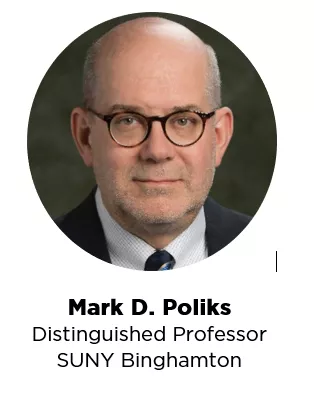
Instructor: Mark D. Poliks, Ph.D. is a SUNY Distinguished Professor of Engineering and Empire Innovation Professor in Systems Science and Industrial Engineering and Materials Science and Engineering at the State University of New York at Binghamton. He is director of the Center for Advanced Microelectronics Manufacturing (CAMM), a New York State Center of Advanced Technology and home to the New York Node of NextFlex. He serves as Chair of the Smart Energy Transdisciplinary Area of Excellence at the Binghamton campus.
His research is in the areas of industry relevant topics that include high performance electronics packaging, flexible hybrid electronics, medical and industrial sensors, printed RF components, materials, processing, aerosol jet printing, roll-to-roll manufacturing, in-line quality control and reliability of electronics. He is the recipient of the SUNY Chancellor’s Award for Excellence in Research.
#FEMC010 Environmental Sustainability and Flexible & Printed Electronics
Watch this course to develop an understanding of the essential components of industrial carbon 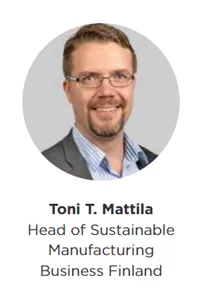 footprint and discuss actions companies and industry can take to reduce theirs. Throughout the course, we paid particular attention to the electronics industry; what the sector has already contributed and what remains to be achieved.
Sustainability is more a way of thinking than a technological solution. To achieve sustainability, a company must develop a comprehensive approach that covers multiple levels and segments of its business.
The role of new technologies – e.g. FHE - was discussed and what role they play in reducing the carbon footprint so that ‘sustainability’ can become a sustainable business.
Instructor: Dr. Toni Mattila is the Head of Sustainable Manufacturing at Business Finland, which is a governmental agency for R&D and innovation funding, business development and internationalization services. Toni leads a national business development program with the goal of transforming Finnish manufacturing industries towards sustainable development. Toni worked for fourteen years in academia as a researcher in the field of microelectronics. Toni is an active member of IEEE Electronics Packaging Society, and a frequent attendee of various electronics conferences.
Get Access to all of these courses (+ bonus classes) today!
SEMI Members: $149
SEMI Non-Members: $229
Students: Free with valid Student ID - email picture to [email protected]