downloadGroupGroupnoun_press release_995423_000000 copyGroupnoun_Feed_96767_000000Group 19noun_pictures_1817522_000000Member company iconResource item iconStore item iconGroup 19Group 19noun_Photo_2085192_000000 Copynoun_presentation_2096081_000000Group 19Group Copy 7noun_webinar_692730_000000Path
Skip to main content
Default Banner Image

Semiconductor Fabs

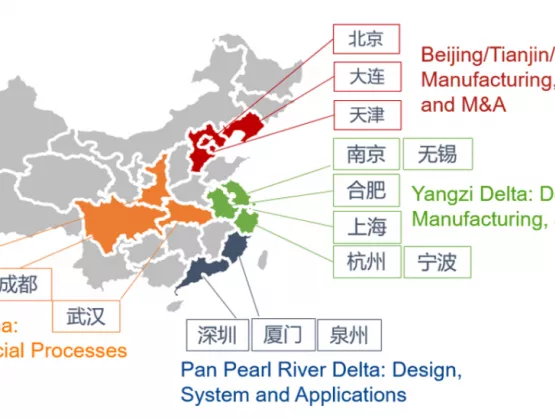
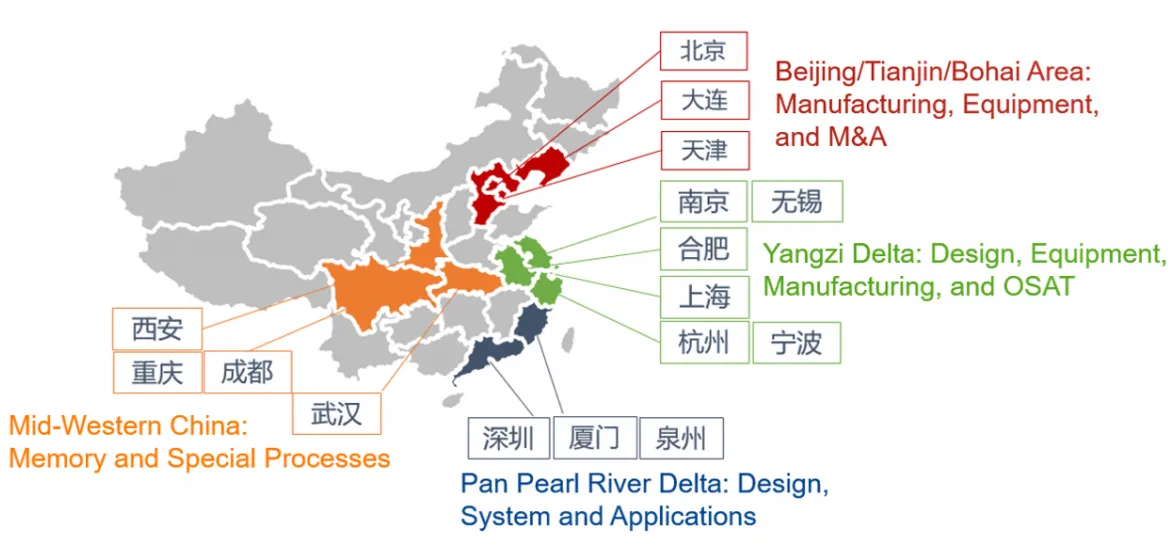
IC design has emerged as the largest semiconductor sector in China, with 2017 revenues of $31.9 billion generated by about 1,380 companies. At the same time, China’s fabless segment has risen to third in global rankings with about one-tenth of worldwide sales.Most of China’s fabless segment produces the logic chips that are key to defense, telecommunications, finance and other industries important to the region’s national security interests and its independence from U.S. and other international suppliers. Investment in fabless logic continues to be the top priority in China’s Phase 2 investment. In mobile, China made meaningful progress through HiSilicon and Spreadtrum, both fabless design houses.In 2017, HiSilicon and UNISOC (formerly Spreadtrum), China’s two largest domestic IC design companies, were ranked in the global top 10 of fabless companies, though most Chinese IC design companies are small, with revenues under $1 million. Working with domestic smartphone makers, both companies have carved out a strong presence in logic and, in particular, the communications and application processors that power data centers and Internet of Things (IoT).Despite their rapid rise, China’s AI accelerators and cryptocurrency ASIC suppliers have yet to appear in China’s top 10. However, we expect their aggressive roadmaps and early adoption of leading-edge process technologies to propel them into the top 10 in the near future. As illustrated in the figure below, an examination of the competitiveness of China’s semiconductor segments reveals that the close proximity of China’s fabless companies to the region’s electronic systems makers plays to their advantage, though access to IP and leading-edge process technologies is a barrier to their growth in the near term. A key barrier to China’s foundries is their limited ability to develop leading-edge process technologies and strategic relationships with top international fabless companies. Most leading international fabless companies rely on customer-owned tooling (COT) and design tools for design. As the approach takes time to develop, it will not support China’s aggressive goal and timeline to independently meet domestic IC demand. Instead, China has been disciplined in executing its strategy to acquire valuable IP and leading-edge technologies by aggressively partnering with international fabless design leaders and pursuing deals with market leaders and laggards. The initial entry point for Chinese fabless companies was the low-margin consumer applications dominated by Chinese suppliers, giving them considerable control over demand. In addition, Chinese companies have aggressively hired top talent from abroad and grown the skills of its engineering workforce to sustain innovation. China will likely free itself from its reliance on non-Chinese developed manufacturing process technology and EDA design tools.China’s semiconductor design growth, concentrated in the Pearl River Delta (see figure below), is fueled by national and local investment programs. SEMI August 2018 The Pearl River Delta, which includes Xiamen, Quanzhou and Shenzhen, is establishing itself as China’s IC design, system and application hub. Domestic and international companies are eligible for investment provided they are established or investing in one of the four regionshat are home to various sectors of the electronics and semiconductor supply chain. Access to large investment funds, coupled with China’s infrastructure build-out, is a strong supporting force to drive the growth of top-tier domestic fabless companies. For its part, the Phase 2 of China’s National Investment Fund targets investments of RMB 150 - 200 billion ($23 billion - $30 billion) in IC design. The growing domestic consumer base and infrastructure investment will drive opportunities for China’s fabless companies over the next decade.To learn more about the latest development on China IC Industry, and get a sample of the China IC Ecosystem Report, visit http://www.semi.org/en/china-ic-ecosystem-report.China IC Ecosystem Report covers the rise of China’s IC industry, national and local government policies, public and private funding, and their implications for China's IC supply chain. The report also compares key domestic companies and their international peers segment by segment.Eugenia Liu is a senior product marketing manager at SEMI. Shanshan Du is chief analyst and program director at SEMI China.
Read More
The China IC Ecosystem Report, a comprehensive report for the IC manufacturing supply chain, reveals that front-end fab capacity in China will grow to account for 16 percent of the world's semiconductor fab capacity this year, a share that will increase to 20 percent by the end of 2020. With the rapid growth, China will top the rest of the world in fab investment in 2020 with more than $20 billion in spending, driven by memory and foundry projects funded by both multinational and domestic companies, according to the new report released today by SEMI.The report also shows that IC Design remained the largest semiconductor sector in China for the second year in a row with $31.9 billion in revenue in 2017, widening its lead over the long-dominant IC Packaging and Test sector. The ascent of China’s IC Design sector comes as the region’s equipment market is expected to claim the top spot in 2020 for the first time on the strength of the continuing development of its domestic manufacturing capability. China’s maturing domestic fab sector is also benefiting domestic equipment and materials suppliers. Both groups continue to see gains in their product offerings and capabilities, particularly in silicon wafer production. The China IC Ecosystem Report is produced by SEMI, the global industry association and provider of independent electronics market research.The more than RMB140 billion (US$21.5 billion) accumulated by the National IC Fund, a critical component of the 2014 National Guideline to address China’s semiconductor trade deficit, has spurred rapid gains throughout the region’s IC supply chain. Semiconductors are China’s largest import by revenue. Phase 2 of funding aims to raise another RMB150-200 billion ($23.0-$30.0 billion).Encouraged by the National Guideline and favorable policies, skilled overseas talent is returning to China, triggering an explosion of domestic IC Design start-ups that are benefiting from access to investment and favorable policies, the report shows.Other highlights from The China IC Ecosystem Report include: Currently 25 new fab construction projects are underway or planned in China. 17 - 300 mm fabs are being tracked as part of this investment and expansion activity. Foundry, DRAM and 3D NAND are the leading segments for fab investment and new capacity in China. China’s IC Packaging and Test industry is also moving up the value chain by enhancing its technology offerings through mergers and acquisitions and building advanced capabilities to entice international integrated device manufacturers. China’s IC materials market, currently dominated by Packaging materials, became the second largest regional market for materials in 2016, a position it solidified in 2017. China’s materials market is expected to grow at a 10 percent CAGR from 2015 to 2019, driven primarily by the region’s new fab capacity ramp in the coming years. Fab capacity will expand at a 14 percent CAGR during that period. The China IC Ecosystem Report covers the latest semiconductor supply chain and market developments including the rise of China’s IC industry, national and local government policies, public and private funding, and their implications for China's IC supply chain. The report also compares key domestic companies and their international peers segment by segment. To learn more and get a sample of the report, visit http://www.semi.org/en/china-ic-ecosystem-report.Eugenia is a Senior Product Marketing Manager at SEMI.
Read More
Can it be that no more new semiconductor fabs are being built in the U.S.?The last new volume fab known is Micron’s Building 60 in Utah, according to the SEMI World Fab Forecast report published in February 2018. The catch is Building 60 is not a new or greenfield facility but rather an existing structure being retooled for 3D NAND. Fab equipment spending for this fab is expected to be high in 2018.Then there is Fab 42 from Intel. Construction started in 2011 before it was shelved. It is expected to begin equipping by end of this year, with equipment spending expected to be high next year.Other fabs built many years ago are still ramping such as Globalfoundries Fab 8 phase 3 (TDC) and D1X (module 1 and module 2). D1X is a research and development pilot, not a high-volume fab. And Globalfoundries’ plans for a second fab in Malta have been pushed out.Samsung in Austin has space for more modules, but there is no indication they will ever be added.The SEMI World Fab Forecast shows five smaller facilities either planned or under construction, but these have little impact in this U.S. fab construction trend.And that’s basically it! No more volume fabs!If we divide fab equipment spending into two categories – investment in new capacity versus upgrades – we see a declining trend for fabs adding capacity. See chart below. (Compare 2005-2011 with 2017-2019). If we look at 2017, 2018 and 2019, Globalfoundries, Intel, and Micron are the big investors in new capacity.This year 60 percent of all fabs are expected to invest in equipment to add capacity, but just one or two volume fabs (Micron and Globalfoundries) account for the bulk of this growth. Same story for 2019, with two volume fabs (Intel and Globalfoundries) representing the lion’s share of the growth. Strike the Intel and Globalfoundries fabs from the equation, and investments in additional capacity would fall below upgrade spending levels.Once these fabs have reached full capacity, additional equipment investments will significantly lag spending increases for upgrades, signaling the end of new fabs in the U.S.
Read More