

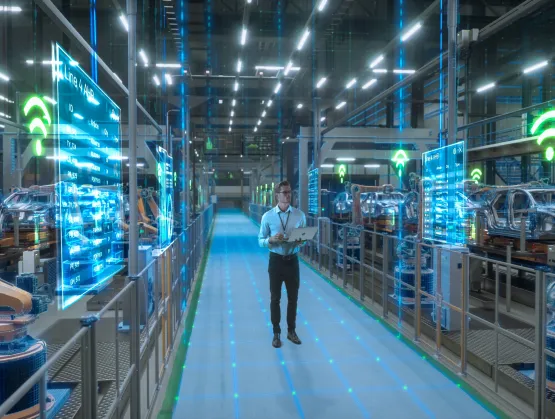
At SEMICON West, industry leaders agreed: Scalable, secure data platforms are now essential for AI-driven semiconductor manufacturing. Federated data sharing, traceability, and edge-to-cloud integration form the digital twin backbone powering intelligent fabs.
If you work anywhere near semiconductor manufacturing, you’ve heard the refrain: AI will optimize everything—yield, uptime, energy, supply chain. The catch? None of it works without a data backbone strong enough to feed, connect, and secure those models across thousands of tools and workflows.
That’s why at SEMICON, leaders from Idaho National Laboratory, Athinia, PDF Solutions, AWS, and Multiscale Technologies aligned on one message: scalable data platforms are no longer optional—they’re the digital twin backbone that turns isolated models into intelligent manufacturing systems.
From Digital Threads to a National Fabric
Ross Kunz (Idaho National Laboratory) kicked off with the SMART USA Initiative, which is building the connective tissue between digital twins across industry, academia, and government. His “digital backbone” vision centers on federated data management, standard semantics, and open APIs—so a process twin built in one fab can plug seamlessly into another.
The payoff: a shared innovation fabric where validated models, datasets, and best practices circulate as national infrastructure, not one-off experiments.
Structured Data, Trusted Collaboration
For Athinia’s Dr. Adam Schafer, the biggest barrier to scale isn’t algorithmic—it’s trust. He showed how Athinia’s multi-party SaaS platform allows device makers, material suppliers, and equipment vendors to share process data securely without exposing IP.
Its 1-2-3 framework (Ingest → Transform → Analyze) normalizes messy fab data into structured, reusable datasets that power root-cause analysis and machine-learning pipelines.
Obfuscation, version control, and collaborative workspaces make the data both governed and actionable—the foundation every digital twin depends on.
Smart Manufacturing’s Beating Heart
PDF Solutions’ Jonathan Holt described digital twins as “purpose-driven virtual representations” that enable forecasting, optimization, and control. His breakdown—component, process, and enterprise twins—anchors AI within the physical reality of manufacturing. Holt emphasized the next frontier: traceability. As fabs grow more distributed, maintaining a single, trusted record of every material and process is what will separate reactive operations from predictive ones.
Scaling from Edge to Cloud
AWS leaders Dhara Vaishnav, Gautham Unni, and Felix David framed digital twins as living systems that thrive only when data flows freely from edge to cloud. Their AWS Digital Twin Framework combines IoT TwinMaker, SageMaker, and a spatial data lake to orchestrate real-time telemetry, simulation, and AI across global fabs.
Security and scalability are baked in: multi-tenant isolation, federated governance, and GenAI-ready APIs that allow twins to learn continuously while keeping intellectual property protected.
AI as the Optimization Engine
Surya Kalidindi (Multiscale Technologies) closed with a look at AI-driven multiscale twins that merge physics-based models, silicon data, and expert knowledge.
His Bayesian frameworks cut silicon trials in half by replacing expensive wafer experiments with calibrated simulations. A semantic layer translates complex fab data into process-aware queries—so engineers can ask questions in their own language and get trustworthy, AI-assisted answers in seconds.
Why It Matters
- Federated data fabrics transform digital twins from silos into shared national assets.
- Secure, structured, and versioned data makes AI trustworthy at scale.
- Multiscale twins connect design, fab, and test for faster yield learning.
- Standards and semantics turn digital twins into the backbone of manufacturing resilience.
What to Watch
- SMART USA interoperability pilots across multi-institution fabs.
- Athinia trust-layer adoption for supplier–fab collaboration.
- AWS TwinMaker and SageMaker integrations with fab MES systems.
- AI agents and Bayesian twins accelerating node development.
Source: Building the Digital Twin Backbone: Why Scalable Data Platforms Are No Longer Optional, SEMICON West 2025. Moderator: Anshu Bahadur (SEMI). Speakers: Ross Kunz (Idaho National Laboratory); Adam Schafer, PhD (Athinia); Jonathan M. Holt (PDF Solutions); Dhara Vaishnav, Gautham Unni, and Felix David (AWS); Surya R. Kalidindi (Multiscale Technologies)


