

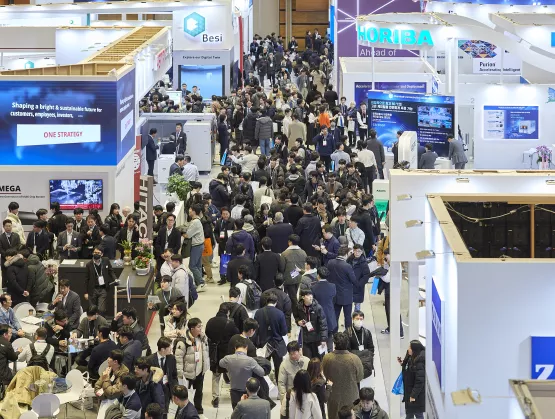
SEMICON Korea 2025 held February 19-21 at the COEX in Seoul was the largest ever, covering 41,832 sqm, with 500 companies participating. Over the course of three days, 70,000 semiconductor professionals from around the world gathered to explore new partnerships, fostering industry growth and technological innovation. Thank you to everyone who participated in SEMICON Korea and helped make the event a success!
SEMICON Korea 2025 Keynotes Call for Collaboration
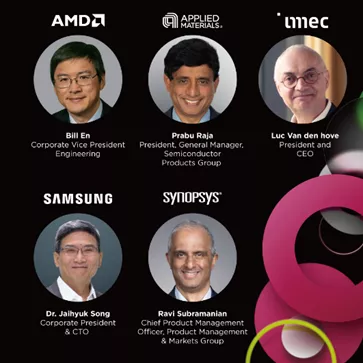
Keynote speeches featured leaders from AMD, Applied Materials, imec, Samsung Electronics and Synopsys, who shared their vision for the semiconductor industry.
The speakers emphasized the importance of technological innovation in preparing for the AI era. They highlighted "collaboration" as the most crucial factor for achieving these innovations.
"Co-Innovation Through Collaboration Across the Entire Semiconductor Supply Chain"
Jaihyuk Song, CTO of Samsung Electronics, said, "Innovation for advanced semiconductor technology is no longer an issue that a single company can resolve alone. Close collaboration with equipment and materials companies, design companies, research firms, and universities is essential." He further emphasized, "Improving AI semiconductor performance goes beyond basic customer-supplier relationships; it demands a co-development system that seamlessly integrates front-end and back-end process collaborations.”
"Independent Process Stages in Semiconductor Manufacturing Is Over"
Prabu Raja, President of Applied Materials, remarked, "In the past, transistors, interconnects, and packaging were optimized separately, but now a change at one stage affects at least 100 subsequent processes, forming a highly complex structure." He explained that the semiconductor industry now requires an integrated approach from design to production rather than mere process optimization. Speed, optimization, and new methodologies will be key to creating the next semiconductor manufacturing paradigm.”
"Independent R&D Slows Down Innovation"
Luc Van den hove, CEO of imec, pointed out, "Each major semiconductor region has its unique strengths, and attempting self-sufficiency in semiconductor manufacturing within a single region could face serious setbacks." He also shared that imec is actively collaborating with Korean semiconductor companies to develop ‘next-generation memory semiconductors.’
AI was another hot topic that took center stage during the keynote presentations.
"No AI Advancement Without Power Efficiency Innovation"
Bill En, Corporate President of AMD, explained, "In the past, computing demand doubled regularly, but the introduction of large-scale AI models like ChatGPT has increased demand 20 times. As a result, the number of data centers has grown from 8,000 in 2021 to 10,655 in 2024, leading to exponential increases in power consumption." He emphasized, "Advancing AI requires power efficiency innovation, and the industry must go beyond hybrid bonding and gate all around (GAA) technology to develop new semiconductor manufacturing techniques."
"AI Will Solve the Semiconductor Design Talent Shortage"
Ravi Subramanian, Chief Product Management Officer of Synopsys, stated, "With AI development, chip design can now be conducted using AI, offering a solution to the talent shortage in semiconductor design."
Additionally, Jaihyuk Song noted that AI is expected to evolve by mimicking the human brain, while Luc Van den hove pointed out that while GPUs are currently ideal for running large AI models, a more versatile chip architecture and technological platform are needed for future AI advancements.
Fostering Collaboration at SEMICON Korea 2025
To support the global expansion of Korean semiconductor equipment, materials and parts companies, the "Supplier Search Program" was also held during SEMICON Korea. This program invited major global players such as Applied Materials, GlobalFoundries, Kioxia, and Micron to connect and explore new business opportunities with over 100 Korean companies.
Additionally, a "Leadership Dinner" was hosted to strengthen partnerships among global leaders. During this event, the SEMI Award ceremony was held to honor companies and individuals who have significantly contributed to the semiconductor industry's development. Congratulations to all the award winners!
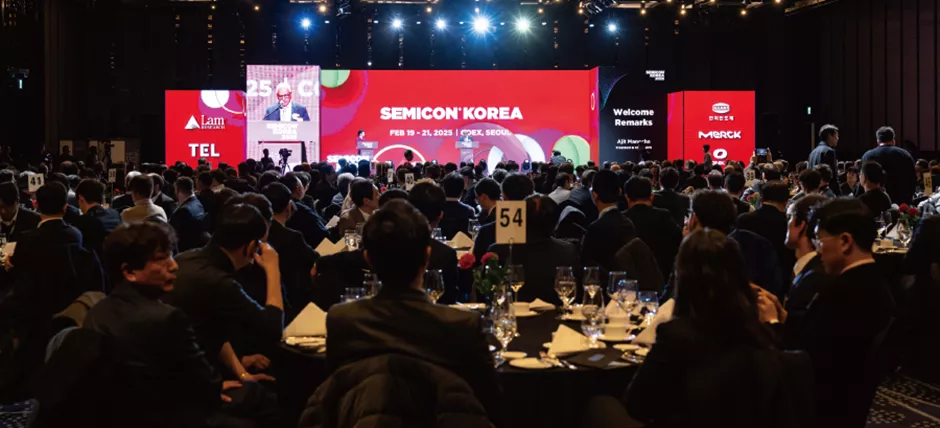
Leadership Dinner of SEMICON Korea 2025
Market Trends Observed at SEMICON Korea
According to SEMI’s Senior Director, Clark Tseng, the semiconductor industry is expected to grow at a compound annual growth rate (CAGR) of 10% from 2023 to 2030, reaching a market size of $1 trillion by 2030.
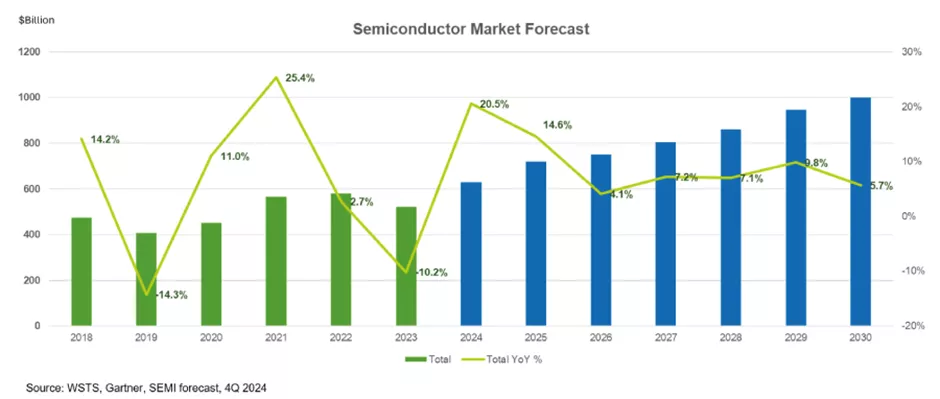
Semiconductor Market Outlook from Clark Tseng’s Presentation
Both Gartner’s VP Analyst, Gaurav Gupta and SEMI’s Clark Cheng identified AI as the key driver of this industry growth, with the automotive sector playing a crucial role in long-term expansion.
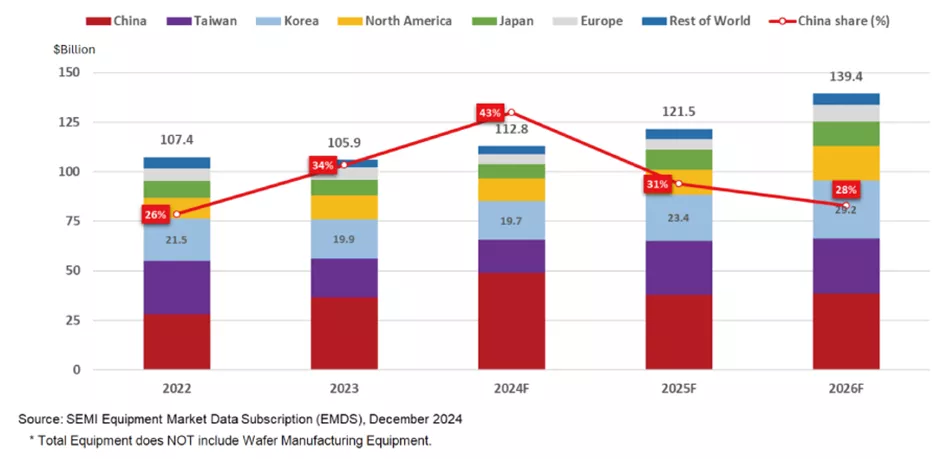
Semiconductor Equipment Market Outlook by Regions from Clark Tseng’s Presentation
The outlook for semiconductor equipment, considered a leading indicator for the industry, also remains strong. The total semiconductor equipment market revenue is expected to reach $112.8 billion in 2024, $121.5 billion in 2025, and $139.4 billion in 2026. Korea’s semiconductor equipment investment is projected to rise from $19.7 billion last year to $23.4 billion this year and $29.2 billion next year. Meanwhile, China’s share of total investment is expected to decline from 43% in 2023 to 31% in 2024 and 28% in 2025.
Special Programs at SEMICON Korea
In addition to market forecasts and advanced technology conferences, SEMICON Korea 2025 featured 30 special programs on hot industry topics. The "Investment Forum" provided in-depth investment insights into the U.S. and Vietnam, while the first-ever "Netherlands-Korea Semiconductor R&D Cooperation Seminar" was held to promote R&D collaboration between Korea and the Netherlands. Notably, the Dutch Minister of Economic Affairs participated in this event.
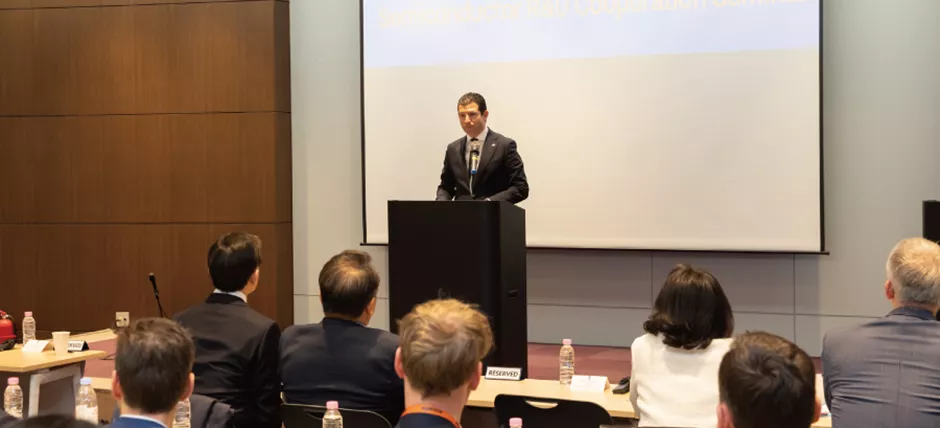
Dirk Beljaarts, The Netherlands Minister, Economic Affairs – Welcome Speech at the Netherlands-Korea Semiconductor R&D Cooperation Seminar
Other key conference topics included cybersecurity, compound power semiconductors, PFAS regulations, sustainability, and smart manufacturing.
The Race to Secure Talent Was in Full Swing!
At SEMICON Korea 2025, exhibitors actively operated recruitment sessions in their booths, with long queues of students eager to participate. Exhibitors increasingly use SEMICON Korea as a platform not only to showcase advanced semiconductor manufacturing solutions but also to attract future talent.
This year, approximately 5,000 university students participated in SEMICON Korea. While many students registered individually, several universities also organized group visits, providing students with an opportunity to gain firsthand experience of the global semiconductor ecosystem.
Special Talent Development Programs at SEMICON Korea
To address the semiconductor industry’s talent shortage, SEMICON Korea hosted various talent development programs:
- Meet the Experts!: Engineers from Applied Materials, Entegris, Hitachi High-Tech, KLA. Lam Research, SEMES, TEL, Wonik IPS and YC mentored university students on career development.
- Women-in-Technology: Female leaders in advanced industries shared insights on promoting diversity in the semiconductor sector.
- Tutorials: Six basic level programs for semiconductor manufacturing technology were provided to strengthen the competitiveness of university students and junior engineers.
- The Path to Becoming a Semiconductor Equipment Specialist: Undergraduate students aspiring to become semiconductor equipment experts explored career paths alongside global professionals.
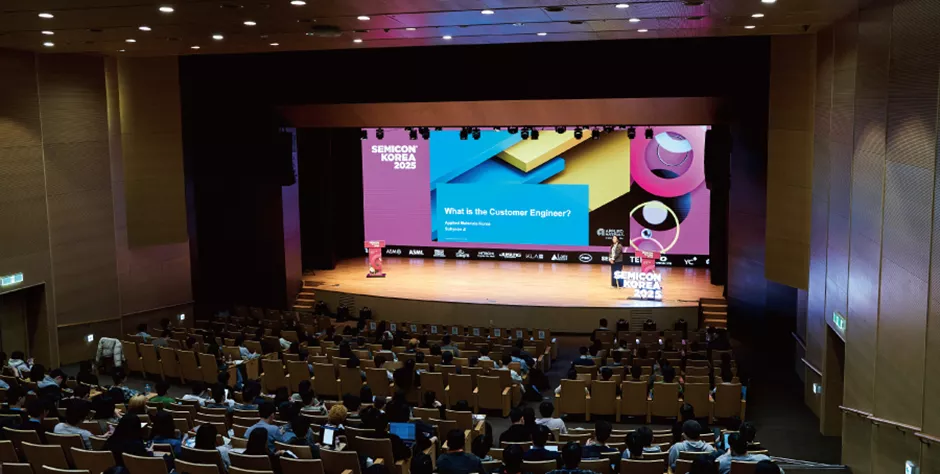
Meet the Experts!
Mark Your Calendar for SEMICON Korea 2026!
SEMICON Korea 2026 will be held from Wednesday, February 11 to Friday, February 13, at COEX in Seoul. Don’t miss this opportunity to explore the cutting-edge technologies shaping the future of the semiconductor ecosystem!


