


As Taiwan’s semiconductor, high-tech, artificial intelligence, and export-oriented sectors continue to grow, renewable energy has evolved from an ESG option into an increasingly important consideration for supply-chain competitiveness, decarbonization commitments, and long-term business planning.
Surplus Renewable Energy Does Not Mean “Too Much Renewable Energy”
One distinction is essential when discussing Surplus Renewable Energy (Surplus RE): its existence does not mean that Taiwan has too much renewable energy, nor does it indicate system-wide market oversupply.
Recent RE100 observations continue to identify high costs and limited supply as key barriers to corporate renewable energy procurement, indicating that corporate demand remains clear while both supply and procurement pathways still have room to expand. Data presented by Taiwan’s Executive Yuan Office of Energy and Carbon Reduction at the September 4 Energy Collaborative Forum likewise showed that renewable electricity generation increased from 4.8% of Taiwan’s power mix in 2016 to approximately 13.1% in 2025, underscoring the growing role of renewables in the electricity system.
Two distinct phenomena are at work: Taiwan’s overall market still needs more renewable energy, while individual companies may experience unmatched electricity as long-term procurement expands. The first concerns whether Taiwan’s renewable energy supply is sufficient to meet corporate demand. The second arises when contracted generation profiles and procurement volumes do not align with a company’s electricity load within the applicable time periods.
In this article, Surplus RE refers to renewable electricity that has already been procured but cannot be wheeled as originally intended because generation and consumption do not align within the applicable time parameters. Its occurrence and scale vary according to corporate load profiles, procurement volumes, energy mix, and project commercial-operation schedules. It does not mean that all companies currently face a Surplus RE issue. Rather, it reflects a market-matching and institutional-design challenge that becomes increasingly relevant as corporate renewable energy procurement expands—not an oversupply of renewable energy across Taiwan.
Taiwan has also recently made concrete institutional progress in corporate renewable energy matching and Surplus RE treatment, including greater flexibility in wheeling allocation and continued policy work on the treatment of unmatched electricity and its associated environmental attributes. These developments are more than technical refinements: they increasingly respond to practical considerations in long-term corporate procurement, project investment and financing, and the continued development of Taiwan’s renewable energy market.
Rigorous Matching and Certificate Rules Are an Important Foundation of Taiwan’s Renewable Energy Market
Taiwan applies a relatively rigorous framework to corporate renewable energy wheeling and recognition. Under the current arrangement, generation and consumption are matched primarily using 15-minute metering data. Once renewable electricity is successfully wheeled, Taiwan Renewable Energy Certificates (T-RECs) are issued based on the actual wheeled volume. This closely links certificate issuance to electricity delivery, strengthening the traceability of environmental attributes, the connection between generation and consumption, and the credibility of corporate renewable energy claims.
This differs from some international markets, where certificates are generally issued against eligible renewable electricity generation and may subsequently be traded separately from the physical electricity. In the U.S., Renewable Energy Certificates (RECs) are created when renewable electricity is generated and delivered to the grid, while in the U.K., one Renewable Energy Guarantee of Origin (REGO) is issued for each 1 MWh of eligible generation. Taiwan, by comparison, more directly links certificate eligibility to actual wheeling outcomes. Time matching therefore affects both whether electricity can be wheeled as intended and whether the corresponding environmental attributes can be obtained and recognized.
Where contracted renewable electricity cannot be matched as intended because of differences between generation and load, the unmatched volume does not, under the existing treatment, receive the corresponding certificates in the same manner as successfully wheeled electricity. The matching and certificate framework itself does not cause Surplus RE; rather, it turns underlying timing differences between generation and consumption into practical market issues involving certificate access, cost allocation, and commercial arrangements.
Recent RE100 data provide another useful perspective. While the share of recognized renewable electricity among RE100 members in Taiwan still has room to grow, the gap between reported and ultimately recognized renewable electricity remains relatively limited. This suggests that a substantial share of reported corporate renewable energy procurement meets the applicable recognition requirements.
The next stage for Taiwan is therefore not to lower existing standards for recognition or environmental integrity, but to increase flexibility in how companies allocate and use renewable energy while preserving credibility and traceability — allowing market efficiency and environmental integrity to advance together.
The Nature of Renewable Electricity Makes Perfect Matching Difficult
Surplus RE is closely related to both renewable electricity generation characteristics and corporate consumption patterns. Solar has a distinct daytime generation profile, wind output varies with wind conditions, and hydropower has its own supply characteristics. At the same time, different companies, facilities, and manufacturing processes have different electricity-load profiles.
Companies can combine wind, solar, hydropower, and projects across different locations to improve the match between renewable electricity supply and their own load. Even so, generation and consumption profiles are unlikely to align perfectly at all times. Where contracted renewable electricity exceeds the company’s matchable load during a particular period, part of that electricity may be unable to complete the originally intended wheeling arrangement and become Surplus RE.
The actual scale of Surplus RE depends on the volume of renewable energy procurement relative to the company’s load, its energy mix, project generation profiles, and project commercial-operation schedules. Where current procurement volumes can still be fully absorbed by the company’s own load, Surplus RE may remain limited. As long-term procurement volumes increase or medium- and large-scale renewable energy projects progressively reach commercial operation, time-matching issues may become more material.
Surplus RE is therefore not a fixed percentage faced by all companies at the same time. It is a market-design issue that becomes increasingly relevant as corporate procurement and new renewable energy supply expand.
When Take-or-Pay Meets Time Matching
For corporate buyers, Surplus RE is more than a technical settlement issue. It is closely tied to the commercial structure of corporate power purchase agreements and the financing of renewable energy projects. Medium- and large-scale CPPAs are typically long-term contracts and may include take-or-pay provisions. These commitments improve revenue predictability for developers and are an important factor in financial institutions’ assessment of project cash flows and bankability.
Under a take-or-pay structure, however, a company may still be contractually required to pay even if part of the renewable electricity cannot be wheeled as intended because of time-matching constraints. Under the original framework, the unmatched portion was also unable to receive the same certificate and environmental-attribute recognition as successfully wheeled electricity. As procurement volumes increase, corporate buyers therefore need to consider not only how much renewable energy they contract, but also how much electricity can actually be wheeled and utilized, and how any unmatched portion will be treated.
To avoid conflating statutory renewable energy obligations with voluntary corporate procurement, the following simplified scenario illustrates the potential commercial scale of unmatched electricity under a long-term CPPA. The assumptions are illustrative only and do not represent average procurement volumes, an average Surplus RE ratio, or a forecast for the Taiwan market.
Assume that a company enters into a CPPA for 50 GWh per year to support its renewable energy and supply-chain objectives. At an illustrative energy price of NT$6 per kWh, the annual notional purchase value would be approximately NT$300 million. If, after load management, portfolio diversification, and cross-facility allocation, 20% remains unmatched, approximately 10 GWh per year would fail to complete the intended wheeling arrangement, corresponding to a notional purchase value of approximately NT$60 million per year.
This article uses 25 years as an illustrative contract term, reflecting the midpoint of approximately 20- to 30-year CPPA terms already seen in Taiwan’s large-scale offshore wind market. This does not imply that all CPPAs use the same tenor. Assuming price, generation volume, and the unmatched share remain constant, and excluding discounting, price adjustments, and other contractual terms, the cumulative notional value associated with the unmatched portion would be approximately NT$1.5 billion over 25 years.
Table: Illustrative Long-Term Corporate CPPA Scenario:
| Item | Assumption / Formula | Result |
|---|---|---|
| Annual CPPA procurement volume | Illustrative assumption | 50 GWh/year |
| CPPA energy purchase price | Illustrative assumption | NT$6/kWh |
| Annual notional contracted purchase value | 50,000,000 kWh × NT$6/kWh | Approx. NT$300 million/year |
| Illustrative unmatched share | Illustrative assumption | 20% |
| Annual unmatched electricity volume | 50 GWh × 20% | 10 GWh/year |
| Notional value associated with unmatched volume | 10,000,000 kWh × NT$6/kWh | Approx. NT$60 million/year |
| Illustrative CPPA term | Midpoint of 20–30 year long-term offtake arrangements | 25 years |
| Cumulative notional value of unmatched portion | NT$60 million × 25 years | Approx. NT$1.5 billion |
Note: The 20% unmatched share is an illustrative assumption informed by scenarios reflected in industry discussions. It does not represent the average Surplus RE ratio among Taiwan companies or a future market forecast. The 25-year term is based on the midpoint of approximately 20- to 30-year long-term CPPAs already seen in Taiwan’s large-scale offshore wind market and does not represent a standard market tenor. Actual outcomes will vary according to corporate load profiles, procurement volumes, energy mix, project generation characteristics, contractual terms, and commercial-operation timing. NT$6 per kWh is likewise an illustrative energy purchase price and does not represent the full cost of corporate renewable energy procurement.
This calculation should not be read as treating unmatched electricity as a direct “market loss.” Its purpose is to show how Surplus RE treatment can affect long-term procurement decisions. Where treatment mechanisms, environmental attributes, and related costs lack sufficient predictability, companies may reflect those risks in procurement volumes, pricing, or contractual terms.
These decisions can in turn affect developers’ offtake arrangements and revenue predictability, with implications for project investment and financing. The significance of Surplus RE therefore lies not only in reducing unmatched volumes, but also in improving predictability for long-term procurement and financing, supporting continued growth in corporate renewable energy procurement and new supply.
Public-Private Collaboration Is Gradually Improving Market Design
Surplus RE intersects with corporate procurement contracts, renewable energy certificates, project finance, transmission and distribution costs, and power-system operations. It is therefore a cross-institutional, multi-stakeholder market-design issue that cannot be addressed by any single mechanism or participant.
The public-private collaboration approach recently articulated by Taiwan’s Executive Yuan Office of Energy and Carbon Reduction is consistent with this need. Relevant government agencies, Taiwan Power Company, and industry participants have held multiple rounds of discussion on flexible allocation, Surplus RE certificates, cross-time treatment of unmatched electricity, and tariffs, bringing policy objectives, corporate needs, commercial conditions, and power-system constraints into a common framework.
The SEMI Energy Collaborative has also contributed through member input and policy dialogue, bringing corporate procurement practices, project commercial conditions, and market experience into policy discussions. This helps stakeholders examine practical issues together and identify arrangements that balance market efficiency, investment viability, environmental integrity, and system stability.
Monthly Matching Within the Same Time-of-Use Period Is an Important Step
On September 3, 2026, Taiwan Power Company revised the Flexible Allocation Pilot Program for the Renewable Energy Market and its related operating rules. Under the existing pilot framework, the revision introduced monthly matching by time-of-use period and extended the pilot through September 30, 2028. This represents a further step in improving matching and allocation flexibility in Taiwan’s corporate renewable energy market. The revised mechanism continues to use the original 15-minute metering data as its underlying basis, aggregating generation and consumption into four time-of-use periods—peak, semi-peak, off-peak, and Saturday semi-peak—before conducting wheeling-volume matching and flexible allocation within the same month and the same time-of-use period.
Table: Key Adjustments to the Flexible Allocation Mechanism for Renewable Energy
| Aspect | Previous Framework | Direction After the Adjustment |
|---|---|---|
| Underlying metering data | 15-minute generation and consumption data | Still based on 15-minute data |
| Matching approach | Matching based on the existing time-based rules | Monthly matching within the same month and the same time-of-use period |
| Time-of-use periods | — | Peak, semi-peak, off-peak, and Saturday semi-peak |
| Allocation models | Existing wheeling arrangement | Single legal-entity allocation; electricity retailer allocation |
| Main objective | Maintain traceability and recognition quality | Improve matching and allocation flexibility while preserving traceability |
| Pilot period | Existing pilot framework | Extended through September 30, 2028 |
Note: The adjustment does not eliminate 15-minute metering. Rather, it builds on the existing metering basis by introducing monthly matching and flexible allocation within the same time-of-use period.
The program retains two allocation models: “single legal-entity allocation” and “electricity retailer allocation.” This gives companies greater flexibility to allocate renewable electricity across different facilities, electricity account numbers, and load profiles, while allowing electricity retailers to play a role in electricity-volume aggregation and allocation.
The core value of the mechanism lies in improving the matching and use of existing renewable electricity while preserving traceability. The longer pilot period also gives the market more time to build operating experience, validate practical needs, and inform further refinement.
The Next Step for Surplus RE Goes Beyond “Eliminating Surplus”
Monthly matching within the same time-of-use period can improve flexibility in matching generation and consumption. Even after flexible allocation, however, differences between generation and consumption profiles may remain across time periods. The next question therefore becomes how unmatched electricity should be treated and how its associated environmental attributes can be preserved, valued, and effectively used.
There has also been concrete progress on the certificate framework. In April 2026, Taiwan’s Bureau of Standards, Metrology and Inspection (BSMI) proposed draft amendments to the Regulations Governing the Implementation of Renewable Energy Certificates. Under the proposal, renewable energy generators that have not entered into a surplus-electricity purchase and sale agreement with Taiwan Power Company could still obtain renewable energy certificates for Surplus RE, while certificates that have not been used or claimed could be transferred to other recipients.
Subsequent policy discussions have also moved toward treating physical electricity and environmental attributes separately. Under the approach being examined, physical electricity that does not complete its intended wheeling arrangement would be handled through the power system, while corresponding certificate issuance based on actual unmatched volumes remains under consideration, with certificate ownership determined by contractual arrangements. The core concept is to separate the treatment of physical electricity from the preservation of environmental attributes, so that failure to complete time matching does not necessarily mean losing the associated environmental value.
This does not weaken the traceability established under the existing wheeling and certificate framework. Rather, policy discussions are examining how environmental attributes associated with unmatched electricity can be treated appropriately while keeping the status of different electricity volumes clearly distinguishable.
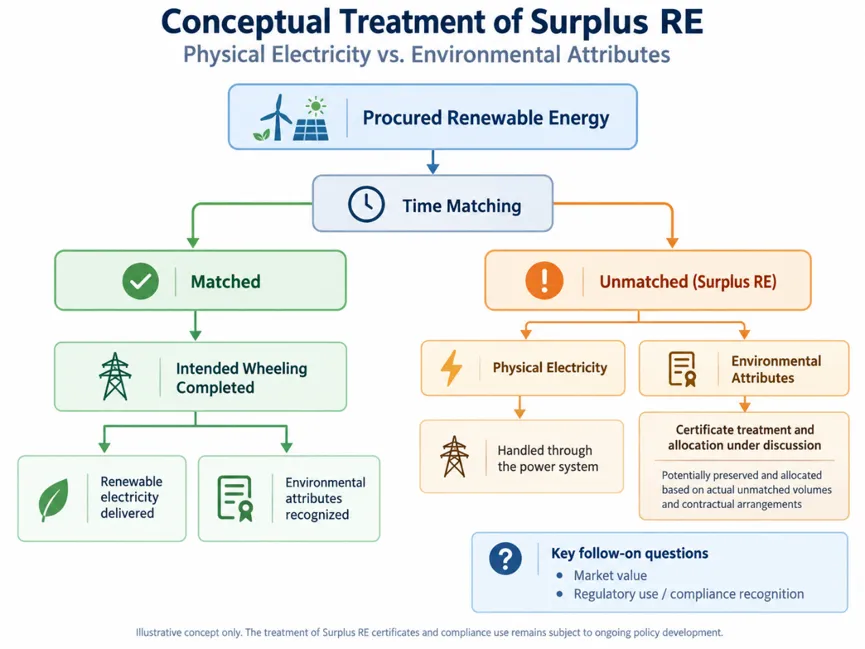
Note: The accompanying illustration reflects the current direction of policy discussion. It does not indicate that all rules governing the issuance, transfer, or compliance use of Surplus RE certificates have been finalized.
Even if a future framework allows corresponding certificates to be issued for Surplus RE, two issues will still require clarification. The first is market value. Under take-or-pay contracts, corporate payment obligations generally do not change with the final matching outcome. If the unmatched portion primarily retains its environmental attributes, its cost and value structure may differ from that of a conventional certificate transaction, while the time value of electricity and the value of environmental attributes will still need to be clarified through market practice.
The second is regulatory use. How such certificates should be identified, and whether they may be used for domestic greenhouse-gas inventories, carbon-fee offsets, or other environmental-management purposes, will require further coordination among the relevant energy, certificate, and environmental authorities.
Cross-time unmatched electricity may require additional market tools. Energy storage is one possible pathway, but its economics, transaction structure, and practical operation still require market validation. It is therefore better considered as one of several possible solutions rather than the single answer.
Beyond Market Efficiency, Cost Predictability Also Matters
Surplus RE treatment also involves costs associated with power-system balancing, dispatch, transmission, and distribution. For industry, the issue is not to challenge reasonable user-pays principles, but to clearly define the costs reflected in different tariff components and the logic used to calculate them, while improving the transparency and predictability of tariff adjustments. Recent policy and industry discussions have also begun reviewing these system costs alongside the existing wheeling-tariff framework, with the aim of developing clearer and more predictable charging arrangements.
This is particularly important for long-term CPPAs. Corporate renewable energy procurement is typically built on multi-year cost assumptions, headquarters approvals, and financial planning. Reasonable recovery of system costs and greater cost predictability are not conflicting objectives. A transparent, phased, and predictable tariff framework can support longer-term procurement, investment, and financing decisions by companies, developers, and financial institutions.
From Market Matching to System Readiness
Any discussion of the next step for Surplus RE also needs to distinguish between today’s market-matching issue and the power-system challenges that may emerge at higher levels of renewable energy penetration. The Surplus RE discussed in this article is fundamentally a matter of matching, allocation, and environmental-attribute recognition under existing renewable energy procurement and wheeling arrangements. It should not be equated with physical electricity oversupply at the system level.
As renewable energy supply and new electricity demand grow in parallel, however, differences in when and where electricity is generated and consumed will place increasing demands on power-system capacity and flexibility. The current market-matching issue and future system-level challenges should therefore remain conceptually distinct, while still being connected within long-term energy-transition planning.
Table: From Current Market Matching to Future System Readiness
| Aspect | Current Surplus RE Issue | System Issue at Higher Renewable Energy Penetration |
|---|---|---|
| Core issue | Gaps in corporate wheeling, matching, and recognition | System-level differences in when and where electricity is generated and consumed |
| Nature of the issue | Market and institutional matching issue | Physical power-system issue |
| Main tools | Matching mechanisms, flexible allocation, certificate treatment, and contractual arrangements | Grid capacity, substations, storage, and other system-flexibility resources |
| Main focus | Improve the use and allocation efficiency of existing renewable electricity | Support higher levels of renewable energy penetration |
| Should not be interpreted as | Taiwan already having too much renewable energy | — |
Note: The current Surplus RE issue primarily concerns market matching and recognition under existing procurement and wheeling arrangements. It should not be confused with physical electricity oversupply at the power-system level.
Recent BNEF analysis identifies data centers as a major driver of global electricity-demand growth, while stable and sufficient grid access has become an important consideration in large-scale data-center siting. As facilities grow in scale, requirements for power supply, connection capacity, substations, and overall system resilience also increase.
Taiwan’s energy transition presents similar system-planning needs. Solar and wind are variable, and new generation may not always be located where new electricity demand emerges. At the same time, growth in AI, semiconductor manufacturing, and other high-tech industries is reshaping existing demand patterns. Future policy discussions therefore need to address grid capacity, substations, energy storage, and other system-flexibility resources alongside continued improvements in renewable energy supply and market design.
These infrastructure requirements are better understood as a necessary evolution in response to changing generation and consumption patterns, rather than as evidence that the existing grid itself is somehow “the problem.” Just as the digital economy’s transition from traditional networks to cloud computing, streaming, and artificial intelligence has required continued upgrades to fiber networks, data centers, and network capacity, the energy transition likewise requires market mechanisms and physical power infrastructure to evolve with new generation and consumption patterns.
Improving Surplus RE treatment therefore addresses today’s market-efficiency challenge, while strengthening the grid, energy storage, and system flexibility prepares Taiwan for the next stage of higher renewable energy penetration.
An Important Milestone, Not the Endpoint
Recent institutional progress builds on years of policy dialogue and practical experience among government, renewable energy developers, corporate users, utilities, and other market participants. More than a year of engagement on Surplus RE has also reinforced an important lesson for the SEMI Energy Collaborative: the maturation of the corporate renewable energy market requires integrated consideration of corporate procurement, electricity matching, certificate recognition, cost structures, power-system operations, and project investment and financing.
Improving Surplus RE treatment is not simply about reducing unmatched electricity in particular time periods. It is about establishing clearer and more predictable treatment mechanisms so that companies, developers, and financial institutions can more effectively assess long-term procurement, project revenues, and investment and financing conditions. Continued discussions among government, Taiwan Power Company, and industry on flexible allocation, Surplus RE certificates, cross-time treatment, and related tariffs are also building practical market experience and providing a foundation for further institutional refinement.
This remains an interim milestone. Questions surrounding the value of physical electricity and environmental attributes associated with Surplus RE, certificate recognition for compliance purposes, cross-time treatment, and system readiness at higher levels of renewable energy penetration will continue to require validation through practical implementation and cross-agency coordination.
For the SEMI Energy Collaborative, the next step is to continue bringing industry needs, international market developments, and Taiwan’s energy-transition conditions into the same dialogue, helping stakeholders identify workable shared pathways. This milestone is not the endpoint, but the starting point for the next stage of market development. Ultimately, the objective is not simply to ensure that companies can procure renewable energy, but to build a market in which renewable electricity can be used effectively, costs are predictable, and corporate investment and renewable energy supply can continue to scale.
Acknowledgements
The Surplus RE issues and related institutional developments discussed in this article build on long-term dialogue and practical experience accumulated across government, industry, research institutions, and other market participants.
The SEMI Energy Collaborative sincerely thanks the Executive Yuan, the Executive Yuan Office of Energy and Carbon Reduction, the Ministry of Economic Affairs, the Energy Administration, the Bureau of Standards, Metrology and Inspection, Taiwan Power Company, the SEMI Green Energy and Sustainability Alliance (GESA), the Taiwan Green Energy Public Welfare Development Association, and Energy Collaborative member companies for their valuable input and support through policy exchanges, technical discussions, sharing of market experience, and institutional deliberations.
Special thanks are extended to Dr. Jing-Ming Wang and Dr. Chung-Shun Chen of the Green Economy Research Center, Chung-Hua Institution for Economic Research (CIER), for their professional insights and discussion on relevant research, policy context, and market developments during the preparation of this article.
These long-term, cross-sector exchanges have deepened shared understanding of corporate needs, policy objectives, and power-system operations, while supporting the continued improvement and maturation of Taiwan’s corporate renewable energy market.
Key References
- Presentations by the Executive Yuan Office of Energy and Carbon Reduction, RE100, and BloombergNEF at the Energy Collaborative Forum on September 4, 2026. The 2016–2025 renewable electricity generation-share figures cited in this article are drawn from the presentation by the Executive Yuan Office of Energy and Carbon Reduction.
- Bureau of Standards, Metrology and Inspection, proposed amendments to the Regulations Governing the Implementation of Renewable Energy Certificates, announced on April 10, 2026.
- Policy exchanges among the SEMI Energy Collaborative, relevant industry representatives, government agencies, and Taiwan Power Company, together with the author’s synthesis.
- Taiwan Power Company, Flexible Allocation Pilot Program for the Renewable Energy Market and related operating rules, latest revised version.
- Ørsted, 2025, official project information for the Greater Changhua 2b & 4 Offshore Wind Farms; the project is supported by a 20-year fixed-price corporate PPA arrangement.
- Northland Power, 2026, official announcement regarding the Hai Long Offshore Wind Project; the project includes a 30-year corporate PPA arrangement.
- U.S. Environmental Protection Agency, Renewable Energy Certificates (RECs); one REC is created for each MWh of renewable electricity generated and delivered to the grid, and the certificate may be traded separately from the underlying physical electricity.
- Ofgem, Renewable Energy Guarantees of Origin (REGO) – Guidance for Generators, Agents and Suppliers; one REGO is issued for each MWh of eligible renewable electricity generated, and the certificate may be transferred with or separately from the underlying electricity.
David (Ta-Wei) Chiang is SEMI Energy Collaborative Lead at SEMI Taiwan.


