

Background
SEMI’s Device Working Group, part of its MEMS & Sensors Industry Group (MSIG), actively works to lower barriers for MEMS-based gas sensor market adoption. In 2022, the group published SEMI MS14 – Guide for Critical Parameters of Gas Sensors [1, 2], which recommends guidelines for gas sensor product datasheets to improve standardization and adoption.
 This article explores what gas sensors are, how they are calibrated, what their limitations are, and how the next generation of MEMS-based gas sensors is driving innovation. Here, we utilize terminology that the most common, accepted, and recognizable across different sensing communities.
From Gas Sensing Elements to Gas Detector Systems
Figure 1 highlights the primary components related to gas sensing. The most fundamental component, the gas sensing element, responds to changes in gas concentration. It is an analog circuit without additional electronics, and it often has only one output like resistance, current, light intensity, or voltage. It is sometimes called a gas sensor, but the recommended terminology is gas sensing element. Such terminology is the most popular, accepted, and recognizable across different communities.
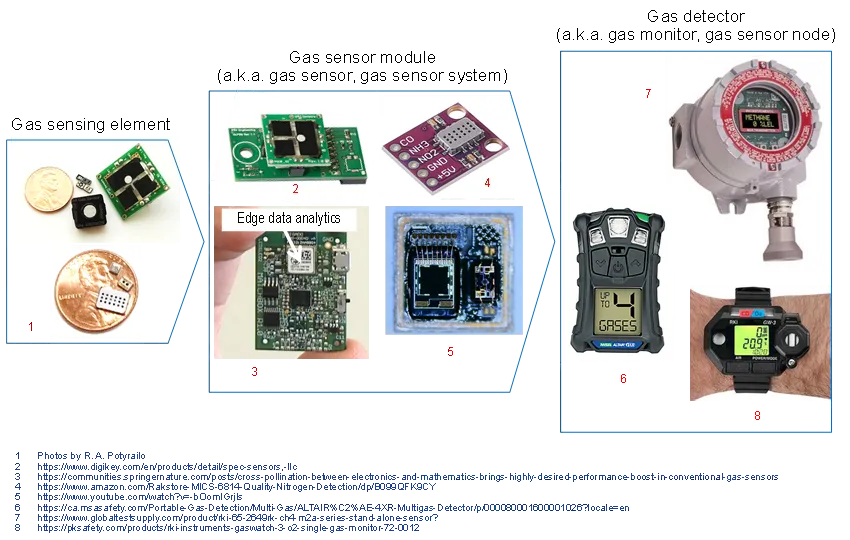
Figure 1: Components related to a gas sensor
The gas sensing element can connect to an additional electronic circuit that includes a signal conditioning module, an analog-to-digital converter, and as of recently, an onboard edge data processor. MEMS microfabrication technology allows multiple gas sensing elements and electronic circuit components to be fabricated as an integrated circuit module. These elements can be as small as a grain of rice.
This combination of elements is often called a gas sensor, gas sensor system, or gas sensor module. However, the recommended terminology is gas sensing module.
The gas sensing module can connect to additional electronic components such as power management, communication, human-machine interfaces, and others. It can also be supplemented with software or firmware and packaged in a mechanical enclosure to create a complete gas sensing instrument. Such gas monitors can be designed as stand-alone, stationary, handheld, or wearable systems, or embedded into bigger systems. The gas sensing instrument is commonly referred to as a gas detector, gas monitor, or gas sensor node, but the recommended terminology is gas detector.
Gas Sensor Calibration
Gas sensor calibration involves exposing a gas sensing element, module, or detector to various gas concentration standards under application-specific conditions. The output is then adjusted to match these standards, and the sensor is calibrated when the output aligns with the tested gas concentrations.
Calibration provides information on uncertainty, non-linearity, and other parameters such as tested gases and their concentrations, and interferents such as ambient humidity and temperature and other gases. CoGDEM Guide to Gas Detection [3] describes common calibration routines and the factors affecting calibration. Companies that serve industrial safety markets also describe the necessary equipment and calibration technologies and offer guidelines and tutorials [4-6].
A gas detector should operate under the expected application conditions to ensure it reports gas concentrations accurately. Examples of such conditions may be indoors, urban outdoors, industrial outdoors, exhaled breath analysis, and others. Accuracy refers to how closely the sensor readings match the actual gas concentrations. A calibration plan should account for all quantitative effects of these conditions. Figure 2 illustrates various gas detector accuracy levels and presents both complete coverage (full factorial) and partial coverage (fractional factorial) calibration plans [7]. These plans help manage calibration costs and complexity.
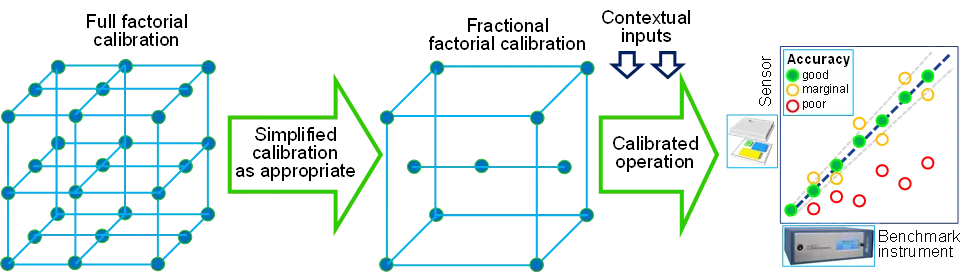
Figure 2: Examples of full factorial and fractional factorial calibrations and correlation plot of benchmark versus sensor responses
The calibration parameters are saved on the gas detector to convert measured responses into gas concentrations. In addition to traditional algorithms for industrial safety gas sensors, multivariate machine learning algorithms are also emerging. These algorithms can incorporate responses from the gas sensing element, along with contextual inputs from auxiliary sensors for interfering gases, temperature, humidity, and pressure. This data can be available on-board of the gas sensing module, on-board of the gas detector, or through the cloud. The calibration cost significantly increases the total production cost of mass-produced gas detectors because it adds additional steps and is time- and cost-intensive, but new approaches based by advanced algorithms have emerged that reduce calibration time and lower calibration costs [8, 9].
Not all gas detectors report individual gas concentrations. Some gas sensing applications only detect when a gas level reaches a specific threshold, for example a residential carbon monoxide alarm. Other gas detectors provide multiple air quality index values by accurately measuring concentrations of five pollutants: ozone, carbon monoxide, nitrogen dioxide, sulfur dioxide, and particulate matter of 2.5 mm and 10 mm [10]. These detectors are typically used for urban outdoor applications.
Limitations of Single Output Gas Sensing Elements Prevent Their Acceptance in Many New Areas
Available amperometric electrochemical sensors, semiconducting metal-oxide chemical resistors, pellistors, thermal conductivity sensors, and many others utilize gas sensing principles that were developed between the 1930s and 1970s. These innovations marked a significant advancement over using canary birds to detect carbon monoxide or miner’s lamps to identify methane in coal mines and other harsh environments. Early sensors relied on strong signals from a sensing element that measured high concentrations of a gas. Over time, engineers miniaturized these sensing elements without changing their underlying design principles, and today, the same sensing methods are still widely used to detect relatively high concentrations of specific gases for safety applications.
However, single output gas sensing elements cannot mathematically differentiate various gases that produce similar sensor signals. They also cannot identify different sources affecting the sensor signal. Further, as the measured gas concentrations are getting smaller, the response drift of the sensing element and effects from other gases in air become more pronounced, reducing detector accuracy.
For this reason, the United States Environmental Protection Agency recently highlighted that existing gas detectors have inherent limitations crucial to understand before collecting and interpreting data [11]. A Nature Perspective also noted that ambient interferences could make the data from single-output gas sensors “essentially meaningless” [12].
Next Generation MEMS Gas Sensors: Solutions for Accurate and Stable Calibrated Gas Sensing
Gas sensor developers and manufacturers are creating solutions that maintain accurate gas sensor performance at lower target gas concentrations over extended periods of time for chemically complex environments without increasing the hardware size or the amount of power consumption [13-15].
These solutions, inspired by traditional gas chromatography, mass spectrometry, and laser spectroscopy detectors that have exceptional gas-recognition abilities that are enabled by one or several independent response variables, which are factors that are varied in the detector in a controlled fashion. Examples of independent response variables are retention time in gas chromatography, mass-to-charge ratio in mass spectrometry, and wavelengths in laser spectroscopy. Although these traditional detectors are relatively large and expensive, they deliver significant societal benefits in exquisite multi-gas detection in chemically complex environments that have earned three Nobel Prizes [16].
SEMI’s MSIG Device Working Group is exploring the tremendous opportunity to emulate the mathematical principles of these large and expensive traditional gas detectors for miniature gas sensors [17, 18]. Our approach is to move beyond the limitations of single-output gas sensing elements and to preserve accurate gas detection in diverse operational scenarios.
Right now, scientists and engineers are designing the next generation of miniature gas detectors to operate one or more gas sensing elements under measurement conditions that suppress or eliminate ambient interferences, boost stability, and reduce power consumption.
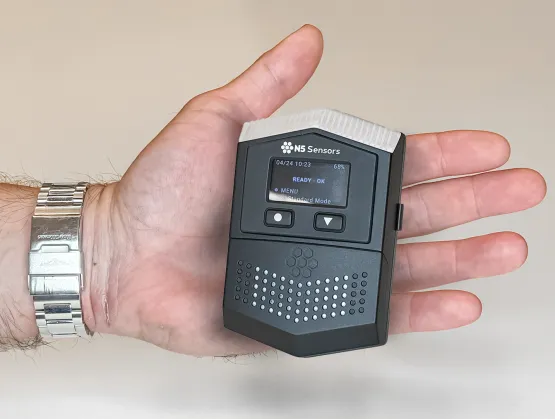
To enhance gas sensing accuracy and stability, metal oxide gas sensing elements are modulated by gas sensing modules using temperature modulation [19] (e.g., Bosch, Renesas, 3S Technologies), dielectric excitation [20] (e.g. GE Vernova) or photoactivation [21] (e.g. N5 Sensors).
Miniature electrochemical sensors use bias modulation and incorporate multi-frequency impedance enhanced readouts [15], whereas acoustic resonant sensing elements are modulated by temperature and multi-frequency impedance enhanced readouts of multiple harmonics [22]. Additionally, stable multi-element, multi-pixel, and multi-modal gas sensing elements are combining different sensing principles to gather more information from the same event, delivering more accurate responses.
Figure 3 conceptually shows how these next-generation gas sensors should be able to compete with the traditional large and expensive analytical instruments on performance without the burden of high SWaP-C (size, weight, power, and cost) [23].
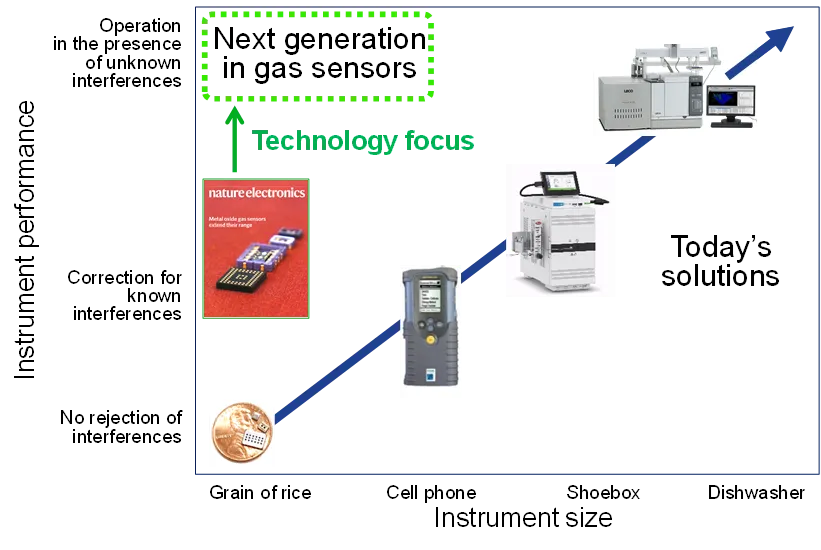
Figure 3: Next generation gas sensors competing with exquisite performance of traditional analytical instruments, but without their high SWAP-C burden. SWaP-C stands for size, weight, power, and cost.
Conclusion
The next generation of gas detectors promises to deliver high performance in diverse and complex environments by overcoming the limitations of single-output gas sensing elements and integrating advanced algorithms and multi-modal sensing techniques. These innovations will not only enhance safety and quality of environmental monitoring, but they will also open new applications for various industries. As the gas sensing field continues to evolve, interdisciplinary collaborations and continued research will be critical for unlocking the full potential of these technologies.
Radislav A. Potyrailo is a Sr. Principal Scientist at GE Vernova Advanced Research.
Andreas Schütze is a Professor at Saarland University.
Sreeni Rao is a VP of Product Management and GM of Environmental Sensing at Interlink Electronics.
Christian Meyer is a Sr. Manager of Application Engineering at Renesas Electronics Corporation.
Paul Carey is Director of MEMS & Sensors Industry Group at SEMI.
References
1. SEMI MS14 - Guide for Critical Parameters of Gas Sensors. SEMI: 2022; https://store-us.semi.org/products/ms01400-semi-ms14-guide-for-critical-parameters-of-gas-sensors.
2. Rao, S.; Potyrailo, R.; Sakauchi, R.; Carey, P., SEMI MS14-0422 Standard: Critical Parameters of Gas Sensors For Emerging Applications. SEMI Advanced Sensors Seminar Series: 2023; p https://www.semi.org/sites/semi.org/files/2023-05/SEMI-Gas%20Std%20Webinar%20V14_230531.pdf.
3. Greenham, L., The CoGDEM Guide to Gas Detection. ILM Publications: 2012.
4. Gas Detector Calibration Procedures, Requirements and Tips, Industrial Scientific 2025, https://www.indsci.com/en/blog/gas-detector-calibration.
5. Gas Detector Bump Test: Bump Testing and Calibration of your Gas Monitors, PK Safety 2025, https://pksafety.com/blogs/pk-safety-blog/bump-testing-and-calibration-of-your-gas-monitors.
6. What Are Calibration and Bump Tests for Portable Gas Detectors: Key Differences and Ways to Help Streamline Compliance, MSA 2024, https://blog.msasafety.com/what-are-calibration-and-bump-tests-for-portable-gas-detectors/.
7. Ryan, T. P., Modern Experimental Design. Wiley: Hoboken, NJ, 2007.
8. Fonollosa, J.; Fernandez, L.; Gutiérrez-Gálvez, A.; Huerta, R.; Marco, S. Calibration transfer and drift counteraction in chemical sensor arrays using direct standardization, Sens. Actuators B 2016, 236, 1044-1053.
9. Robin, Y.; Amann, J.; Schneider, T.; Schütze, A.; Bur, C. Comparison of Transfer Learning and Established Calibration Transfer Methods for Metal Oxide Semiconductor Gas Sensors, Atmosphere 2023, 14, (7), 1123.
10. Technical Assistance Document for the Reporting of Daily Air Quality – the Air Quality Index (AQI), US Environmental Protection Agency 2014, EPA-454/B-24-002.
11. Barkjohn, K. K.; Clements, A.; Mocka, C.; Barrette, C.; Bittner, A.; Champion, W.; Gantt, B.; Good, E.; Holder, A.; Hillis, B. Air Quality Sensor Experts Convene: Current Quality Assurance Considerations for Credible Data, ACS ES&T Air 2024, 1, (10), 1203–1214.
12. Austen, K. Pollution patrol, Nature 2015, 517, 136-138.
13. Bur, C.; Bastuck, M.; Spetz, A. L.; Andersson, M.; Schütze, A. Selectivity enhancement of SiC-FET gas sensors by combining temperature and gate bias cycled operation using multivariate statistics, Sens. Actuators, B 2014, 193, 931-940.
14. Schütze, A., Keynote: High performance gas measurement systems – bridging the gap between sensors and analytics. IEEE International Symposium on Olfaction and Electronic Nose (ISOEN), Grapevine, TX, May 12-15: 2024.
15. Potyrailo, R. A. In Cross-Pollination of Electronics and Mathematics: Unlocking New Horizons in Ambient Gas Sensing, SEMI MEMS and Sensors Technical Congress (MSTC) 2025, Georgia Institute of Technology, Atlanta, GA, March 26-27, 2025.
16. The Nobel Foundation 2025, https://www.nobelprize.org/prizes/lists/all-nobel-prizes/.
17. Potyrailo, R. A.; St-Pierre, R.; Crowder, J.; Scherer, B.; Cheng, B.; Nayeri, M.; Shan, S.; Brewer, J.; Ruffalo, R. First-order individual gas sensors as next generation reliable analytical instruments, Appl. Spectrosc. 2023, 77, (8), 860–872.
18. Potyrailo, R. A.; Shan, S.; Cheng, B. Individual Optical Multi-Gas Sensors as Next Generation Second-Order Unobtrusive and Continuous Operation Analytical Instruments, Microchim. Acta 2025, Special Issue in Memory of Otto S. Wolfbeis, DOI: https://doi.org/10.21203/rs.3.rs-6234291/v1.
19. Schütze, A.; Sauerwald, T., Dynamic operation of semiconductor sensors. In Semiconductor Gas Sensors, Elsevier: 2020; pp 385-412.
20. Potyrailo, R. A.; Go, S.; Sexton, D.; Li, X.; Alkadi, N.; Kolmakov, A.; Amm, B.; St-Pierre, R.; Scherer, B.; Nayeri, M.; Wu, G.; Collazo-Davila, C.; Forman, D.; Calvert, C.; Mack, C.; Mcconnell, P. Extraordinary performance of semiconducting metal oxide gas sensors using dielectric excitation, Nat. Electron. 2020, 3, 280–289.
21. Deb, S.; Mondal, A.; Reddy, Y. A. K. Review on development of metal-oxide and 2-D material based gas sensors under light-activation, Current Opinion in Solid State and Materials Science 2024, 30, 101160.
22. Potyrailo, R. A., Tutorial: Next generation of gas sensors: anticipated and unanticipated advantages over last-century sensor designs. IEEE SENSORS, Vienna, Austria, Oct 29 - Nov 01: 2023.
23. What is SWaP-C?, NSTXL National Security Technology Accelerator 2022, EPA-454/B-24-002.


