

INTRODUCTION
Full automation, also known as full-auto or lights-out manufacturing, is the capability that enables factories to process products automatically with minimum human interaction according to a defined specification. While this capability has become the norm in fab manufacturing, the assembly, test, and packaging (ATP) segment in the semiconductor manufacturing supply chain has just begun to realize the potential of full-auto. Southeast Asia has been a leader in ATP in both volume production and adoption of advanced manufacturing techniques. Many integrated device manufacturers (IDMs) and outsourced semiconductor assembly and test (OSATs) companies have significant manufacturing operations in this region. While the original motivation in Southeast Asia was cost-effective manufacturing driven by the heavy reliance on human content, the current scenario is more driven by smart manufacturing and automotive-driven programs like “zero defects.” ATP in Southeast Asia will now need to embrace the concept of full-auto to not only address current needs and markets, but also compete with other regions of the world that have been aggressive in manufacturing efficiency and their use of automation.
The pervasive use of full-auto capability also includes many aspects of non-product activities, such as preventive maintenance (PM) decisions, alarm management, communication of key factory events, etc. The driving forces behind full-auto include variability in processing caused by differences in human expertise, inefficiency in data collection and availability, inability to process complex data quickly, and quality and cost consideration.
The journey to full-auto is fraught with many challenges, and many proven methodologies that have been effective in fab manufacturing are also applicable in assembly and test. To highlight the need for full automation and provide direction for its implementation, this paper identifies potential challenges of full-auto and provides a strategic and operational roadmap to enable an effective transformation for ATP in Southeast Asia.
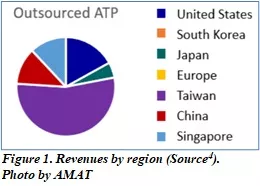
CURRENT CHALLENGES IN THE ASSEMBLY & TEST ENVIRONMENT
Semiconductor assembly and test factories have increased in complexity over the years. Some of the areas that have contributed in complexity include:
- Supply Chain Complexity: Gone are the days when this segment was dominated by IDMs. The bulk of this segment is now handled by OSATs. Different combinations of IDM and OSAT supply chains for the same products add significantly to the complexity that impacts many aspects of quality and delivery performance.
- Technology and Product Complexity: Multiple products belonging to different technologies such as lead frame, flip-chip, and advanced packaging technologies now run concurrently in assembly and test factories, leading to a product mix explosion.
- Equipment and Process Complexity: Fixed process flows are no longer given. Variable process flows for the same product exist in many factories, driven by requirements from different customers. Requirements common in fabs, such as process time windows, are now in assembly processes.
- Human Resource Complexity: The above-mentioned complexities have an impact on the human resources that operate and manage assembly and test factories. Even highly experienced operators would consider it challenging to comprehend supply chain, technology, product, equipment, and process factors into routine tasks, such as lot selection, priority lot processing, lot holds, etc.
In addition to these complexities, the assembly and test environment is undergoing a significant transformation driven by the following:
- The increased presence of automotive products, resulting in increased emphasis on quality, yield, and reliability.
- The dynamic nature of both the industrial and consumer markets necessitate effective planning, scheduling, and execution capabilities that can ensure high customer satisfaction.
- The significant role of products targeted towards the consumer segment and their associated short life cycles have added to an already complex manufacturing environment.
- The transition from legacy packaging to advanced packaging has driven manufacturers to embrace entirely new types of factories, products, equipment, process, and expertise. This transition must be done while also ensuring legacy products with legacy technologies are manufactured sometimes within the same factory.
- The significant jump in data and information requirements for all the above-mentioned complexities and environment factors. And factories must contend with retrofitting capabilities to address market and customer requirements.
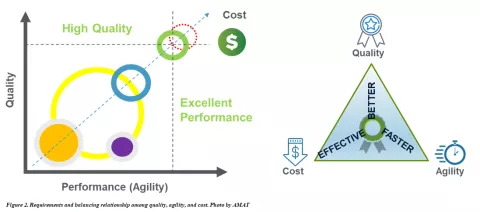
As illustrated in Figure 2, all the above requirements drive the need for agility without compromising quality or cost. In fact, it is prudent to say that faster agility is required in the face of demands for increasing quality and decreasing costs. In the manufacturing space, this has been the focus for factory automation. While manufacturers are doing their best to extract maximum value out of these efforts, opportunities lie in areas not yet fully explored.
THE STRATEGIC ROADMAP FOR FACTORY AUTOMATION
Not long ago workers in frontend fabs moved carts, pushed buttons to start up equipment, and tracked WIP on spreadsheets. Gradually, fabs moved to a new level of automation, with the ability to aggregate data from the equipment, automate material handling systems, and implement advanced process control (APC) capabilities such as run-to-run (R2R) control and fault detection. Next, the industry advanced to a level where heuristic intelligent systems began to take control of factories, with positive, measurable benefits. Unfortunately, despite the complexities detailed previously, the semiconductor assembly and test industry has remained in the manual phase of the fab for years.
Even in frontend fabs that have sought after a higher level of automation control, limitations began to appear. Many companies continued to use existing technologies, all of which lacked enough compute power, bandwidth, data aggregation, and filtering to move to these higher levels of automation. Today, many in the industry seek a path that supports transition from the current mix of manual and automation-initiated control to full automation. The assembly and test segment will also experience such difficulties when transitioning from manual control to full automation.
At a strategic level and to provide direction, Figure 3 shows a proposed roadmap that illustrates the potential improvement of automation capability from nodes of ascending capability.
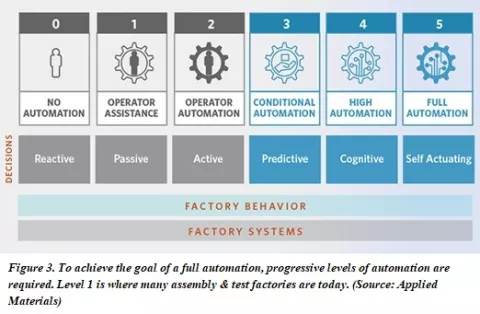
During Level 1 automation, factories adopt automated material handling systems (AMHS), begin tracking yields and defects, and implement some preventive maintenance. At Level 2, factories use real-time dispatching and R2R process control.
With Level 3 automation, manufacturers attempt to achieve the first phases of full automation, including figuring out how to bring in real-time scheduling and predictive techniques. With faster processing speeds now available, companies can apply machine learning. Level 3 is also a proving ground for applications that run on these new technologies. At this level of automation, companies also begin to develop their digital twins and decide what components can or cannot move to the cloud. As these companies look down the road to their end goal, realizing that the processes and systems of yesterday aren’t necessarily going to work tomorrow, they will face a steeper learning curve than ever before in building user trust in the technology.
The move to Level 4 is significant because this is where the solutions must implement requirements never adopted before in the factory and, by adopting these requirements, make good decisions. The systems at this level of automation take in data, and then in real time, make decisions that improve productivity.
Level 5, full automation, depends on the ability to determine whether the weakest part of the system works. If the weakest link doesn’t work, then the whole system will fail.
IMPLEMENTATION OF FACTORY AUTOMATION
At an operational level, factory automation capabilities are implemented in an evolutionary manner. Due to the rapid adoption of advanced technologies in the packaging segment of semiconductor processing, a significant need exists for tighter management and control of manufacturing operations. This starts with implementing manufacturing execution systems (MES), statistical process control (SPC), equipment automation (EA), and advanced dispatching and scheduling. This is then followed by implementing advanced equipment and process control methodologies such as fault detection and classification (FDC) and APC. Effectively using these methods is hindered by continually relying on manual methods and procedures. In such complex environments, these manual approaches generally produce many procedural errors when executing the manufacturing process, leading to product scrap and quality issues.
All the quality and productivity concepts mentioned previously must be known by the advanced dispatching and scheduling solution. And finally, actual execution and transportation is achieved using automated workflow management and automated material handling. These concepts are functionally categorized as automated decision making, automated execution, and automated material handling. These automated functions use advanced capabilities and serve as the backbone and infrastructure that enables full-auto or lights-out manufacturing.
Figures 4a and 4b illustrate the operational roadmap for implementing full automation.
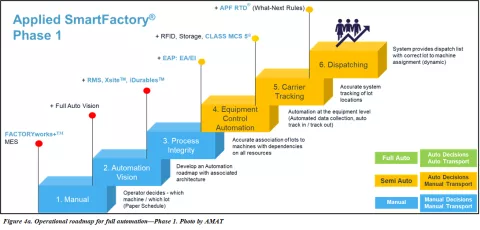
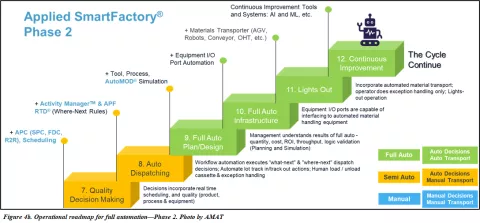
This operational roadmap considers the natural progression of automation capability, the prerequisites for each capability, and the learning involved to get to the next step. This roadmap has also been proven for effectiveness and “implementability.”1
SUMMARY AND CONCLUSION
Full automation in semiconductor assembly and test is no longer a myth. While the legacy of the assembly and test segment has relied heavily on manual methods, primarily driven by lower costs in eastern parts of the world, the current reality demolishes this premise. The complexities of the modern supply chain, as well as the emerging complexities in technology, products, equipment, and processes, necessitate the urgent need to adopt automation methods. The exponential growth of automotive, smart computing, communication, and Industrial Internet of Things (IIoT) content in the product-mix serves as a catalyst to this adoption. The automotive segment represents a significant leap in quality requirements and factory capabilities. Lastly, current processing and supply chain requirements have made it nearly impossible for a human to comprehend simple processing tasks such as lot selection and lot transport.
REFERENCES
- “Factory Automation Enables Sustainable Manufacturing in Assembly and Test,” Didier Chavet and Shekar Krishnaswamy, SEMICON Southeast Asia, April 2016.
- “Moving to a New Level of Intelligent Manufacturing,” David Hanny, Nanochip Fab Solutions, January 2020.
- “Challenges and Strategies to Achieve Full Automation in Semiconductor Assembly and Test,” Joe Napiah and Richard Stafford, SEMICON Southeast Asia, August 2020.
- “Semiconductors: U.S. Industry, Global Competition, and Federal Policy,” Congressional Research Service Report, October 26, 2020.