

By Laurens Kwakman, Thermo Fisher Scientific, and Laura Nguyen, SEMI
After a successful first phase activity and the recent release of SEMI E177, Specification for Transmission Electron Microscope (TEM) Lamella Carriers Used in Electron Microscopy Workflows, the first new SEMI Standard for a Lamella Carrier (LC) to be used in automated Transmission Electron Microscopy (TEM) workflows, the SEMI Standards Electron Microscopy (EM) Workflow Taskforce has now engaged in a second phase activity that aims at developing a new Lamella Carrier Container (LCC). This new activity, Doc. 6592, New Standard: Specification for Container for Transport and Storage of Transmission Electron Microscope (TEM) Lamella Carriers within Electron Microscopy Workflows, was approved by the Physical Interfaces & Carriers (PIC) Technical Committee during the SEMI Standards Fall Meetings in November. The Task Force kicked off the next important step in defining the industry needs for a fast, efficient and automated TEM analysis workflows.
The TEM LC is the support vehicle for the extremely thin and fragile TEM samples (~ 20 nanometer thin lamellas) that are processed in the different systems that are part of the TEM workflow, i.e. a FIB/SEM system for sample preparation and extraction from the device wafers, a TEM microscope for sample analysis and an (optional) Plasma cleaner for sample cleaning prior to TEM analysis. As this TEM lamella carrier needs to be transported between the different systems that are part of the TEM workflow, the use of a mechanical support for the lamella carrier is required, the lamella carrier “container”: to ensure that lamella carriers can be transported automatically between different types of TEM workflow tools from different suppliers the lamella carrier container needs to interface with each and any of these tools and, thus, needs to be well defined and standardized.
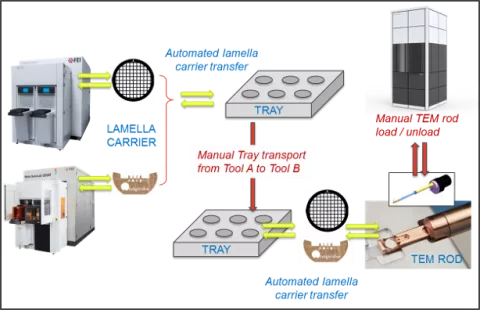
Partially automated TEM workflow. Transfer of Standardized Lamella Carriers between a standardized Lamella Carrier container (here a Tray) and FIB-SEM and TEM microscope systems.
The automated TEM workflow with automated LC transport can be compared with the automated wafer transport in wafer Fabs: the Silicon wafers are the support for the active devices (Dies) and are transported collectively in a standardized FOUP that interfaces with all different processing tools via a FOUP port and an EFEM (Equipment Front-End Module). In this analogy the ultra-thin lamellas correspond to the active devices, the Lamella carrier to the Silicon wafer and the lamella carrier container to the FOUP. Hence, at (FIB/TEM/auxiliary) tool level a LC container load station is needed that interfaces to the tool specific front-end module that transfers LCs from the LC container into the tool specific LC holders (e.g. the TEM-rod at the TEM side).
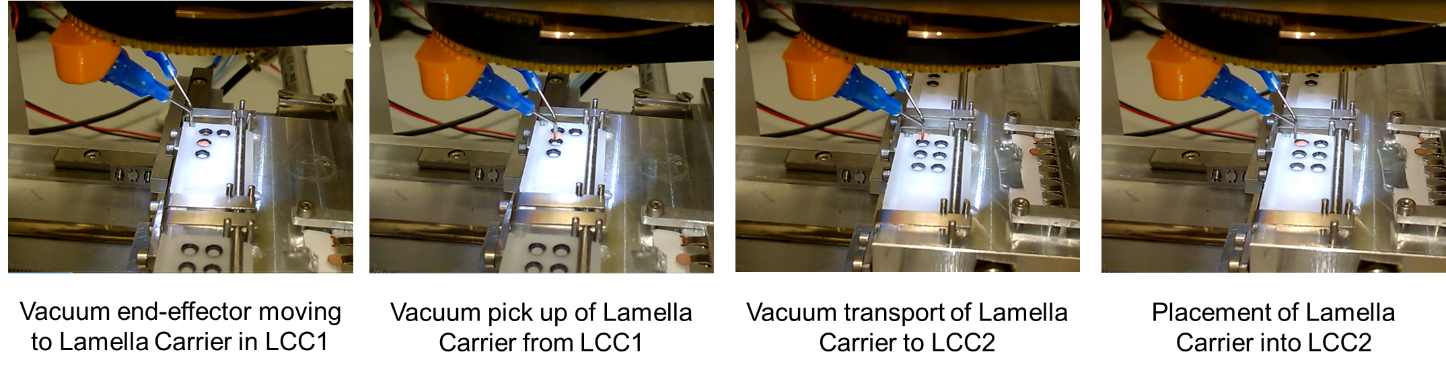
The Standardization effort for the LCC is to guarantee commonality of physical designs, LC handling strategies and SW/HW interfaces between different equipment manufacturers.
As the LC Container definition is limited to physical dimensions, formfactors and specific features such as LC pockets, ID markers etc., this standardization effort may seem relatively simple, however, there are many challenges that require a consensus about how the LCC will be used and what technologies will be applied for LC transport automation. For example, the number of LCs that can be contained in a container has to match the end-user requirements and will depend on productivity and cycle-time objectives, currently not yet defined , the LC pocket design will depend on the type of transport technology used – vacuum based pick and place is shown to work but alternatives such as using Bernouilli principles may be considered as well.
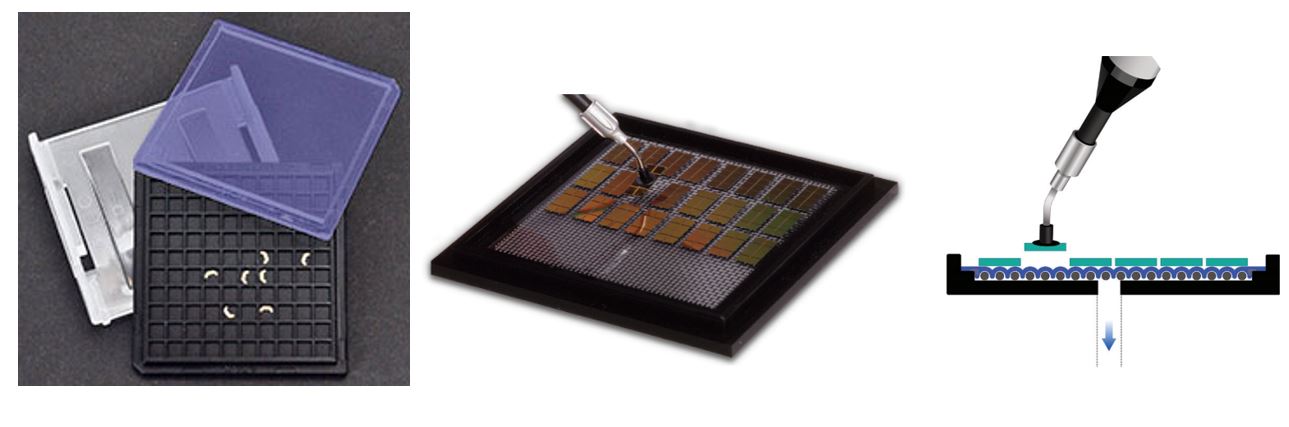
Hence active inputs and contributions are required from all stakeholders including the chip manufacturers, the microscopy suppliers and the lamella carrier suppliers and new companies are solicited for their specific technologies and expertise in adjacent fields (example: pick & place of diced Dies). In the coming months an inventory will be made of all relevant LCCs characteristics, of preferred technical solutions and based on a Task Force wide consensus, a first draft Specification is targeted to be available by Summer 2020. The project timeline for completion is to have a first Letter Ballot by November 2020 and the Technical Committee Chapter approval by March 2021.
The next task force meeting will be held via teleconference on December 12, 2019 at 15:00 Pacific Time. Please contact Laura Nguyen at [email protected] to be added to the meeting invite.
The next face-to-face task force meeting is scheduled for March 31, 2020 in conjunction with the SEMI Standards North America Spring Meetings at SEMI Headquarters in Milpitas, California. To attend these meetings, you must be a SEMI Standards Program member. There is no cost, but registration is required. Registration opens early 2020.
Get Involved
SEMI Standards development activities take place throughout the year in all major manufacturing regions. To get involved, join the SEMI International Standards Program at: www.semi.org/standardsmembership.
For more information please visit our main Web site and current events page. If you have any questions regarding SEMI Standards activities, please contact your local SEMI Standards staff.
Standards Watch
SEMI
www.semi.org
December 5, 2019