

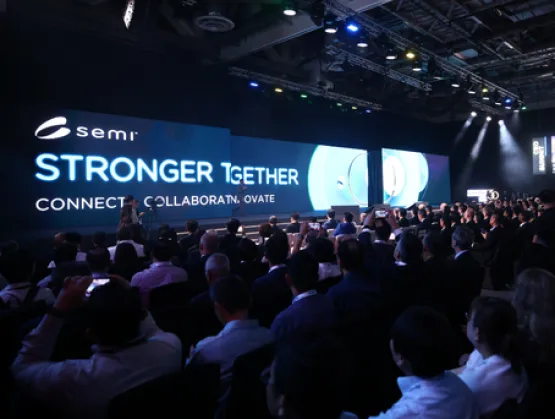
Malaysia’s Semiconductor Industry Outlook Ahead of SEMICON Southeast Asia 2026
Malaysia’s semiconductor story is entering a more ambitious phase—one that goes beyond output and asks a sharper question: how does the country capture more value in an industry increasingly shaped by AI, electrification, and supply chain realignment?
In 2026, the message coming through is consistent: build on Malaysia’s manufacturing strength, while accelerating higher-value capabilities—especially IP creation and local IC design—and deepening advanced packaging momentum.¹
That context matters because SEMICON Southeast Asia 2026 is just around the corner. Taking place 5–7 May 2026 at MITEC, Kuala Lumpur, the show brings the semiconductor ecosystem together under the theme “Transform Tomorrow”. (⁵,⁶)
From manufacturing strength to IP-led competitiveness
Malaysia has long been recognised for its manufacturing depth—especially in the Assembly, Test and Packaging (ATP) space. But the 2026 narrative is increasingly about something harder—and more valuable—than volume: technology ownership and IP-based advantage.
In an interview, Malaysia’s Minister of Economy described the push to move beyond assembly, packaging and testing as an “ultimate test,” underscoring that “the value starts with intellectual property,” while pointing to RMK-13 frameworks intended to help firms access global IP platforms so chips can be designed and developed locally.¹
This direction is also showing up more explicitly in the country’s local capability-building agenda. One update noted that Malaysia has identified and is supporting the establishment of more than six local integrated circuit design firms, positioning this as a step toward “Made by Malaysia” technology IP.² More recently, reporting highlighted efforts tied to the MyChipStart and SemiconStart programmes aimed at nurturing local IC design capabilities as Malaysia pushes higher up the value chain.³
Seen together, the ambition is straightforward: strengthen what already works—industrial execution—while building the design and IP layers that determine margin capture and long-term competitiveness. (¹,²,³)
Advanced packaging momentum is reinforcing Malaysia’s next chapter
Policy ambition needs real capability to match. One of the clearest examples in early 2026 is continued expansion in advanced packaging and OSAT—particularly within Malaysia’s manufacturing clusters.
Chipbond Technology Corporation officially opened a new advanced manufacturing facility in Batu Kawan, Penang, with an investment of close to US$200 million. The announcement positions the plant as a reinforcement of Malaysia’s role in the global OSAT value chain and as a hub for advanced semiconductor manufacturing.⁴
This matters because advanced packaging is no longer peripheral. It is increasingly central to how performance scales—especially in AI-era compute, heterogeneous integration and high-density systems—making OSAT capability depth a strategic advantage, not just an operational one.
Why SEMICON SEA 2026 arrives at exactly the right time
This is the backdrop against which SEMICON Southeast Asia 2026 lands in Malaysia. The show runs 5–7 May 2026 at MITEC, Kuala Lumpur, and the official programme lays out three days anchored by leadership summits, market outlook discussions, deep technical forums, workforce development programs, energy dialogues and structured business and policy engagements.⁵
If Malaysia’s objective is to upgrade while staying globally connected, SEMICON SEA functions as a practical connector—helping leaders and organizations align on roadmaps, accelerate partnerships, and translate capability-building into real commercial outcomes.
What to watch at SEMICON Southeast Asia 2026
On Day 1 (5 May), SEMICON Southeast Asia 2026 opens with the Opening Ceremony (10:00–11:30) at MAINStage, Level 3 (Ballroom 2), MITEC, featuring welcome remarks by Ms. Linda Tan (President, SEMI Southeast Asia) and opening remarks by Mr. Ajit Manocha (President & CEO, SEMI).⁸ The same afternoon, the Executive Leadership Summit (14:00–17:30) brings together senior executive leaders— from AEM Holdings, onsemi, Sandisk, Soitec, GlobalFoundries, and Lam Research—to unpack the strategic priorities shaping the next wave of industry partnerships and growth. (⁹,¹⁰)
On Day 2 (6 May), the spotlight shifts to market direction and execution. The Market & Industry Outlook Forum (09:30–13:30) at MAINStage features perspectives from BCG, Kearney, McKinsey, SEMI, and The Malaysian Investment Development Authority (MIDA), providing a strategic read on the cycle ahead and what it means for investment and competitiveness. (¹⁰,¹¹) Day 2 also deep-dives into AI adoption through the AI for Manufacturing Forum and AI for Product Testing Forum, reflecting how factories and test strategies are being reshaped by AI-era requirements. (¹²,¹³)
By Day 3 (7 May), attention turns to the operational imperatives of scale. The Sustainability Summit (09:30–17:00) focuses on energy, emissions, efficiency, and regulatory readiness as manufacturing footprints expand across Southeast Asia.¹⁴ In parallel, the Cybersecurity Forum (09:30–12:15) highlights the rising need for cybersecurity resilience across fabs, equipment, and supply chains, including industry standards and assessment frameworks such as SSCA.¹⁵
Across all three days, the handshake@SEMICON is a focused 1.5-hour networking platform bringing together industry and government agencies, with sessions hosted by MIDA, Business Sweden, and European Union to drive strategic engagement.16
Intelligent Manufacturing Showcase
A highlight of SEMICON SEA 2026, the Intelligent Manufacturing Showcase—jointly powered by Sandisk and SEMI—offers an immersive guided walkthrough of the evolution of intelligent manufacturing. The experience takes visitors from real-time, mixed‑reality visibility across the production floor, to AI‑enabled assistance with Sandisk ExP and additive manufacturing, and ultimately to a Factory of the Future featuring AI iAssist and Vision AI—demonstrating how digital technologies and AI can accelerate decision-making, resolve issues faster, and redefine how humans work alongside smart manufacturing systems.17
A timely moment for Malaysia and a clear next step
Malaysia’s semiconductor landscape in 2026 is entering a more outcome-driven phase. The priority is clear: strengthen what Malaysia already does exceptionally well—industrial execution and scale of the ecosystem— while accelerating the capabilities that determine long-term value capture, including IP ownership, local IC design, advanced packaging depth, and stronger supply chain connectivity.
This is where SEMICON Southeast Asia 2026 becomes especially timely. As the region’s flagship platform hosted in Malaysia, it brings the right stakeholders into one place—decision-makers, engineers, technology providers, policy-makers and ecosystem partners— to turn shared priorities into practical collaboration. Across leadership dialogue, market outlooks, AI-enabled manufacturing, sustainability and cybersecurity readiness, supplier sourcing and workforce development, the programme is built to support the conversations and connections that move projects forward.
To plan your visit and explore the full program, refer to the official Programs page.⁷
References
¹ Malaysia’s 10-year chip design goal is facing ‘ultimate test’: economy minister
² Miti: Govt has identified IC design firms to develop ‘Made by Malaysia’ technology IP
³ Govt to boost IC design capabilities via MyChipStart programme
⁴ Chipbond Technology Strengthens Malaysia’s Advanced Semiconductor Ecosystem with New Penang Facility
⁵ SEMICON Southeast Asia 2026
⁶ SEMICON Southeast Asia 2026 on SEMI.org
⁷ Program-at-a-Glance
⁸ Opening Ceremony
⁹ Executive Leadership Summit
¹⁰ SEMICON Southeast Asia 2026 Speakers
¹¹ Market & Industry Outlook Forum
¹² AI for Manufacturing Forum
¹³ AI for Product Testing Forum
¹⁴ Sustainability Summit: Energy & Emissions | Efficiency | Regulatory
¹⁵ Cybersecurity Forum
¹⁶ handshake@SEMICON
¹⁷ Sandisk Intelligent Manufacturing Showcase


